
I've been on Florida pool routes since the late 1990s — my father has been a licensed Florida pool contractor since 1989, and he's the one who taught me — and every fall some version of the same text comes in from up north: “We land Saturday. Can you have the pool warm?” The honest answer depends on three things: the month you land, the kind of heater on your pad, and whether that heater has fired since spring.
This is the return checklist I'd hand every snowbird. Closing the house up in May is the opposite job, with its own checklist in our snowbird guide to the May–October absence.
Step one: do you even need heat when you land?
Plenty of October snowbirds pay to heat a pool that's already warm. Typical unheated water temperatures, from our ideal pool temperature guide:
| You land in | Typical unheated water | Heater plan |
|---|---|---|
| October | 86–90°F | Don't run it. Have it test-fired so you know it works before the first cold front. |
| November | 80–86°F | Usually optional. A small rise for kids, seniors, or a cool week. |
| December | Low-to-mid 70s | Yes, if anyone will swim. Reaching 84–86°F is a 10-plus-degree rise. |
| January–February | 70s, lower after a hard cold front | Yes — and a heat pump works hardest on the coldest mornings. |
The number that matters is the rise: the gap between where the water sits and where you want it.
Why a heat pump needs days and gas needs hours
Heating water is plain physics. One BTU raises one pound of water one degree Fahrenheit, and a gallon of water weighs about 8.3 pounds. So every degree on a 15,000-gallon pool takes roughly 125,000 BTU, and a 10-degree December rise takes about 1.25 million BTU — before the pool loses a single BTU back to the night air.
- A heat pump moves heat; it doesn't make it. It pulls warmth out of the outside air, like an air conditioner in reverse, so it's cheap per degree — but its output follows the weather. The U.S. Department of Energy says heat pump pool heaters work efficiently as long as the air stays above roughly 45–50°F, and some units, Hayward's among them per its own FAQ, cut off below about 50°F and display an LP code. Frost and a defrost cycle on a chilly morning are normal.
- A gas heater makes its own heat. It burns natural gas or propane, so air temperature barely matters: faster, any weather, and every hour costs more.
Here's that 1.25 million BTU on paper, with zero heat loss, using the same output figures our pool heater size calculator works from:
| Heater | Heat output | 10°F rise, 15,000 gal, on paper | Real world |
|---|---|---|---|
| Heat pump (typical residential) | 110,000–140,000 BTU/hr | About 9–11 hours at full output | Slower: output drops as the air cools and the pool sheds heat overnight. Plan in days. |
| Gas, 266k nameplate | ~218,000 BTU/hr (at ~82% efficiency) | About 6 hours | Slower in wind with no cover. Plan in hours. |
| Gas, 400k nameplate | ~328,000 BTU/hr | About 4 hours | The fastest option on most pads. Plan in hours. |
Real life is slower than paper: the pool loses heat the whole time it's gaining it, and evaporation off the surface is by far the biggest loss, per the Department of Energy. How much slower depends on your pool's size, the rise, the wind, and whether there's a cover — so there's no one magic number of days. With a heat pump, start days ahead, not the night before, and earlier for a bigger rise or a cold week. With gas, you're planning in hours, though how many still depends on size and rise. The full comparison is in our pool heaters guide.
The return countdown
Work backward from your landing date:
| When | What happens | Who |
|---|---|---|
| When you book the flight | Tell your pool service the landing date, target temperature, and whether the spa needs heat | You |
| About two weeks out | Pre-return visit: filter cleaned, heater test-fired, fault history read; any failed part quoted in writing and ordered | Your pool service (you approve quotes) |
| Days before you land (heat pump) | Heater on at target, pump scheduled through the warmest hours, cover on at night | Your pool service or your app |
| Hours before you land (gas) | Heater on at target | Your pool service or your app |
| The day you land | Nothing. The last visit's 6 p.m. service report, with photos, shows you the pool first | You |
| First week back | Chemistry rechecked for warm water and swimmers | Your pool service |
The two-week visit is the one people skip, and the one that matters — if you have a heater, make sure your pre-return walkthrough includes a test-fire. A dead igniter found two weeks out is a scheduling problem. Found the night you land, it's a cold pool for as long as the part takes.
What gets checked first after months off
When a heater has sat since spring, we work the pad in this order. Flow before fire, every time.
| Order | Check | Why it matters after a summer off |
|---|---|---|
| 1 | Filter and flow | Summer storms load filters with debris, and almost every heater needs proper flow to fire |
| 2 | Pump speed and valves | A variable-speed pump turned down to a quiet summer speed may not make heater flow; valves get turned during storm prep |
| 3 | Fault history | Most modern heaters log recent faults — read them before anyone hits reset |
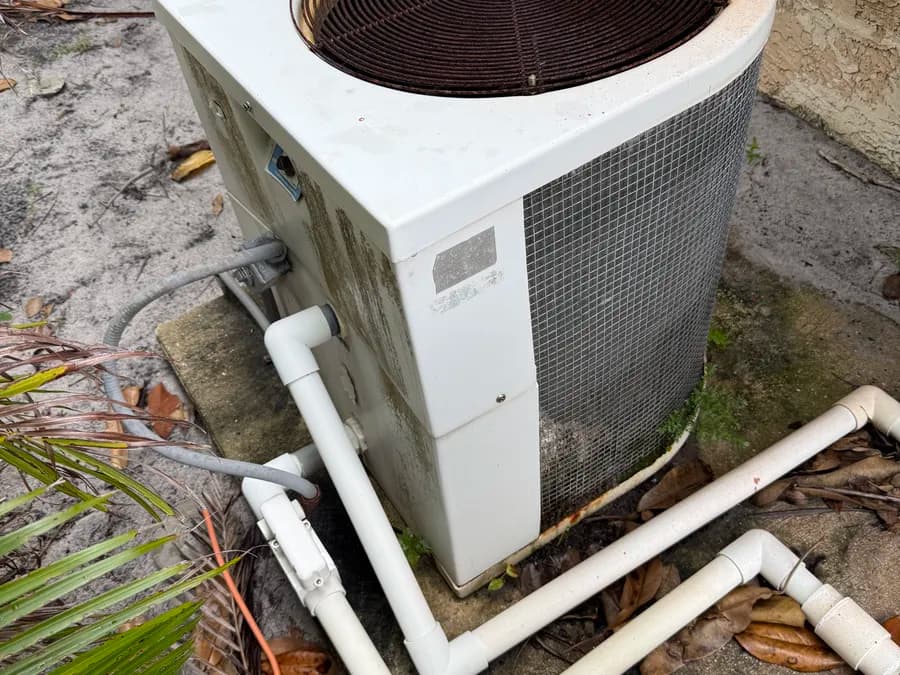
| 4 | Inside the cabinet and coil | Ants, wasps, lizards, and frogs move into idle heaters; leaves pack heat pump coils |
| 5 | Power and fuel | Breakers, GFCIs, the gas valve, the propane level — owners often shut these off on the way out in May and forget |
| 6 | Water balance | Warmer water is more scale-forming, so calcium, pH, and alkalinity need to be right before long heat cycles |
| 7 | Salt cell | Summer rain dilutes salt, and the cell needs the same flow the heater does |
Scale is why balance matters more once the heater runs — see our calcium hardness reference. And if a named storm hit the pad (hurricane season runs through November), follow the post-storm heater inspection checklist before anything fires.
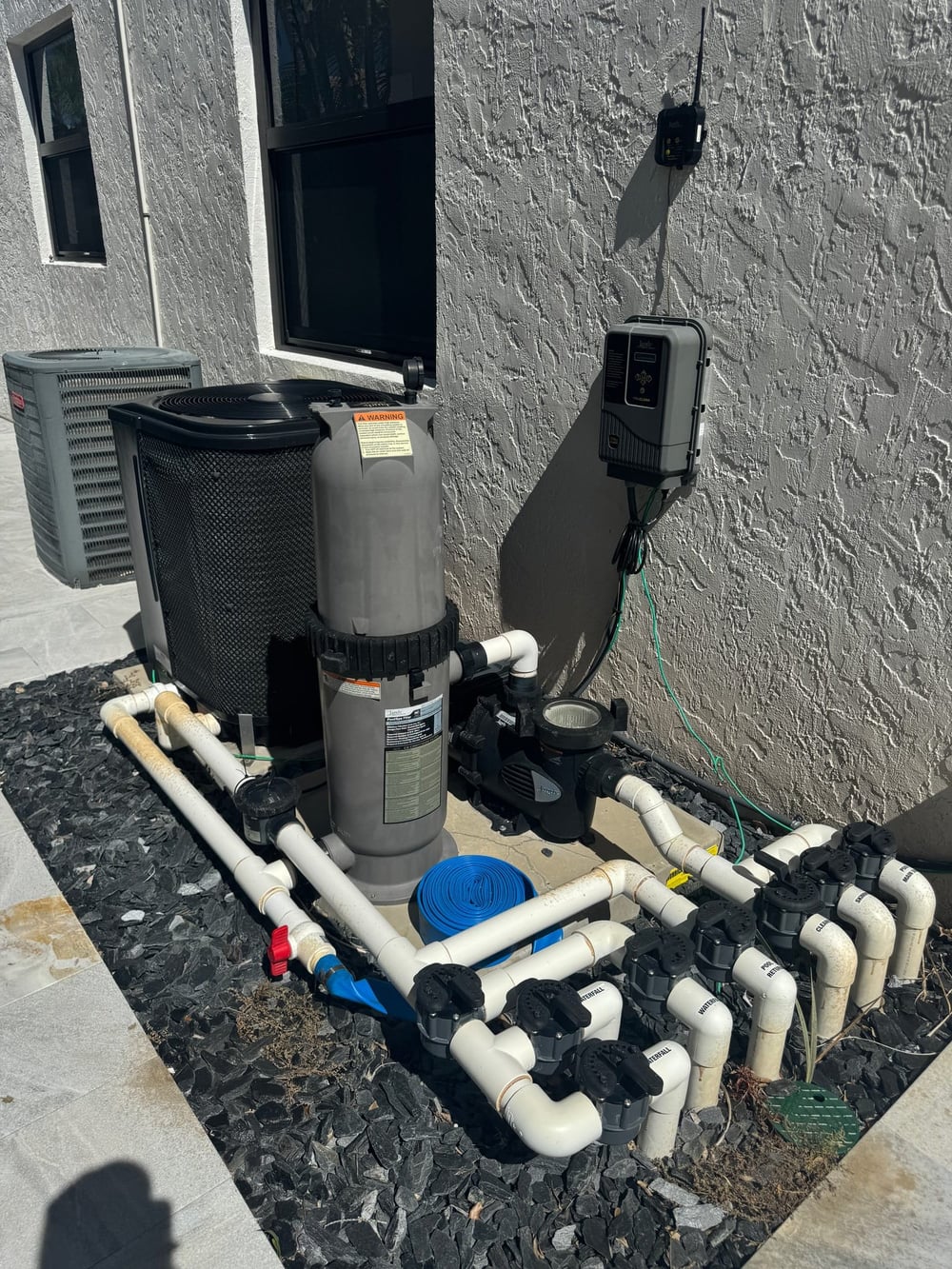
What fails at first startup after a summer off
What we see when a heater fires for the first time since spring:
| Symptom | Usual cause after months off | First move |
|---|---|---|
| Won't fire; flow or pressure fault | Loaded filter, low summer pump speed, or a valve left turned | Clean the filter, raise pump speed, check valves — before buying any part |
| Gas heater clicks, never lights | Gas off or propane low; insects in the burner tray; worn igniter or flame sensor | Confirm the fuel supply first, then clear the burner tray |
| Heat pump fan runs, water stays cool | Cold morning (normal below about 50°F on many units), debris-packed coil, or a refrigerant problem | Wait for warmer air and clean the coil; refrigerant work needs an EPA 608-certified tech |
| Nothing powers on | Breaker or GFCI off, ants in the contactor or board, chewed wiring | Reset a breaker once — if it trips again, stop and call |
| Runs, but the pool never gets warm | Setpoint too low, or the pump only runs a few hours overnight — a heater only heats while the pump runs | Match the setpoint and automation schedule to daytime hours |
The full symptom-by-symptom diagnostic is in our pool heater troubleshooting guide, and if the fix is a part, our heater repair-vs-replace cost guide covers when a repair is worth it.
What to tell your pool service before you fly in
- Your landing date and time. We work backward from it.
- Your target temperature and who's swimming. Grandkids at 86°F is a different job than laps at 80°F.
- Pool, spa, or both.
- What you shut off when you left. Breaker, gas valve, propane, automation, water.
- Automation access. An app login or guest access.
- Your repair approval threshold. So a small part doesn't wait on a callback.
- What changed over the summer. A storm, a contractor on the pad, a new house-watcher.
Heating from up north: remote access done right
If your pad has automation with a phone app — Pentair, Hayward, and Jandy all make one — you can watch water temperature and turn the heater on from the airport. Our pool automation guide covers the systems. Three rules from the route:
- Don't make the season's first fire a remote one. A heater that has sat for months should light with someone at the pad who can see flow, smell gas, and open the cabinet. After that, remote is fine.
- Check both thermostats. On many setups the automation drives the heater while the heater's own panel acts as a limit. If the panel is set lower than the app, the lower number wins and the pool stalls.
- Test the app before you count on it. Power blips and router swaps knock controllers off Wi-Fi. Open the app a week out, not at the gate.
What it costs to heat for your return
No blog post can quote your monthly heating bill; it swings with your pool's size, the rise, your utility rate, and the weather. Two levers matter most. Heater type: a heat pump moves heat rather than making it, so it costs far less per degree, while gas costs the most per hour and earns its keep on fast heat-ups and spas. A cover at night: the Department of Energy says pool covers can save 50–70% of pool heating costs, because evaporation is the biggest heat loss. Past that, every degree you ask for is heat you pay to make and keep, so set the target for who's actually swimming.
| Pre-season heater work | 2026 cost | Notes |
|---|---|---|
| Heater diagnostic | $0–$125 | Free for weekly-route clients |
| Annual heater cleaning / tune-up | $150–$350 | Clears the cabinet and protects the exchanger |
| Most heater repairs | $250–$1,800 | Diagnosed and quoted in writing first |
| Heat exchanger or compressor | $4,000–$5,000 | Usually the point where replacement makes more sense |
| New heater installed | $5,000–$7,000 | Sized on site |
A tune-up is cheap next to a compressor, and October is the time for it — before the first cold front sends a lot of heaters into service at once (here's what those first-cold-front calls usually turn out to be). Heater repairs are managed by us under our Florida Certified Pool/Spa Contractor license (CPC1461731), with specialists brought in when a job calls for one.
Run your pool's numbers
Is your heater even big enough for a December rise? Plug your surface area and temperatures into our pool heater size calculator. Undersized means a conversation about heater installation and replacement; right-sized but won't start means our pool heater repair service. Pricing weekly service too? Try our pool service cost calculator.
The low-risk first step
Whether you land in October or December, the lowest-risk first step is a free on-site evaluation. We'll check flow and the filter, test-fire the heater, read its fault history, test your water on site, and tell you honestly whether it's ready — whether you hire us or not.
Florida's Best Pool Service is family-owned, CPO C-105377, fully insured, and runs weekly routes through Boca Raton, Delray Beach, Fort Lauderdale, Highland Beach, Boynton Beach, Pompano Beach, Coral Springs, Coconut Creek, Wellington, and the surrounding South Florida service corridor. Weekly service starts from $125/month, and most pools land at $125–$240. Your regular tech, same day every week — if they're out that day, weather moves the route, or your pool needs a specialty service, we send another member of our team or a specialist instead. Photo-documented service report sent at 6 p.m. the day of every visit. Month-to-month — no long-term lock-in. Built around 40+ years of combined founder experience between Matt Balog, Joe Ford, Ronald Liddell, and Doug Santiago.
Need the heater looked at before you fly in? Book heater service for a heater diagnostic (free for weekly-route clients) and a written quote.
Request a free evaluation or call 954-347-1120.
Frequently Asked Questions
It depends on the heater and the temperature rise. A heat pump needs days, not hours: it moves heat out of the outside air, typical residential units put out roughly 110,000–140,000 BTU an hour, and a 15,000-gallon pool needs about 125,000 BTU for every degree before any heat loss. A gas heater needs hours. Exactly how many days or hours depends on pool size, how many degrees you're raising it, the weather, and whether there's a cover. If you land in October or most of November you may not need to run it at all, but have it test-fired so you know it works.
Usually not. An unheated South Florida pool typically runs 86–90°F through October and 80–86°F in November, which is comfortable for most swimmers. December is when the water drops into the low-to-mid 70s and a heater earns its keep. Even in October, have the heater test-fired so you know it works before the first cold front.
A heat pump doesn't make heat; it moves heat out of the outside air into the water, so its output is limited and follows the weather. The U.S. Department of Energy says heat pump pool heaters work efficiently as long as the air stays above roughly 45–50°F, and some units cut off below about 50°F. A gas heater burns natural gas or propane under a heat exchanger, puts out more heat per hour, and doesn't depend on air temperature. The trade-off is cost: a heat pump is far cheaper per degree, and gas is the fast, expensive option.
Yes, if your equipment pad has an automation system with an app; Pentair, Hayward, and Jandy all make one. Three cautions: don't make the season's first fire a remote one, because a heater that has sat for months should light with someone at the pad checking flow, the cabinet, and the gas; make sure the heater's own thermostat isn't set lower than the app, because on many setups the lower number wins; and open the app a week ahead, since power blips and router changes knock controllers offline.
After months off, the usual causes are a filter loaded with summer storm debris or a variable-speed pump turned down below the flow the heater needs; a gas valve, breaker, or GFCI that was shut off or tripped; propane that ran low; insects nesting in the burner tray or ants packed into a contactor; or, on a heat pump, a cold morning below its operating range. Check flow and power first. If it still won't fire, a heater diagnostic runs $0–$125 and is free for weekly-route clients.
Your landing date and time; your target temperature and who's swimming; whether the spa needs heat too; anything you shut off when you left, such as the breaker, gas valve, propane, or automation; app access if you have automation; your repair approval threshold, so a small part doesn't wait on a callback; and anything that may have changed the pad over the summer, like a storm or contractor work.
Yes, more than almost anything else. The U.S. Department of Energy says evaporation is by far the largest source of a pool's energy loss and that pool covers can save 50–70% of pool heating costs. A cover at night lets a heat pump keep the heat it made during the day instead of losing it to the night air.
A heater diagnostic runs $0–$125 and is free for weekly-route clients; an annual heater cleaning or tune-up runs $150–$350. If the check finds a failed part, most heater repairs run $250–$1,800, diagnosed and quoted in writing first. A failed heat exchanger or compressor runs $4,000–$5,000, which is usually the point where a new heater at $5,000–$7,000 installed makes more sense. Repairs are managed by us under our Florida Certified Pool/Spa Contractor license, with specialists brought in when a job calls for one.
Need a pro to handle this?
Florida's Best Pool Service has serviced South Florida homes for 40+ years. CPO-licensed. Fully insured. 230+ five-star reviews.