
South Florida Commercial & HOA Pool Service That Passes Inspection
Most community pools don't fail because the water gets dirty — they fail because nobody touches the equipment that keeps it clean. We built our commercial program around the part everyone else skips: the chemical feeders, the crocs, the filters, the flow.
The problem with how most commercial pools get serviced
Here's what we walk into when we take over a community pool from the previous company. The chemical feeders aren't working. Out of roughly the last six commercial accounts we've taken over, not one had functioning feeders. The crocs — the chlorine and acid containers that are supposed to pump into the pool 24 hours a day — were either completely empty or the feeder lines were cracked and spraying chemical all over the pumps and motors.
This isn't rare. It's the norm. And it's not always because the techs are bad — it's because the job, the way most companies run it, is physically impossible. A commercial tech for a big company runs 10 to 20 community pools a day. To keep those pools properly chlorinated you'd refill the crocs at each one — but a single truck can't legally carry enough chemical to do that. So the tech dumps a jug or two straight into the pool, jacks the chlorine to unsafe levels, and hopes it holds until the next visit.
Then the filters get neglected, flow drops, back-pressure builds, and the expensive equipment starts breaking. Eventually the Department of Health shows up, sees the violations, and closes the pool. Then the company scrambles to fix it — after the residents are locked out and the board is furious.
We wrote the full breakdown in three field pieces: Matt on the math that breaks commercial pool service, and Doug on why community pools fail Department of Health inspections and how to read a commercial pool in five minutes.
A dedicated maintenance and inspection visit
Our commercial program splits the work into two roles instead of one.
The service tech does the visible job — brushes the tiles, vacuums, checks the water level and flow, balances the chemicals, and checks the filters.
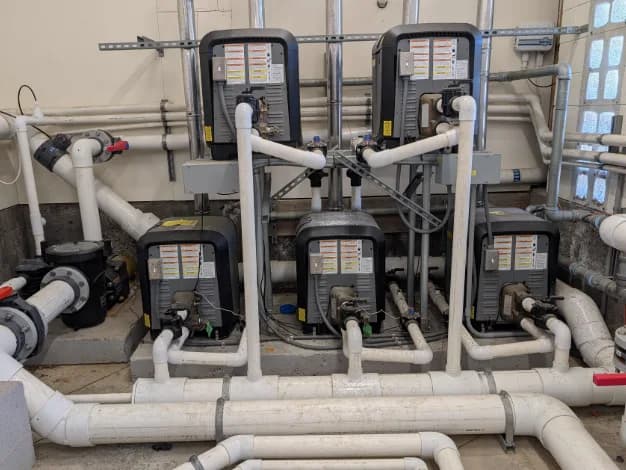
A dedicated maintenance tech runs a separate route across all our commercial accounts whose onlyjob is the part everyone else skips: going through the equipment, cleaning the filters, and loading the crocs with chlorine and acid so the feeders never run empty. He's effectively a roving inspector. He checks everything, fills everything, reports back, and stays focused on the equipment pad.
That solves the impossible-math problem. No single truck has to carry a week's worth of chemical for twenty pools. One person, dedicated to chemical delivery and equipment, keeps every account's feeders loaded and working — which is the one thing that actually makes a South Florida commercial pool run. The second that chemical stops going in, you've got about three days before it turns — faster in summer.
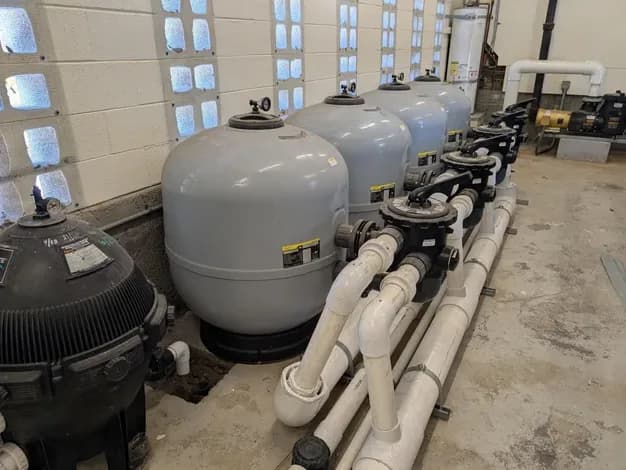
Service keeps the pool open. When the equipment or the surface needs more than service, we handle that under our Florida Certified Pool/Spa Contractor license (CPC1461731): commercial pool repair for pumps, filters, feeders, controllers, heaters, and drain covers, and commercial pool resurfacing for HOA, condo, apartment, and hotel pools.
Commercial pools we keep inspection-ready
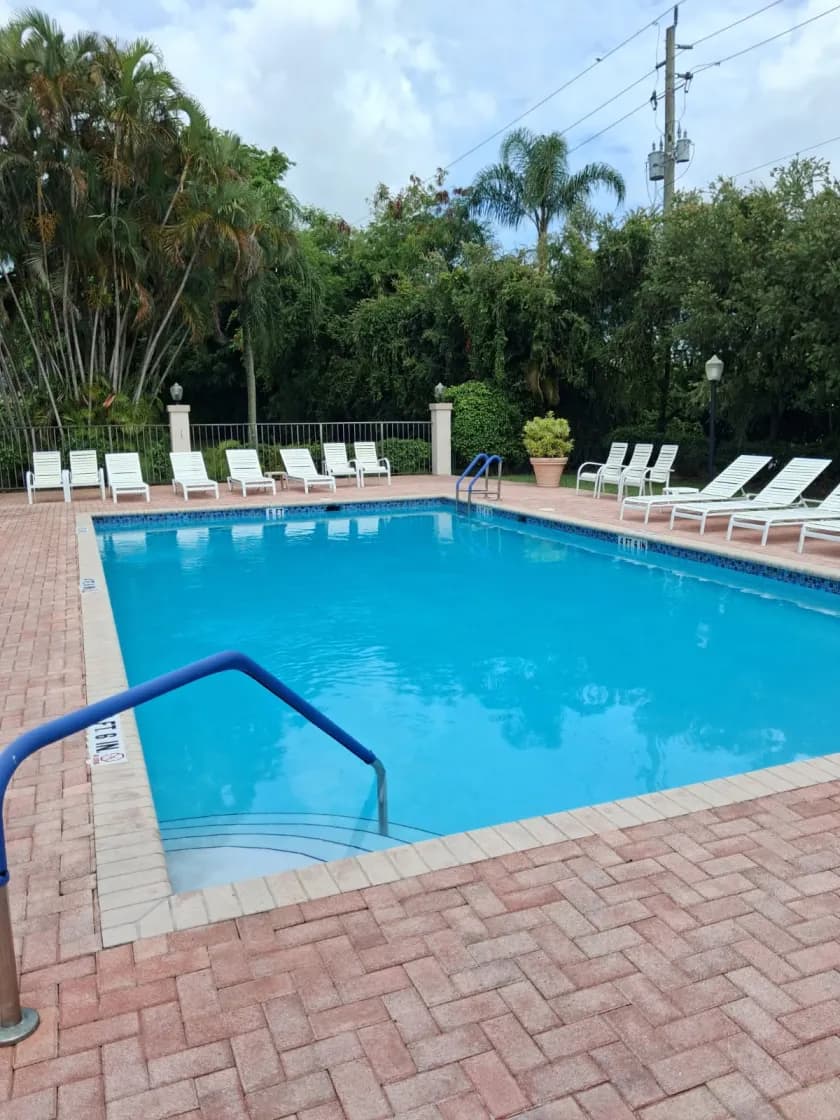
HOA, condo, and hotel pools we service across South Florida — held to Florida Department of Health standards every visit.

Watch: How To Clean a Commercial DE Filter and Surge Tank | Full Walkthrough
Doug, our senior commercial tech, cleans a commercial DE filter and surge tank end to end with nothing skipped, including the parts that go wrong.
Why Homeowners Choose Florida's Best Pool Service
What the Department of Health checks — and what we run every visit
This is the checklist our techs run every visit, because it's the checklist the inspector runs once or twice a year.
Doug's five-minute walk-up inspection turns this into a checklist a property manager can run themselves.
We take over problem pools — and fix them
One community we took over.Black algae across the walls and floors. The previous company never sent anyone to fix it; the Department of Health came, saw the algae, and closed the pool. By the time the old company showed up to treat the stains, we'd already met with the property manager, taken over the account, gotten the equipment working right — and it's been running clean since.
Another account.The previous tech installed a fresh four-cartridge filter set a couple months earlier — then never cleaned them. When we pulled them, they were completely brown and orange, chemically destroyed. At $150–$175 a cartridge, that's a needless four-figure replacement caused by skipping a 15-minute filter clean.
The pattern is always the same: very obvious things, completely wrong, left that way until something forced the issue. From a 30,000-gallon community pool to a 340,000-gallon resort-scale pool with a water slide, we've serviced the full range.
Certified for Florida commercial pools — specifically
Florida classifies HOA and condo community pools as public pools, which means they must be operated under a named Certified Pool Operator. Florida's Best Pool Service holds CPO C-105377.
Beyond that, our lead tech Matt Balog holds the FPPS — Florida Public Pool Specialist (#600551), a Florida-specific credential most vendors don't carry. Unlike the online CPO course — which teaches almost nothing about chemical feeders — the FPPS is heavy hands-on equipment training: feeder and pump manufacturers brought in to certify techs directly, electricians, even an attorney walking through the legal side. Our commercial techs train to that standard.
You can verify both credentials on our credentials page, and the difference between the two operator credentials is broken down in FPPS vs CPO. For the technical reference, see our commercial pool operations library.
Talk to us about your community pool
If your HOA, condo association, or managed property needs a commercial pool service that actually maintains the equipment — and keeps you ahead of the Department of Health instead of behind it — send us the details and we'll set up a site assessment. If your pool has already been closed for violations, that's exactly the situation we take over most.
Frequently asked questions
A named CPO certificate holder responsible for the pool (Florida classifies HOA/condo pools as public pools — Florida's Best Pool Service holds CPO C-105377); the FPPS credential (Florida Public Pool Specialist) most vendors don't carry (Matt Balog, #600551); proof they service the equipment pad, not just the water; a dedicated chemical-delivery and inspection visit on top of cleaning; multiple visits per week with eyes on the equipment; and commercial insurance with a named after-storm protocol in writing.
Bathing load and equipment. A 200-unit condo pool might see 50 people on a weekend versus a family of four at a home pool, and it runs on commercial-grade equipment — collector tanks, gutter systems, multiple feeders, and controllers — that must stay within Department of Health spec at all times. It also runs 24 hours a day; you can't just shut it off.
Most commonly: empty chemical crocs or missing/broken feeders, flow below the required gallons-per-minute (usually from neglected filters), unsafe filter pressure, mis-set water level, unchecked stabilizer, and missing safety equipment (life ring, shepherd's hook, code signage). We check every one of these every visit.
Multiple times per week, per the pool's required service schedule — plus a separate dedicated maintenance and chemical-delivery visit so the feeders never run dry between cleanings. No single truck can legally carry enough chlorine for a full route of community pools, so we split chemical delivery into its own route.
Both. Our commercial techs are trained on commercial equipment — feeders, pumps, filters, controllers, heaters — not just chemistry and cleaning. Catching and fixing equipment problems early is the entire point of the program.
Yes. Several of our current accounts came to us exactly that way. We assess the violations, get the equipment working correctly, reset the chemistry, and get the pool back open and compliant.
Yes. Florida classifies HOA and condo community pools as public pools, which must operate under a named Certified Pool Operator — Florida's Best Pool Service holds CPO C-105377. Our lead tech Matt Balog also carries the FPPS (Florida Public Pool Specialist, #600551), a Florida-specific public-pool credential most vendors don't have.