Between Matt Balog (our founder), Ronald Liddell, Doug Santiago, and me, we've put 40+ years of combined founder experience into Florida's Best Pool Service, and one of the most expensive misunderstandings I see on commercial accounts in South Florida is the assumption that a pool guy with “a license” is automatically cleared to service an HOA, condo, hotel, or country club pool. He isn't. Florida has four pool-related credentials that get casually called “a license” — and only two of themlegally allow a person to be the responsible servicer of a public pool. If your property is being serviced by someone who only holds a CPC or a Class C pool servicing contractor license, you're one inspection away from a closure notice on the gate.
The four credentials property managers confuse
This is the table I wish every condo board and hotel GM in Boca Raton, Delray Beach, and Fort Lauderdale had taped to the inside of the equipment room door. Construction licenses and operator certifications are different animals — issued by different agencies, with different scopes, for different purposes.
| Credential | Issued by | What it actually allows | Satisfies the public-pool operator rule? |
|---|---|---|---|
| CPC — Certified Pool Contractor | Florida DBPR (CILB) | Build new pools, do structural work, statewide | No — construction license, not an operator credential |
| Swimming Pool/Spa Servicing Contractor (Class C) | Florida DBPR (CILB) | Repair, replace equipment, resurface — no new builds | No — repair license, not an operator credential |
| CPO — Certified Pool Operator | PHTA / NSPF (DOH-approved) | Maintain water chemistry and operate the pool day-to-day | Yes — DOH-recognized operator certification |
| FPPS — Florida Public Pool Specialist | FSPA (Florida Swimming Pool Association), DOH-approved | Maintain water chemistry and operate the pool day-to-day | Yes — DOH-recognized operator certification |
If you want to go deeper on each one, our technician library covers them individually: CPC, Swimming Pool/Spa Servicing Contractor, CPO, and the broader licenses-explained overview.
What “public pool” actually means in Florida
This is where most boards get blindsided. Under Chapter 514, F.S. and the implementing rule 64E-9, F.A.C., a “public swimming pool” isn't just the city pool or the public park splash pad. It includes effectively every pool that isn't a single-family residence:
- Condo associations and HOAs
- Apartment buildings with 5 or more units
- Hotels, motels, resorts, B&Bs, and most short-term-rental properties
- Country clubs and member-only swim clubs
- Gyms, health clubs, and spa facilities
- Schools, daycares, and after-school programs
- Mobile-home parks, RV parks, and campgrounds with pools
- Water parks, splash pads, and interactive water features
If your property fits any of the above, the pool is regulated as a public pool by the Florida Department of Health (FDOH) — which means it must operate under the responsible charge of a person who holds CPO or FPPS, full stop. There is no loophole, no “our pool is small” exception, no “our contractor has been doing it for years.”
FPPS — the Florida-specific operator credential
The Florida Public Pool Specialist (FPPS) is the state's home-grown commercial operator certification. It's administered by the Florida Swimming Pool Association (FSPA) and approved by the FDOH under Chapter 514. The course is built explicitly around Florida rule (64E-9) — bather load math, chemistry ranges, log-keeping requirements, fecal/AFR response, deck-and-equipment safety, ADA compliance — and it's the credential most South Florida commercial operators end up holding because the content maps directly onto what an FDOH inspector actually checks.
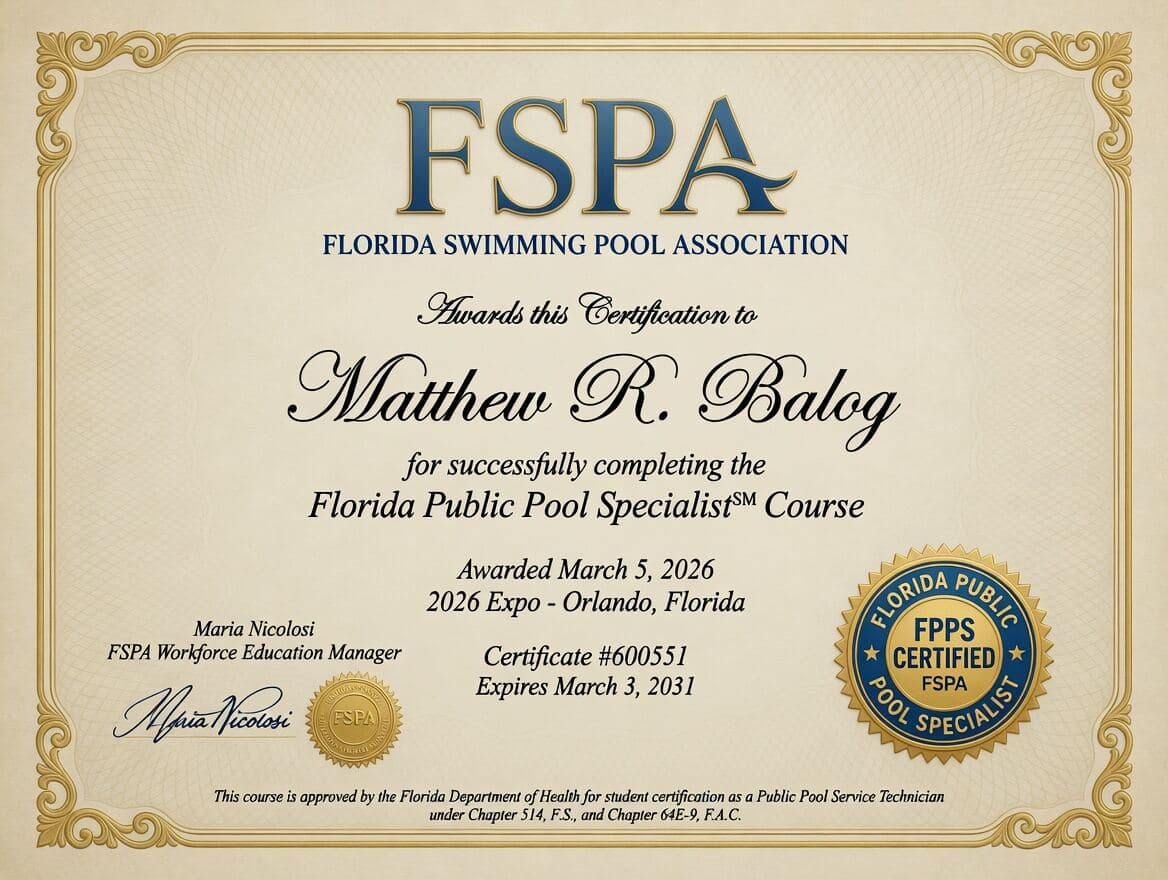
FPPS is a 5-year certification with continuing-education renewal. It's the credential Matt Balog holds on behalf of Florida's Best Pool Service (#600551, valid through March 3, 2031) — the documentation is published on our FPPS credential page.
CPO — the national equivalent recognized in Florida
The Certified Pool Operator (CPO) program is administered nationally by the Pool & Hot Tub Alliance (PHTA) — the same organization that absorbed the older NSPF program. Florida DOH recognizes CPO as equivalent to FPPS for the operator requirement under 64E-9. Many commercial pool servicers carry CPO because the credential travels across state lines; FPPS doesn't.
Florida's Best Pool Service carries CPO C-105377 at the company level. Functionally, the choice between CPO and FPPS for a Florida operator is a matter of preference — FPPS is more Florida-rule-specific; CPO is more portable. Holding both (which we do, deliberately) is belt-and-suspenders: it means inspectors see both credentials on file and your property carries zero ambiguity on operator coverage.
FPPS vs CPO — head-to-head
Practical differences between the two DOH-approved operator credentials. Both satisfy 64E-9, F.A.C.; the choice is logistical, not regulatory.
| FPPS | CPO | |
|---|---|---|
| Full name | Florida Public Pool Specialist | Certified Pool Operator |
| Issuing body | Florida Swimming Pool Association (FSPA) | Pool & Hot Tub Alliance (PHTA, formerly NSPF) |
| Geographic scope | Florida-only | National (transfers across all 50 states) |
| Course length | ~16 hours (typically 2 days) | ~16 hours (typically 2 days) or blended online + 1-day classroom |
| Curriculum focus | Built around Florida rule (Chapter 514, F.S. + 64E-9, F.A.C.) — bather load, log requirements, Florida-specific signage and incident response | General commercial pool operation — chemistry, filtration, safety, recordkeeping (state-rule-agnostic baseline) |
| Exam | Written, ~50 questions, 75% passing | Written, 50 questions, 75% passing |
| Certification term | 5 years | 5 years |
| Typical cost (course + exam) | $300–$425 | $325–$475 |
| Renewal | Continuing education + re-cert through FSPA | Continuing education + re-cert through PHTA |
| FDOH recognition | Yes — recognized under Chapter 514 | Yes — recognized under Chapter 514 |
| Best fit for | Florida-only operators who want the deepest 64E-9 alignment | Multi-state operators or operators who may relocate |
| Florida's Best Pool Service holds | #600551 (Matt Balog, exp. March 3, 2031) | C-105377 (company) |
Why a CPC or Class C alone is not enough
A CPC license lets a contractor build a pool. A Swimming Pool/Spa Servicing Contractor (Class C) license lets a contractor repair, replace, and resurface. Both are issued by DBPR's Construction Industry Licensing Board — they regulate construction trades, not water operation. Neither one says anything about whether the license-holder knows how to keep chlorine in code range on a 50,000-gallon condo pool with 80 bathers a day.
That's the operator's job. And the operator must hold CPO or FPPS. If you've hired a pool company because they showed you a state CPC certificate and that's their only credential — they can install your heater, but they can't be the person of record on your public-pool operations. The inspector will write up the property, not the vendor. More on the licensing layer cake here.
How Florida's Best Pool Service stacks up on commercial accounts
This is what we bring to a public pool. Not marketing — credentials and the documentation trail behind them:
| Coverage area | Credential / system | What it gets you |
|---|---|---|
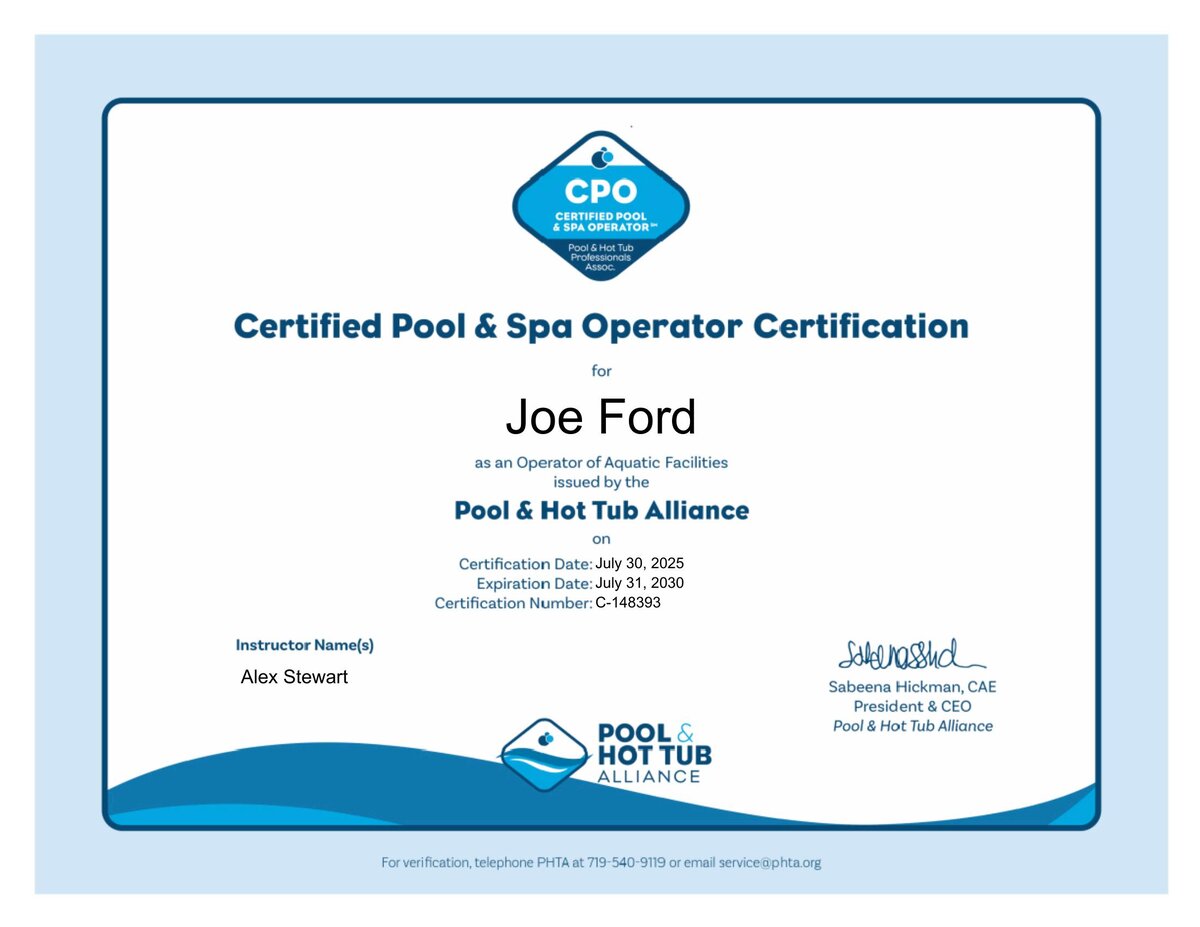
| Public-pool operator of record | FPPS #600551 (Matt Balog), CPO C-105377 (company) | Both DOH-approved credentials on file; redundant coverage if one is mid-renewal |
| Field execution + training | Doug Santiago — 10+ yrs commercial ops & FDOH compliance training | Every tech completes in-house commercial protocol training before independent commercial-route work |
| Insurance | General liability + workers' comp | Certificate of insurance furnished to property management on request, additional-insured endorsement available |
| Chemistry & log compliance | Professional water testing with written logs every visit | Documentation trail FDOH expects on inspection day; no scramble to reconstruct |
| Incident response | Fecal/AFR/blood protocol per 64E-9; documented closure & reopen procedure | You don't guess; we execute and document |
| Service tier | Commercial weekly + on-call | Regular tech once the route is established; backup-tech coverage built in |
Getting shut down by the state — the most common causes
FDOH inspectors close public pools regularly across Palm Beach, Broward, and Miami-Dade counties. From what we've seen on accounts we've taken over after a closure, the reasons cluster into six buckets:
| Closure cause | What inspector found | Typical fix window |
|---|---|---|
| No certified operator on file | Property could not produce a CPO or FPPS certificate for the responsible servicer | 1–7 days (vendor swap + paperwork) |
| Chemistry out of code range | Free chlorine below 1.0 ppm (or above 10), pH outside 7.2–7.8, cyanuric acid above 100 ppm | 24–72 hours after corrective dosing + retest |
| Incomplete or missing logs | No daily chemistry log, no incident log, no equipment-maintenance record on site | Same-day if logs were kept but off-site; days–weeks if never kept |
| Equipment or safety violation | Anti-entrapment cover missing/damaged, broken main drain grate, GFCI inoperative, missing rescue equipment, no working phone, faulty signage | 24–96 hours depending on part availability |
| Fecal/AFR incident mishandled | No closure documented, no super-chlorination performed, no required hold time observed before reopen | Immediate procedure + documented retest |
| Bather-load / clarity failure | Cloudy water, main drain not visible from deck, turnover rate inadequate for bather load | 24–48 hours of filtration recovery + chemistry correction |
How to remedy a closure — the order of operations
If your pool is already closed and the FDOH placard is on the gate, the path back to open isn't complicated, but it has to be done in the right order. Inspectors do not grant verbal reopens. Everything has to be documented.
- Read the closure notice. The inspector lists the specific violation(s) cited. Don't guess — work the actual list.
- Confirm a certified operator is on file. If the original closure cited no operator of record, you must produce a current CPO or FPPS certificate before any other corrective step gets credit.
- Perform corrective action on each cited item. Chemistry dosing, equipment repair or replacement, log reconstruction (going forward — you can't backfill historical logs honestly), signage correction.
- Document every step. Photos, receipts for parts, signed chemistry retest results from calibrated equipment, time-stamped service log.
- Request a re-inspection. Submit the documentation package to the county FDOH office and request the re-inspection in writing.
- Hold the line on the reopen day. Don't let residents or guests back in the pool until the inspector pulls the placard and signs off. A premature reopen is its own violation.
If you don't have an in-house team who has done this before, this is exactly the kind of situation where a vendor with both the operator credential and the compliance experience earns the relationship. We've taken on multiple closed-pool accounts in the last 24 months and turned them around inside the 24–72 hour window for chemistry/equipment issues, and inside a week for credential/log reconstruction issues.
The 30-second decision framework for property managers
- Does your current vendor hold CPO or FPPS? If they can't produce a current certificate naming the responsible servicer, replace the vendor before the inspector replaces you.
- Does your vendor carry general liability + workers' comp with the property as additional insured? Ask for the certificate. If they hesitate, that's an answer.
- Does your vendor leave a chemistry log on site every visit? Strips in a binder don't count. Calibrated reagent results, time-stamped, signed.
- Do you have a documented fecal/AFR closure protocol? If the answer is “we'd figure it out,” that's a future closure waiting to happen.
- How fast can your vendor get a tech on-site for an emergency? “Next week” isn't an acceptable answer when the gate has a placard on it.
The low-risk first step
Whether you're running a 22-unit Boca Raton condo, a 200-room Fort Lauderdale hotel, a Delray Beach country club, or a Coral Springs HOA — the lowest-risk first step is a free credential and compliance review. We'll walk your equipment pad, review your current vendor's credentials and log practices, identify the specific gaps an FDOH inspector would write up, and tell you honestly what your property actually needs. Whether you hire us or not.
Florida's Best Pool Service is family-owned, CPO C-105377, FPPS #600551, fully insured, and runs commercial routes through Boca Raton, Delray Beach, Fort Lauderdale, Highland Beach, Boynton Beach, Pompano Beach, Coral Springs, Coconut Creek, Wellington, and the surrounding South Florida service corridor. Your regular tech, same day every week, once your route is established. Documented chemistry logs and incident reports. Month-to-month — no long-term lock-in. Built around 40+ years of combined founder experience between Matt Balog, Joe Ford, Ronald Liddell, and Doug Santiago.
Request a free credential & compliance review or call 954-347-1120.
Frequently Asked Questions
Florida law (Chapter 514, F.S. + 64E-9, F.A.C.) requires every public pool to be serviced under the responsible charge of a person who holds either a CPO or an FPPS certification — those are the two DOH-approved credentials.; A CPC (Certified Pool Contractor) or Swimming Pool/Spa Servicing Contractor license is a construction/repair credential — it does not satisfy the operator requirement on its own.; "Public pool" in Florida = HOAs, condos, apartments with 5+ units, hotels/motels, country clubs, gyms, schools, water parks, and most short-term rental pools — not just government-owned facilities.; Florida's Best Pool Service holds both: CPO C-105377 (the company) and FPPS #600551 (Matt Balog, valid through March 3, 2031) — plus Doug Santiago's in-house FDOH commercial training program.; Most state shutdowns trace to 4 root causes: missing operator credential on file, chemistry out of code range, incomplete logs, or unaddressed equipment/safety violations — all four are fixable inside 24–72 hours with the right vendor..
FPPS (Florida Public Pool Specialist) is the Florida-specific operator certification administered by the Florida Swimming Pool Association and approved by FDOH under Chapter 514, F.S. and Chapter 64E-9, F.A.C. CPO (Certified Pool Operator) is the national equivalent administered by the Pool & Hot Tub Alliance (formerly NSPF), and Florida DOH recognizes it as equivalent to FPPS for the operator requirement. Both are 5-year credentials with continuing-education renewal. FPPS course content is more Florida-rule-specific; CPO is more portable across state lines. Either one satisfies the public-pool operator requirement. Florida's Best Pool Service holds both — CPO C-105377 at the company level and FPPS #600551 held by Matt Balog.
No. Both CPC (Certified Pool Contractor) and the Swimming Pool/Spa Servicing Contractor license (often called Class C) are issued by Florida DBPR's Construction Industry Licensing Board. They regulate construction trades — building, repairing, replacing equipment, and resurfacing. Neither one is an operator credential under Chapter 514, F.S. or 64E-9, F.A.C. A vendor who only holds CPC or Class C cannot legally be the responsible servicer on a public pool. The property — not the vendor — gets written up if an FDOH inspector finds no CPO or FPPS holder on file.
Under Chapter 514, F.S. and 64E-9, F.A.C., a public swimming pool is effectively any pool that isn't a single-family residence. That includes HOAs and condo associations, apartment buildings with 5 or more units, hotels, motels and resorts, B&Bs and most short-term-rental properties, country clubs and member-only swim clubs, gyms and health clubs and spa facilities, schools and daycares and after-school programs, mobile-home parks and RV parks and campgrounds with pools, and water parks and splash pads. There's no 'our pool is small' exception. If your property fits any of those categories, FDOH regulates it as a public pool and the operator-credential requirement applies.
From accounts we've taken over after a closure, the reasons cluster into six buckets: no certified operator on file (the property couldn't produce a current CPO or FPPS certificate), chemistry out of code range (free chlorine below 1.0 ppm or above 10, pH outside 7.2–7.8, cyanuric acid above 100 ppm), incomplete or missing logs, an equipment or safety violation (missing anti-entrapment cover, broken main drain grate, inoperative GFCI, missing rescue equipment, faulty signage), a fecal or AFR incident that wasn't handled per protocol, and a bather-load or clarity failure (cloudy water, main drain not visible from the deck). Most chemistry and equipment issues are fixable inside 24–72 hours; credential and log issues take 1–7 days.
The order matters. (1) Read the closure notice and work the actual cited violations — don't guess. (2) Confirm a certified operator (CPO or FPPS) is on file — if that was the cited violation, nothing else gets credit until it's corrected. (3) Perform corrective action on each item: chemistry dosing, equipment repair, log reconstruction going forward, signage fixes. (4) Document everything — photos, receipts, time-stamped retest results from calibrated equipment. (5) Submit the documentation to the county FDOH office and request a re-inspection in writing. (6) Don't reopen the pool until the inspector pulls the placard and signs off. A premature reopen is its own violation. If your in-house team hasn't done this before, the fastest path is a vendor who already carries the operator credential and has run the protocol on other accounts.
Three things, non-negotiable. (1) A current CPO or FPPS certificate naming the responsible servicer — not the company logo, the individual holder. (2) A certificate of insurance showing general liability plus workers' compensation, with the property listed as additional insured. (3) A chemistry log left on-site every visit with calibrated reagent results (not test strips), time-stamped and signed. Bonus tier: a documented fecal/AFR closure-and-reopen procedure, and a stated emergency-response window (next-day or sooner for a chemistry emergency on a hotel or condo pool).
Yes — commercial accounts are one of our core service tiers. We hold both DOH-approved operator credentials (CPO C-105377 at the company, FPPS #600551 held by Matt Balog, valid through March 3, 2031). Doug Santiago — one of our four partners — has 10+ years of commercial pool operations and FDOH compliance training experience and runs our in-house technician training program. Every technician working a commercial route independently has completed that training. We service HOAs, condos, hotels, country clubs, apartment buildings, gyms, and other public pools across Boca Raton, Delray Beach, Fort Lauderdale, Highland Beach, Boynton Beach, Pompano Beach, Coral Springs, Coconut Creek, and Wellington. Free credential and compliance review available for prospective accounts.
Need a pro to handle this?
Florida's Best Pool Service has serviced South Florida homes for 40+ years. CPO-licensed. Fully insured. 230+ five-star reviews.