
Water Chemistry Management in South Florida
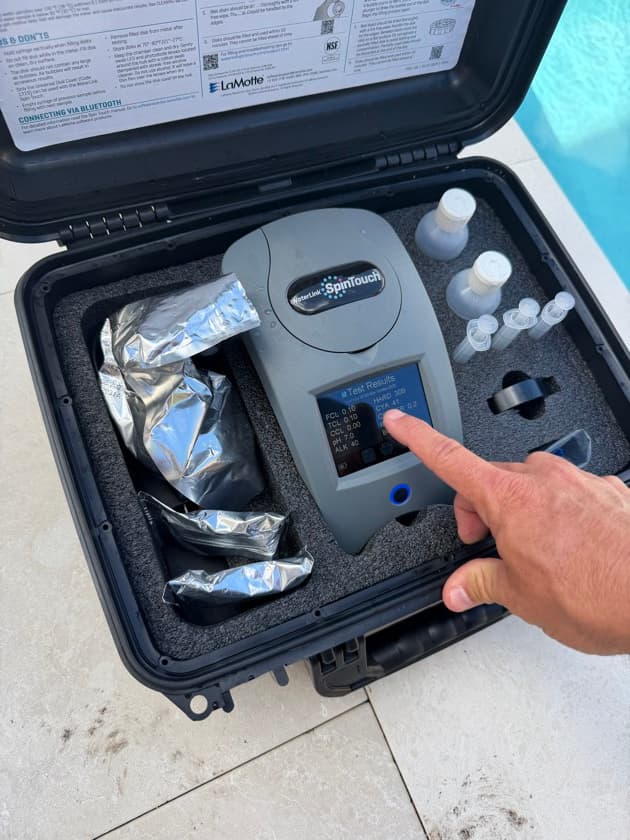
Florida heat, humidity, and hard water knock pool chemistry out of balance fast. We test with strips every visit, bring a LaMotte WaterLink Spin Touch photometer to tougher pools, and dose precisely — no shock-bombs, no upsell chemicals.
Why Florida pool chemistry is its own discipline
Pool chemistry in South Florida is not the same problem you're reading about on a generic pool blog written for Pennsylvania. We're tropical. We're a swamp. We have:
- UV intensity that destroys unprotected chlorine in under 2 hours — making cyanuric acid (stabilizer) management non-negotiable.
- Hard source water — calcium hardness creep is a year-round battle, especially with cal-hypo or evaporation.
- Water temperatures over 85°F most of the year — chlorine demand doubles compared to a 70°F pool, and bacterial growth runs faster than your filter.
- Phosphate inputs from fertilizer runoff, palm-canopy organics, and source water — the food source for every algae bloom you've ever fought.
- Hurricane and tropical-storm contamination — debris, organic matter, and chemistry resets multiple times a year.
Most pool companies treat all of this with the same playbook they used in 1992 — dump cal-hypo, dump muriatic acid, drive off. That playbook destroys equipment, costs you money, and still leaves you with green water in August. We do it differently. And when chemistry crashes fast — green or cloudy overnight before a balanced pool can recover — our same-day emergency pool service stabilizes the water before the bloom takes hold. Already green? Our Boca Raton green pool cleanup recovers it — and weekly pool cleaning & maintenance keeps chemistry from drifting in the first place.
The 7-point chemistry panel — what we track
We test with strips on every visit. Tougher pools, or pools that need specialized testing, get our LaMotte WaterLink Spin Touch photometer on site, which reads many of these from one small sample.
A test strip is a quick read; a photometer is a closer one. That's why tougher pools get the Spin Touch.
Two of the seven parameters cause the most expensive failures in South Florida pools — CYA creep and seasonal phosphate spikes. Deep references: cyanuric acid creep by Jeff Balog (licensed Florida pool contractor since 1989), phosphates after summer rain by Matt Balog, and the technical library articles on cyanuric acid, phosphate control, and calcium hardness.
Why we don't “shock” your pool
Shocking — dumping a giant scoop of cal-hypo or a jug of liquid chlorine to spike free chlorine over 10 ppm — is the standard South Florida pool-route move. It looks decisive. It's also chemical warfare on your pool.
What shocking actually does
- Spikes pH and calcium hardness — calcium plates onto salt cells and heater coils, permanently reducing efficiency
- Drives stabilizer either way out of range or wastes hundreds of dollars of CYA
- Burns rubber gaskets, o-rings, and pool-light seals
- Strips nickel out of heat-exchanger coils — that's how a heater dies in 3 years instead of 10
- Genuinely unsafe for kids, pets, and the technician handling concentrated chlorine and acid without proper PPE
- Doesn't actually fix the underlying problem — bad filtration or high phosphates — so you'll be doing it again in two weeks
What we do instead
Steady, low-impact sanitization with trichlor tablets through a properly tuned floater. Targeted boosts (di-chlor or non-chlorine shock) when chemistry actually demands one — not on a calendar. Filtration cleaned aggressively when it falls behind. Phosphates removed at the source. Result: less swing, less scale, less destroyed equipment, less algae.
Trichlor, dichlor, cal-hypo, sodium hypo — the right tool for your pool
There are roughly 80 ways to balance a Florida pool. We pick the right chemistry for your water — not the one our supplier wants to move.
pH first. Then everything else.
pH is the master variable. Adjust it before chlorine, before alkalinity correction, before anything else. Why?
- Chlorine effectiveness drops sharply above pH 7.8. At 7.5 pH, ~50% of your chlorine is the active killing form (HOCl). At 8.0 pH, only ~22% is active. Same FC reading, half the sanitizing power.
- High pH + high calcium = scale. Plates onto salt cells, heater coils, tile. Permanent. Expensive.
- Low pH etches plaster, dissolves grout, corrodes metal trim. Most aggressive when below 7.0.
- pH drives total-alkalinity decisions. You can't correctly target TA without knowing pH first.
Florida pools default toward high pH because of CO₂ off-gassing in heat and aerated jets. We correct gently and continuously with muriatic acid — small doses, often — never panic-pour. Same logic for alkalinity: small adjustments, keep buffer stable, don't chase a single number.
Chemistry handled in the field
Every weekly visit includes a water test and balancing — test strips on every pool, and a LaMotte WaterLink Spin Touch photometer for the tougher ones.
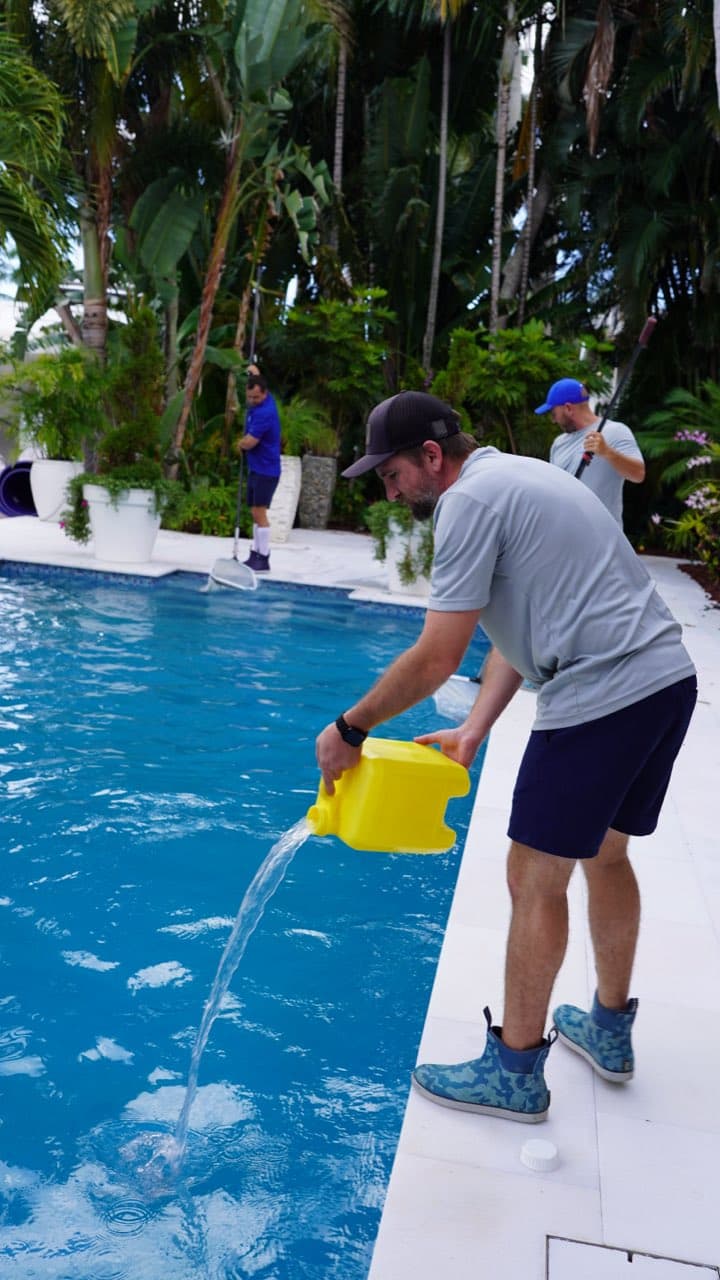
Watch: Why Your Pool Chemistry Never Stays Balanced
A Florida pool chemistry walkthrough covering circulation, stabilizer, sanitizer types, and alkalinity, with an explanation of why each pool needs its own maintenance approach.
Why Homeowners Choose Florida's Best Pool Service
Stabilizer (cyanuric acid)
South Florida sun destroys unprotected chlorine in under 2 hours. Cyanuric acid binds to chlorine and shields it from UV degradation, extending useful life by 4–8×.
Target: 30–50 ppm.Below 30, you burn through chlorine. Above 80–100, chlorine becomes “lazy” — bound too tightly to the CYA molecule to kill pathogens efficiently. The only fix at that point is a partial drain.
We monitor CYA monthly and dose conservatively. Trichlor adds CYA continuously, so we account for it across the season — the goal is never to need a drain.
Phosphates
Phosphates feed every algae bloom you've ever fought. Sources in South Florida: fertilizer runoff, decomposing palm fronds, source water, sunscreen, even rainwater carrying organic dust.
Target: under 200 ppb. When phosphates climb above that, even healthy chlorine struggles to keep up — algae has too much fuel.
We test phosphates quarterly and apply polyaluminum or lanthanum-based removers when needed. Included in your monthly rate.Most companies charge $40–$80 per phosphate treatment as an add-on. We don't.
Calcium, hard water, and the scale you can't ignore
South Florida fill water runs hard — typically 250–400 ppm calcium hardness right out of the tap. Add evaporation (concentrating CH further), cal-hypo shock dosing, and high pH, and you get scale. Scale is mostly invisible until it isn't.
Where scale shows up first
- Salt cell plates — reduces chlorine output, then triggers “Inspect Cell” errors, then permanently shortens cell life
- Heater coils — insulates the heat exchanger, drops efficiency, eventually triggers thermal cutoff or component failure
- Waterline tile — calcium ring climbs higher every year, permanent without bead-blasting or pumice removal
- Pool finish — scaling on plaster, Diamond Brite, or pebble surfaces — visible as white roughness or cloudy patches
How we manage it. Quarterly Langelier Saturation Index (LSI) calculation — the single number that tells us whether your water is in scaling territory or etching territory. Adjust pH and TA to keep LSI between -0.3 and +0.3. Use scale inhibitors when CH is unavoidably high. Dilute (partial drain) when nothing else works. Recommend a salt-cell acid clean every 3–6 months on saltwater pools — see equipment inspection for full salt-cell health monitoring, or equipment upgrades when a cell or heater is end-of-life.
Every chemical included. No add-on bills.
Other companies use chemistry as a profit center — extra invoices for stabilizer, phosphate treatments, “shock packages,” algaecide. We don't.
- ✓Chlorine (trichlor tablets, dichlor granular, liquid)
- ✓Cyanuric acid / stabilizer
- ✓Muriatic acid + pH-up
- ✓Sodium bicarb (alkalinity up)
- ✓Calcium increaser
- ✓Phosphate remover (quarterly)
- ✓Algaecide as needed
- ✓Clarifier as needed
- ✓Salt (saltwater pools)
- ✓Non-chlorine shock when chemistry calls for it
- ✗Stabilizer top-off — ~$150 every 3 months
- ✗Phosphate treatment — $40–$80 per visit
- ✗“Shock package” — $50–$100 per dose
- ✗Algaecide surcharge
- ✗Clarifier surcharge
- ✗“Hot week” chemical surcharges
- ✗Pool-store water-test trips
Our complete water chemistry guide library covers chlorine math, CYA management, phosphate sources, LSI calculation, and Florida-specific protocols. Written by our techs. No email required. Want a number for your pool? Run yours through our pool service cost calculator.
Water chemistry — frequently asked questions
Tests the water every weekly visit with test strips; tougher pools get a LaMotte WaterLink Spin Touch photometer that reads many parameters from one small sample (phosphates tested quarterly); Target ranges: FC 2–4 ppm, pH 7.4–7.6, TA 70–100 ppm, CYA 30–50 ppm, CH 200–400 ppm; Two most under-diagnosed Florida failures: CYA creep above 80 ppm and seasonal phosphate spikes August–October; Included in flat-rate monthly service (from $125/month) — no chemical add-on bills.
Every weekly visit includes a water test with test strips. The parameters we track are free chlorine (FC), combined chlorine (CC), pH, total alkalinity (TA), cyanuric acid / stabilizer (CYA), calcium hardness (CH), and salt. Tougher pools, or pools that need specialized testing, get a LaMotte WaterLink Spin Touch photometer on site, which reads many of these from one small sample. Phosphates are tested quarterly.
Yes — we test with strips on every visit. For tougher pools, or pools that need specialized testing, we step up to a LaMotte WaterLink Spin Touch photometer, because a basic strip can miss the slow drifts that matter most in Florida — stabilizer (cyanuric acid) creep, calcium drift, and alkalinity. A stabilizer number that's off can be the difference between protected chlorine and chlorine the sun burns off.
Yes. Chlorine, stabilizer, muriatic acid, pH-up, calcium increaser, phosphate remover (quarterly), algaecide, clarifier, and salt for saltwater pools — all included in the flat monthly rate. We don't bill chemical add-ons. We don't charge for stabilizer top-offs. We don't have a 'shock package' line item.
Free chlorine target is 2–4 ppm at all times — but the right answer depends on your stabilizer level. Higher CYA needs higher FC to stay effective. We balance both together using the FC-to-CYA ratio (target ~7.5%) rather than chasing one number in isolation.
South Florida sun destroys unprotected chlorine in under 2 hours. Cyanuric acid binds to chlorine and shields it from UV degradation, extending its useful life by 4–8×. Target is 30–50 ppm. Below 30 ppm, you'll burn through chlorine. Above 80–100 ppm, chlorine becomes 'lazy' and stops killing pathogens efficiently — at which point only a partial drain fixes it.
What most companies call 'shocking' — dumping cal-hypo or liquid chlorine to spike FC over 10 ppm — spikes pH and calcium hardness, plates scale onto your salt cell and heater coil, burns rubber gaskets and o-rings, strips nickel out of heat exchangers, and is unsafe to handle without proper PPE. We use steady trichlor sanitization with targeted boosts when needed, not panic dumps.
Trichlor (tablets) — slow-dissolve, slightly acidic, raises CYA. Our default for Florida residential. Dichlor — fast-dissolve, neutral pH, raises CYA. Good for boost. Cal-hypo — fast, strongly basic, raises calcium and pH — useful in soft water but punishing in hard Florida water. Liquid chlorine (sodium hypo) — fast, strongly basic, no CYA contribution. Each has the right job. We pick by pool, not by routine.
We test phosphates quarterly. South Florida phosphate sources — fertilizer runoff, decomposing organics, source water — feed algae directly. When phosphates climb above 200 ppb, we apply a polyaluminum or lanthanum-based remover. Included in your monthly rate.
Pool-store water testing is sales, not service. The reading you get back is calibrated to upsell you chemicals. We test on-site — strips every visit, our LaMotte WaterLink Spin Touch photometer on tougher pools — log the results, and dose precisely on the visit. No round-trip to a back room, no upsell pressure.
Crystal-clear water. No shock-bombs. Every chemical included.
Book your free on-site walkthrough. We'll test your water on site, walk you through what it's actually doing, and start weekly service the next week. 100% money-back guarantee on your first month.
Available in every city we serve
Select your city for local pricing and neighborhood details.