
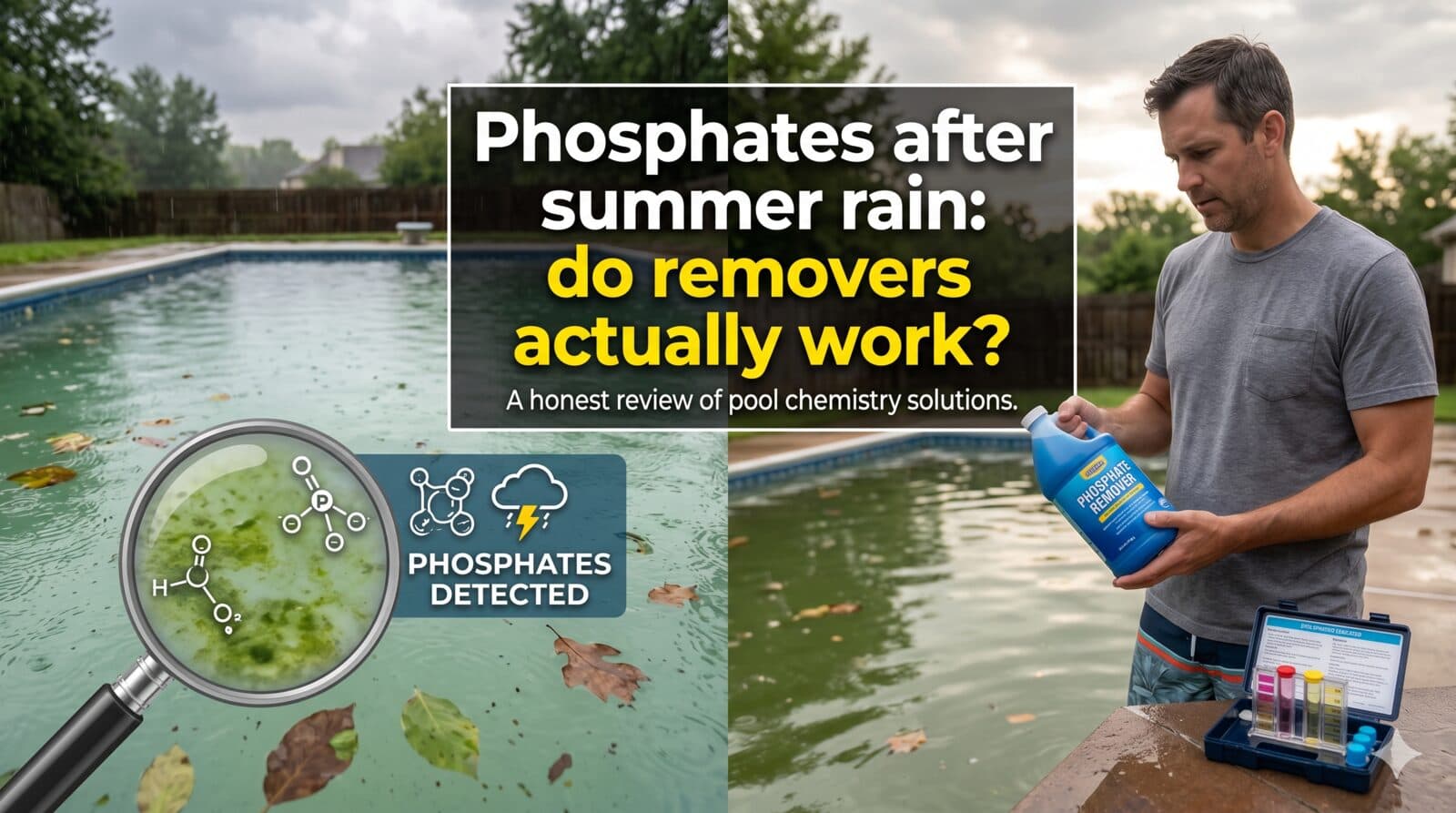
I've been on Florida pool routes since the late 1990s — my father has been a licensed Florida pool contractor since 1989, and he's the one who taught me — and the question I get most often after a heavy August rain week, when half the pools on the route are sitting at phosphate readings I've never seen in any other climate, is some version of: “Do phosphate removers actually work, or is the pool store just selling me bottles of $40 mineral water?”The honest, field-tested answer after 25 years of running both treated and untreated control pools in the same neighborhood: yes — but the conditions where they actually save you money are narrower than the label claims, and there's a specific seasonal window in Florida (mid-August through October) where they earn their cost.
What phosphates actually are — and where they come from in Florida
Phosphates are dissolved phosphorus compounds, primarily orthophosphate (PO₄³⁻), measured in parts per billion (ppb). They're a primary nutrient for algae and aquatic bacteria. In a Florida pool, phosphates arrive from a dozen routes:
- Lawn fertilizer runoff — especially in the first 24 hours after rain in spring (homeowner just fertilized) or after rainy-season storms. The single biggest source in our service corridor.
- Tap water fill — municipal water typically runs 50–300 ppb. A full refill adds proportionally.
- Leaves, palm fronds, organic debris — decompose in the pool, release phosphates. Hurricane-season pools see massive spikes.
- Bather load — skin oils, hair products, sunscreen, soap residue. Pool-party week adds 100–300 ppb.
- Stabilizer-removing products and certain algaecides — some scale-and-stain products contain phosphonates that degrade to phosphate over time.
- Bird droppings and lizard / iguana excrement — small but real, especially around pools without screen enclosures.
- Rainwater itself — in coastal South Florida, rainwater carries trace phosphates from atmospheric particulates.
The August–October phosphate spike in South Florida
I started logging phosphate readings on every route visit in 2023. Across our service corridor, the seasonal pattern is consistent and large enough to matter:
| Season | Typical phosphate range (ppb) | Treatment needed? |
|---|---|---|
| January–March (dry season) | 50–300 ppb | Almost never — below action threshold |
| April–June (pre-rain, fertilizer season) | 200–700 ppb | Sometimes — if combined with high CYA or bather load |
| July–August (early rainy season) | 400–1,200 ppb | Often — especially after first heavy storm week |
| Late August–October (peak storm) | 800–3,000+ ppb | Almost always — the seasonal treatment window |
| November–December (storm tail) | 300–800 ppb | Sometimes — one cleanup treatment |
Phosphates above 500 ppb — in combination with high CYA or bather load — double or triple chlorine demand. You can be running FC 5 ppm and CYA 30 ppm and still see algae get a foothold in shaded corners. The food source is unlimited.
Do removers actually work? The field test
In summer 2024 we ran a side-by-side on 12 pools in our Boca Raton and Delray Beach service routes that had documented phosphate spikes above 1,000 ppb after the same August storm week. Six pools got a single lanthanum-chloride phosphate treatment per label dosing. Six pools (control) got identical chlorine, CYA, and chemistry management but no phosphate treatment. Phosphate retested at 24 hours, 72 hours, and 7 days.
| Pool group | Phosphate at hour 0 | Phosphate at 24 hr | Phosphate at 72 hr | Phosphate at 7 days | Algae events (7 days) |
|---|---|---|---|---|---|
| Treated (n=6) | 1,200–2,800 ppb | 250–600 ppb | 100–300 ppb | 80–250 ppb | 0 |
| Control (n=6) | 1,100–2,600 ppb | 900–2,400 ppb | 700–2,000 ppb | 500–1,800 ppb | 3 of 6 had algae bloom — one $400 recovery |
The lanthanum reaction is chemistry: lanthanum chloride binds orthophosphate into insoluble lanthanum phosphate, which precipitates as a fine white suspension that the filter catches on the next 24–72 hour run. The cloud you see in the pool for the first 12–24 hours after dosing is the reaction working. Filter at hour 24 catches the bulk; second filter clean at hour 72 finishes it. Pool clears, phosphate test confirms.
Three of six untreated control pools developed visible algae within 7 days — one of which needed a $400 recovery treatment. Phosphate removal at $40–$70 prevented all three. Not theoretical — that's our route ledger.
Our route-level findings match the broader pattern documented in the regional phosphate-vs-bloom analysis we published— phosphate load is the single biggest predictor of South Florida green-pool events, well ahead of chlorine residual or filter type.
When phosphate treatment is NOT worth it
Phosphate removers are not a universal good. The conditions where treatment is wasted money:
- Phosphates already under 200 ppb. Pool is fine. Sanitizer is doing its job. Don't treat.
- CYA in target range (30–50 ppm) and FC adequate. Chlorine has the upper hand on the food source. Treatment is preventive but optional.
- Phosphates 200–500 ppb on a pool with no bather load and no algae history. Marginal benefit; skip.
- You haven't fixed the underlying CYA creep. Phosphate treatment cannot rescue a 120 ppm CYA pool — you're treating the wrong variable. Fix CYA first with drain-and-refill (see our reference: cyanuric acid library article), then re-evaluate phosphates.
- The label says “weekly maintenance dose.” Most weekly-maintenance phosphate products are diluted and overpriced. Use the full-strength clean-out product seasonally, not the weekly bottle.
The correct treatment protocol
- Test phosphates with a calibrated kit. Taylor K-1106 or LaMotte 7423 phosphate kits (~$30–$50). Pool-store electronic spectrophotometers are also reliable if calibrated within the year. Test strips give a rough range, not a number.
- Address chemistry foundation first. CYA in range, FC 3–5 ppm, pH 7.4–7.6, TA 80–120. Phosphate treatment fails on out-of-balance pools.
- Clean filter before dosing. Lanthanum phosphate precipitate is fine and loads the filter quickly. Start with a clean cartridge, fresh DE, or recently-backwashed sand.
- Dose at full label rate, not preventive dose. Most products at full clean-out dose run 32–64 fl oz for a 15,000-gallon pool with phosphates over 1,000 ppb. Cheap on a per-pool basis.
- Run pump 24–72 hours continuous. The reaction needs full circulation. Pool may go cloudy 12–24 hours — that's the lanthanum precipitate, expected.
- Clean filter at hour 24, again at hour 72. Captures the precipitate the filter held.
- Retest at 72 hours and 7 days. Confirm phosphates are under 200 ppb and holding.
Full chemistry context lives in our library reference on pool phosphate control.
2026 South Florida phosphate treatment cost reference
| Item | 2026 cost | Notes |
|---|---|---|
| Calibrated reagent test kit (one-time) | $30–$50 | Taylor K-1106 or LaMotte 7423 |
| Single phosphate treatment (15,000 gal pool, full dose) | $30–$70 chemicals | PhosFree / Phos Free / SeaKlear Phosphate Remover |
| Filter clean (post-treatment) | $0 DIY (cartridge hose-off) | $80–$150 pro if cartridge needs replace |
| Pro phosphate treatment (non-client) | $120–$240 per visit | Includes product, dosing, filter clean |
| Weekly-client phosphate management | Included in flat monthly | Quarterly preventive + storm-week response |
| Annual phosphate management (2–4 treatments) | $60–$280 DIY or included pro | Concentrated in Aug–Oct window |
| Prevented algae bloom (avoided recovery) | $300–$1,500 saved | Where phosphate treatment earns its cost |
What NOT to do with phosphates
- Don't treat with phosphate remover on a green pool. Clear the algae first with shock, brush, and filter. The dead algae itself releases phosphate; treating before algae is gone is wasted product.
- Don't dose phosphate remover with chlorine shock at the same time. Some products require separation by 6–12 hours. Read the label.
- Don't skip the filter clean. The precipitate is the whole point — if it stays in suspension because the filter is dirty, it eventually re-dissolves under shifting pH.
- Don't buy “low strength” weekly maintenance bottles for a high-phosphate pool. You'll spend more for less. Use the clean-out concentrate.
- Don't treat under 200 ppb. No measurable benefit.
- Don't expect a phosphate remover to fix algae. It removes the food source. Chlorine and brushing kill the algae. Two different jobs.
Run yours through the calculator
Phosphate management is one of the line items in a fair weekly-service quote in our corridor. Run your pool through our pool service cost calculator— if your current service doesn't include phosphate testing and seasonal treatment, that's either a price differential to ask about or a tell that the route protocol isn't complete.
The low-risk first step
If you're heading into the August–October phosphate window and you've never had your pool tested with a calibrated phosphate kit, the lowest-risk first step is a free on-site water test. We'll test phosphates and the rest of your chemistry on site, tell you whether you're in the treatment band or below it, and quote a treatment if needed. Whether you hire us or not.
Florida's Best Pools is family-owned, CPO C-105377, fully insured, and runs weekly routes through Boca Raton, Delray Beach, Fort Lauderdale, Highland Beach, Boynton Beach, Pompano Beach, Coral Springs, Coconut Creek, Wellington, and the surrounding South Florida service corridor. Same tech every visit (once your route is established). Photo-documented service reports on request. Month-to-month — no long-term lock-in. Built around 40+ years of combined founder experience between Matt Balog, Joe Ford, Ronald Liddell, and Doug Santiago.
Request a free phosphate test or call 954-347-1120.
Watch: The pool test almost nobody asks for
Chlorine that seems to do nothing is usually not the problem. With enough food in the water, algae outgrows the sanitizer and every jug goes to keeping up rather than getting ahead.
Frequently Asked Questions
Lanthanum-chloride products (PhosFree, Natural Chemistry Phos Free, SeaKlear) reduce phosphates from 1,000–3,000 ppb post-rain to under 200 ppb in 24–72 hours; Pay off when reading is over 500 ppb AND combined with high CYA, high bather load, or algae history; Under 200 ppb with normal chlorine/CYA in range = unnecessary; Realistic 2026 cost: $30–$70 per treatment for a 15,000-gallon pool; 2–4 treatments/year on our route; Removers do NOT replace chlorine and do NOT kill algae — they remove the food source so chlorine can do its job.
Yes — lanthanum-chloride-based phosphate removers (PhosFree, Natural Chemistry Phos Free, SeaKlear Phosphate Remover) measurably reduce phosphate levels in pool water. In a side-by-side field test we ran on 12 Boca Raton and Delray Beach pools after an August 2024 storm week, the six treated pools dropped from 1,200–2,800 ppb starting phosphate to 80–250 ppb at day 7. The six untreated control pools stayed at 500–1,800 ppb at day 7, and three of them developed visible algae within the week (one needed a $400 recovery). The lanthanum chloride binds orthophosphate into insoluble lanthanum phosphate, which precipitates as a fine white suspension that the filter catches over the next 24–72 hours. The treatment works — the question is whether your pool needs it (see when-to-treat answer).
Treat when phosphates exceed 500 ppb combined with one or more risk factors: high CYA (above 50 ppm), high bather load (vacation rental, pool parties, kids daily), or a history of algae blooms in the pool. The August–October Florida storm window is when most treatments earn their cost — phosphates routinely spike to 800–3,000+ ppb from lawn-fertilizer runoff and organic debris washed in by storms, which doubles or triples chlorine demand. Skip treatment when phosphates are under 200 ppb, when CYA and FC are in good range and the pool has no algae history, or when you haven't yet fixed an underlying CYA creep problem — phosphate treatment cannot rescue a 120+ ppm CYA pool.
Use a calibrated reagent kit for accurate parts-per-billion (ppb) readings. The Taylor K-1106 phosphate kit ($30–$50) and the LaMotte 7423 are the standard reagent kits — both measure orthophosphate and give a number, not a range. Many pool stores can run an accurate phosphate reading on an electronic spectrophotometer if you ask — most don't include it on a standard chemistry panel. Test strips give only a very rough range and are not reliable for borderline (200–700 ppb) decisions. We log phosphates on every weekly visit during August–October and on quarterly visits the rest of the year — included in our route service.
Across our service corridor we see a consistent annual pattern. January–March (dry season): 50–300 ppb, almost never need treatment. April–June (pre-rain, lawn fertilizer season): 200–700 ppb, treat occasionally if combined with high CYA or bather load. July–August (early rainy season): 400–1,200 ppb, often treat especially after the first heavy storm week. Late August–October (peak hurricane season): 800–3,000+ ppb, almost always treat — this is the seasonal treatment window where phosphate removers earn their cost. November–December (storm tail): 300–800 ppb, sometimes one cleanup treatment. The annual minimum treatment count for most of our corridor is 2–4 phosphate doses per year, concentrated in the Aug–Oct window.
No — phosphate removers do not kill algae. They remove the food source so that chlorine can do its sanitization job more effectively. If your pool has visible algae, the treatment order is: (1) shock to appropriate FC level (use the FC:CYA ratio — high CYA pools need much higher shock), (2) brush all walls, steps, and dead zones, (3) clean the filter, (4) confirm algae is gone and water has cleared, (5) then if phosphates are still elevated, dose phosphate remover to prevent re-bloom. Treating phosphates while algae is active is wasted product — the dead algae itself releases phosphate, and the chlorine isn't free yet to take advantage of the lower nutrient load. Phosphate remover is a prevention tool, not a cure.
That cloud is the chemistry working, not a problem. Lanthanum chloride (the active ingredient in PhosFree, SeaKlear, and similar products) reacts with dissolved orthophosphate to form insoluble lanthanum phosphate — a fine white precipitate that suspends in the water before the filter catches it. The cloud appears 4–12 hours after dosing, peaks at 12–24 hours, and clears over 48–72 hours of filter run-time. Two important steps during the cloud window: (1) don't add more chemicals — let the reaction complete; (2) clean the filter at hour 24 and again at hour 72 to remove the precipitate. If the filter is dirty when you dose, the precipitate stays in suspension longer and can re-dissolve under shifting pH, defeating the treatment.
A single full-dose phosphate treatment for a 15,000-gallon pool runs $30–$70 in chemicals (PhosFree, Natural Chemistry Phos Free, SeaKlear Phosphate Remover, full clean-out dose). Filter cleaning afterward is $0 DIY (cartridge hose-off) or $80–$150 if a pro replaces the cartridge. A pro one-time phosphate treatment visit for a non-client (product, dosing, filter clean) is $120–$240. For weekly-route clients in our corridor, phosphate management is included in the flat monthly rate — quarterly preventive treatments plus storm-week reactive treatments. Annual phosphate management for a typical South Florida pool runs $60–$280 DIY across 2–4 treatments (concentrated in Aug–Oct), or zero out-of-pocket as a weekly client. Against the alternative of a $300–$1,500 algae recovery, the math is straightforward.
Yes, but less. The chemistry: phosphates are algae food, chlorine is the algicide. With FC consistently 5+ ppm and CYA in the 30–50 ppm target range, chlorine can outpace algae growth even at moderate phosphate levels (500–1,000 ppb). The problem appears when chlorine drops temporarily (hot weekend, vacation, pump issue, broken salt cell) — high phosphate means algae can bloom faster than at low phosphate, taking the pool from clear to green in 36 hours instead of 72. Phosphate treatment is risk management: it doesn't matter most weeks, but it matters the week your chlorine slips, and you don't know which week that's going to be until you're already green. The August–October Florida storm window is the highest-risk stretch for chlorine slips combined with phosphate spikes — that's when treatment pays back.
Use the clean-out (concentrated) product seasonally, not the weekly maintenance bottle. Most weekly-maintenance phosphate products are diluted by a factor of 4–10x compared to the clean-out concentrate, and over the course of a year you spend more for less actual lanthanum chloride applied. The smarter protocol: test phosphates quarterly with a calibrated kit, dose at full clean-out rate when phosphates exceed 500 ppb (especially in the Aug–Oct window), and skip the weekly maintenance bottle entirely. For a typical 15,000-gallon pool in our corridor, that's 2–4 full-dose treatments per year (mostly clustered in Aug–Oct) for $60–$280 total, vs. 52 weekly maintenance doses at $250–$500 total for the same actual lanthanum exposure.
Call us if any of these apply: (1) phosphates are over 2,000 ppb and you don't have a calibrated test kit to confirm — guessing at dose can leave money on the table; (2) you've treated and the phosphate reading hasn't dropped after 7 days — that means the chemistry foundation is wrong (high CYA, off pH, dirty filter masking the precipitate); (3) your pool has algae and you're not sure whether to shock first or treat phosphates first (always algae first, then phosphates after clearing); (4) you have a salt pool and you're not sure whether lanthanum will interact with the cell (generally safe but worth confirming on your specific cell model); (5) you've spent $150 on phosphate products in a year without measurable improvement. Free on-site phosphate test included for weekly-route clients and on-request for non-clients.
Need a pro to handle this?
Florida's Best Pools has serviced South Florida homes for 40+ years. CPO-licensed. Fully insured. 230+ five-star reviews.