


Pool Heater Repair & Replacement
Heat pumps, gas heaters, and solar — diagnosed right, fixed honestly, sized correctly.
Need heater work? Book a heater diagnostic and get a written quote before any work.
Book heater serviceWhat Heater Repair includes
Heater not heating, throwing an error code, leaking, or shutting off too soon? We diagnose heat pumps, gas heaters, and solar across every major brand — Hayward, Raypak, Pentair, AquaCal, Jandy. We start with the cheapest likely cause (a clogged filter chokes flow and is behind a huge share of "dead" heaters), then give you an honest repair-or-replace recommendation. Any repair or component replacement is quoted in writing, approved by you first, and handled under our CPC license. We also catch what most companies miss: bad water chemistry and wrong-sized, mis-plumbed equipment quietly destroying your heater.
- ✓Full heater diagnostic — flow, ignition, error codes, pressure
- ✓Filter/flow check first (the #1 cause of a heater that won't fire)
- ✓Error code analysis (flow faults, HP/high-pressure, ignition lockout)
- ✓Heat pump compressor + coil service scope
- ✓Gas valve, burner, and igniter service scope
- ✓Heat exchanger inspection — repair-or-replace recommendation
- ✓Honest repair-vs-replace math (new heater ≈ $5K–$7K; major component ≈ $4K–$5K)
- ✓Correct heater sizing + diverter/plumbing check to stop premature failures
- ✓Annual heater cleaning and tune-up ($150–$350): open the housing, clear debris, protect the exchanger
- ✓Repairs and component replacement handled by our own crew under our CPC license
South Florida homeowners with a heater that won't heat, throws codes, leaks, or is 10+ years old and due for a repair-or-replace decision.
What to expect: our heater diagnostic
Most heater "failures" aren't what the homeowner thinks. A heater that won't fire is usually starved for flow, not broken — so we work a fixed sequence from cheapest cause to most expensive, and you see the finding at each step before anyone talks about parts.

- 1Filter & flow check
We pull the filter cartridge and run the system first. A clogged filter chokes off the water flow almost every heater needs to ignite — and a huge share of "dead heater" calls end right here, fixed for the price of a rinse.
- 2Read the error code
We read the fault on the display — a flow fault (often a code in the 100s), HP/high-pressure, or an ignition lockout — to pinpoint the system at fault instead of guessing.
- 3Component test
Depending on the code we test the igniter, flame sensor, pressure switch, and gas valve on gas units, or the compressor, coil, and refrigerant pressures on heat pumps.
- 4Heat exchanger inspection
We check the exchanger for etching, scale, and leaks. This is the part that decides repair vs. replace — at $4,000–$5,000 it's usually the trigger to put money toward a new unit.
- 5Sizing & plumbing check
We confirm the diverter valve is set correctly and the heater is matched to your flow rate. Wrong sizing and a mis-used diverter are what quietly blow heat exchangers and pumps — we catch it before it costs you thousands.
- 6Written quote + recommendation
You get a flat-rate quote in writing and an honest repair-or-replace call. Nothing is ordered or installed until you approve the number.
Repair or replace? The honest math
Most heater repairs land between $250 and $1,800 — sensors, igniters, flow switches, relays, gas valves, control boards. Those are worth fixing on a heater that still has life in it. Where the decision flips is the two big internals: a failed heat exchanger or compressor runs $4,000–$5,000, and a brand-new, more efficient heater installed is $5,000–$7,000. When the repair gets that close to a replacement, we'll tell you straight that the new unit is the smarter spend.
Our rule of thumb: repair if the heater is under ~10 years old and the fix is under ~30% of a new unit; replace if it's 15+ years old, the exchanger or compressor is gone, or the repair crosses ~50% of replacement. You always get the numbers in writing first — we don't decide for you, we give you the math and the recommendation.
Heater repair across Palm Beach and Broward
We repair pool heaters on routes across Boca Raton, Delray Beach, Boynton Beach, Highland Beach, Deerfield Beach, Pompano Beach, Lighthouse Point, Fort Lauderdale, Coral Springs, Coconut Creek, Margate, Wellington, Lantana, and Manalapan. Heat pumps are most of what we see on South Florida pads, followed by gas heaters on spas and pools that need fast heat, and the busiest weeks come with the first cold fronts of the season.
Repairs are handled by our own crew under our Florida Certified Pool/Spa Contractor license. Our own techs do the work, start to finish. If the diagnostic says the heater is done, we size and install the replacement too, so you're not starting over with a second company.
Why heaters fail early in South Florida (and how we stop it)
The most expensive heater failures here aren't worn-out parts — they're wrong sizing and bad plumbing baked in at install. A diverter valve run closed, or a 3-inch line forcing too much water through a heater rated for ~70 GPM, swells and blows the heat exchanger and can take the pump with it. We've seen that one mistake cost a homeowner roughly $10,000. So we check the diverter and the heater's sizing against your actual flow on every visit.
The other silent killer is water chemistry. Balanced water lets a heater run 10–15 years; acidic water etches the heat exchanger and high calcium scales it shut, and either one can mean a new heater every 2–3 years. Keeping your chemistry in range is the cheapest heater insurance there is — and it's exactly what our weekly service is built to do.
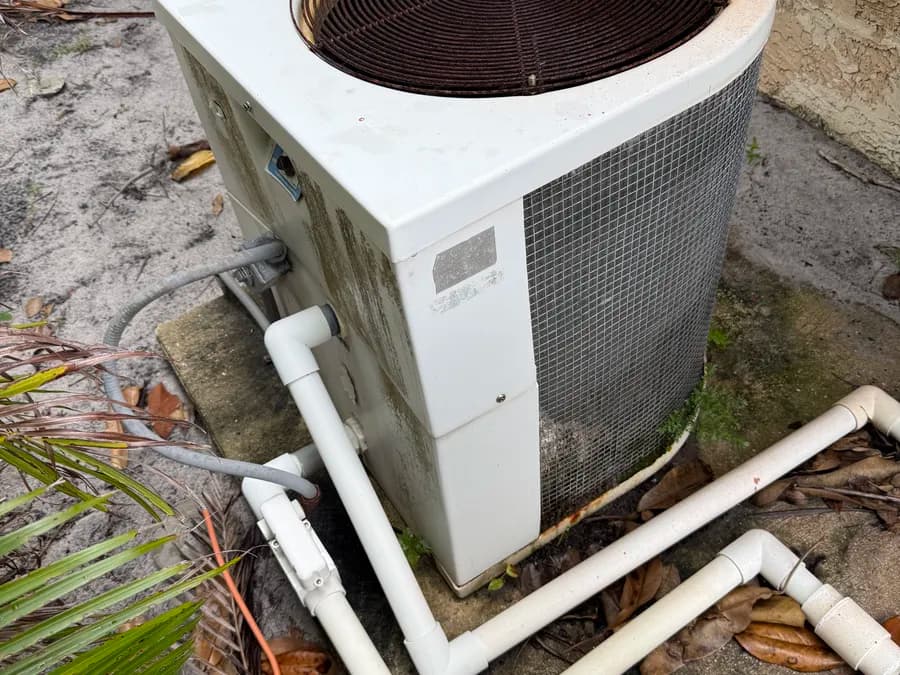
On the job in South Florida

Heater Repair — Common Questions
It depends on the failure. We diagnose first and quote in writing before any parts are ordered. A small fix — a flow problem from a dirty filter, a sensor, an igniter — is inexpensive. Major component replacement is where the math changes: a new heat exchanger or compressor typically runs $4,000–$5,000, and a full new heater runs about $5,000–$7,000. When the repair gets that close to a replacement, we'll tell you honestly that a new, more efficient unit is the better spend.
Nine times out of ten it's the simplest thing: a dirty filter. A clogged filter chokes off water flow, and almost every heater needs proper flow to fire and stay running — so we pull the cartridge and run the system before anything else. The other big one in South Florida is cold weather: heat pumps pull warmth from the air, so a cold snap can stop one from heating (a gas or electric-resistance heater still works). After flow, we read the error code to pinpoint the fault.
Yes — all major brands: Hayward, Raypak, Pentair, AquaCal, Jandy, and more, across heat pumps, gas heaters, and solar. Error codes vary by brand but the common ones are flow faults (often a code in the 100s) and HP/high-pressure — both of which frequently trace back to the filter. We diagnose the specific brand and model, then quote the exact parts.
Run the math. A new heater is roughly $5,000–$7,000; replacing a heat exchanger or compressor is about $4,000–$5,000. When the repair costs that much, you're better off putting the money toward a new, more efficient unit. And if the heater is 15+ years old, replace it regardless — old copper heat exchangers can deteriorate to where they're no longer safe for your pool water. Repairing a heater older than ~10 years is usually a bad investment.
Heat pumps dominate here — South Florida stays warm enough year-round that they're the cheapest, most consistent way to heat a pool, and far more efficient than gas. The catch is they lose effectiveness during a cold snap. Gas heats fastest and works in any weather, so it wins for spas/hot tubs and anyone who wants the pool hot in a hurry regardless of operating cost. Electric-resistance heaters work cold but are expensive to run and the salt air destroys them. Solar is cheap to run but can leak onto and damage your roof and may void roof warranties.
Usually not. Nine times out of ten a little water on the pad is just condensation. But if it's a lot of water clearly coming from the unit, that often points to a failed heat exchanger, which typically means a new heater. If you can physically see it leaking, shut your pool pump off and call us — running it can make the damage worse.
Yes. An annual heater cleaning or tune-up runs $150–$350. We open the housing, clear debris and nesting insects, check the burner or coil, and protect the heat exchanger. Paired with balanced water, it's the cheapest way to keep a heater going for decades instead of replacing it early.
Yes. We size and install new heat pumps and gas heaters under our CPC license. Most new heaters run $5,000–$7,000 installed, including removal of the old unit, with any new gas line or electrical circuit quoted separately. You get one written price before anything is ordered.
With balanced water and a yearly cleaning, heaters can last 10–15 years. With bad chemistry they can fail in 2–3. Too-acidic water etches the heat exchanger; too-basic water calcifies and closes off the pipe. The other silent killer is bad installation — an oversized heater or a mis-used diverter valve forcing too much water through a unit (a 3-inch line into a 2-inch heater rated for ~70 GPM) swells and blows the heat exchanger, and can blow your pump too. We check chemistry, sizing, and plumbing as part of every heater visit.
Why Homeowners Choose Florida's Best Pool Service
Want a number for your pool? Run yours through our pool service cost calculator.
Ready to get started?
Free on-site evaluation. Flat-rate pricing. Regular-tech, same-day weekly service.