


Coconut Creek Pool Service: One Water Supply, Every Pool in Town
Your regular tech weekly — no contracts.
- Service
- Weekly pool service in Coconut Creek, FL — your regular tech, same day every week
- Phone
- 954-347-1120
- Base
- Licensed pool service company based in Boca Raton, serving Coconut Creek and South Florida
- Service area
- Coconut Creek (ZIP 33063, 33066, 33073, 33076, 33093) · Broward County, FL
- Water supply
- Purchased finished from Broward County WTP 2A, Pompano Beach — the city treats none of its own
- Neighborhoods
- Wynmoor Village, Township, Banyan Trail, Hidden Hammocks, Coral Lakes, Winston Park, Cocoplum
- ZIP codes
- 33063, 33066, 33073, 33093, 33097
- Contracts
- No long-term contracts — month to month
- Rating
- 5.0 stars across 230+ Google reviews
- Experience
- 40+ years combined founder experience · 10,000+ pools serviced
- Licenses
- CPO C-105377 + FPPS 600551
One supplier, no substitutions
Coconut Creek does not treat a drop of its own water. The city's own 2025 annual water quality report says it plainly: it purchases treated water from Broward County's District 2A Water Treatment Plant in Pompano Beach. Broward's FY2024 annual report names the relationship from the other side — District 2 includes the utility's largest wholesale water customer, the City of Coconut Creek, which accounts for roughly 22 percent of the total potable water consumed by the utility's customers and pays compensation amounting to 4 percent of the utility's gross water revenues.
Then there is the exclusivity clause, which is the part nobody servicing pools here ever mentions. Without prior County approval, Coconut Creek is prohibited from buying or otherwise providing water within its service area from any source other than the County. The County's own report adds that there appears to be no practical or economic incentive for the city to pursue development of its own facility or alternative sources of supply. District 2 does hold emergency interconnections with Deerfield Beach, Hillsboro Beach, Pompano Beach and Palm Beach County, but those are what they sound like. All of the city's normal supply comes down one pipe.
Plant 2A was originally constructed in 1975 with 20 MGD of treatment capacity and expanded in FY 1994 to 40 MGD, with 30 MGD permitted. One plant, five decades of Coconut Creek build-out hanging off it, and monthly samples pulled from 60 locations across a service area that also takes in part of Parkland.
That single supply line is a diagnostic tool, not trivia. In a city carved up between several small utilities, a chemistry oddity on one street stays on one street. In Coconut Creek, when something moves upstream, it moves in Township, Winston Park, Coral Lakes and Wynmoor in the same week. When three houses on one route report the same strange reading in the same seven days, we stop rebalancing pools and go test the fill water — because here, that is a live possibility rather than a long shot.
Two rows on the 2025 report are worth knowing about before someone else tells you about them badly. The city reported a total coliform treatment-technique violation covering January through December 2025, with one Level 1 assessment completed on July 23, 2025 and three corrective actions completed. And chloramine — the disinfectant carried through the distribution system — showed a detected level of 4.26 ppm against an MRDL of 4.0, across a range running 1.77 to 4.26 ppm. The city reported no violation on that row, and that is not a typo: MRDL compliance is assessed on a running annual average rather than on the single highest reading of the year. What it means at your pool is simpler. Water topped off in a week near the top of that range is not the same product as water topped off in a week near the bottom, and the free-versus-combined split is where you see it first.
The week the supply changes
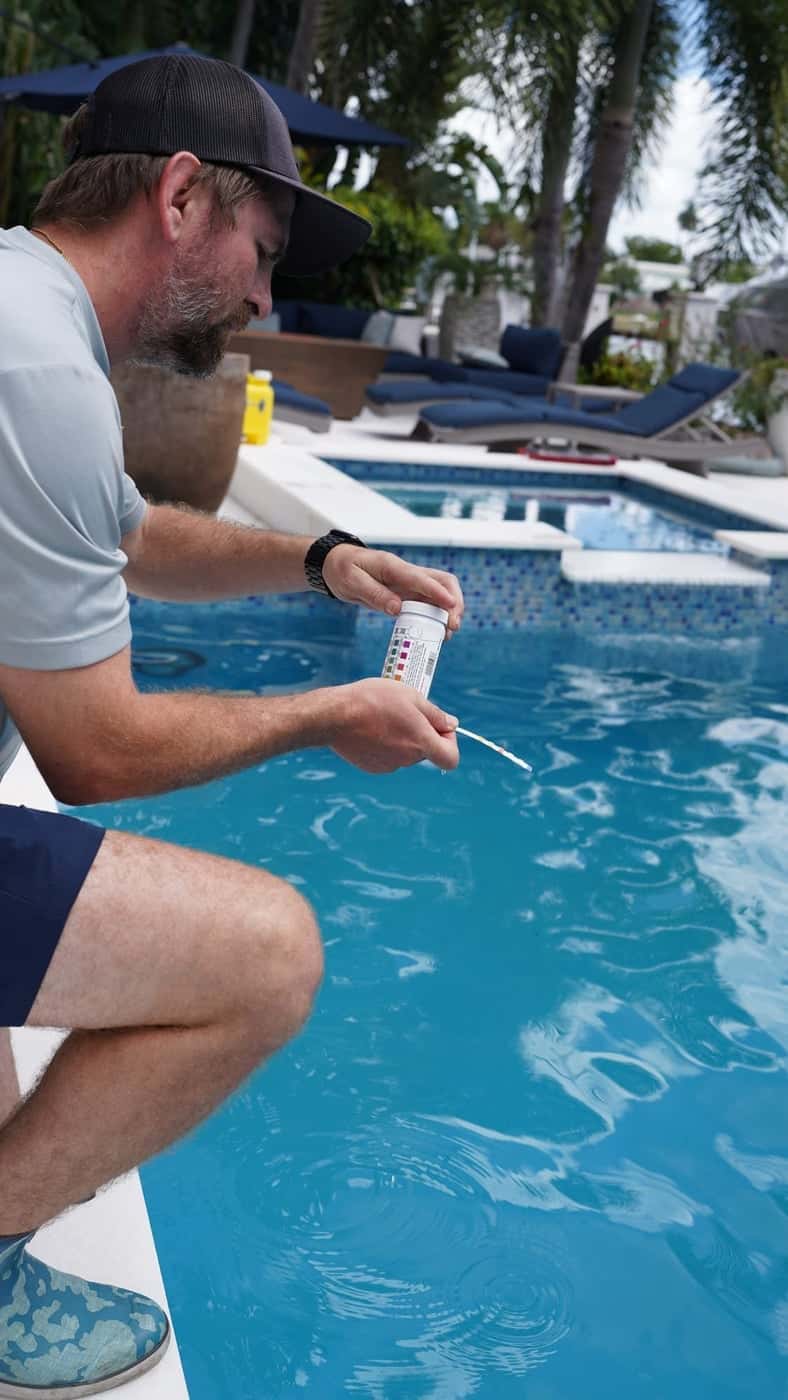
Here is the baseline, so you can tell when it has moved. County wells draw from the Biscayne Aquifer at 50 to 200 feet. The raw water is softened with lime and ferric chloride, filtered, then disinfected with chloramines — chlorine combined with ammonia — carried through the pipes as a residual. Fluoride is added to the finished water; Coconut Creek's own report says added, not naturally occurring. When an advisory, a flush, a main break or a disinfection change lands on top of that, this is the order we work in.
Test free and combined chlorine before deciding anything. Chloraminated fill water arrives already carrying combined chlorine, so a heavy top-off can open a total-versus-free gap that reads like a sanitation failure and is nothing of the sort. The reading tells you whether the pool needs shocking or needs leaving alone.
Do not add stabilizer blind. The reflex after a chemistry surprise is to reach for cyanuric acid, and CYA is the one number you cannot easily take back out — you find out you overshot in August, when the chlorine quietly stops working and nobody can explain why.
Test calcium hardness rather than assuming it. The county treats the raw water to reduce hardness, but neither the city's report nor the county's publishes a finished hardness number — so there is nothing to look up, only something to measure. Anyone who tells you which way Coconut Creek water pushes your plaster without a test kit in their hand is guessing at your expense.
Watch the water leaving the hose, not just the water in the pool. Cloudy, milky or discoloured fill after a flush or a main break is the tell that the change happened upstream of your property line.
Extend filtration run time for the rest of that week rather than dosing harder. A supply change usually shows up as a demand problem and a clarity problem, and both of those are solved by turnovers.
Re-test after a full turnover, not the morning after the dose — and before anyone swims. A pool that was corrected at 4pm has not finished mixing by 8am.
Treat any citywide advisory as citywide. One supplier means your neighbour's pool, the association deck two streets over and the amenity pool at the far end of the city are all getting identical water on an identical day. If you hear it on your street, assume the whole route sheet is affected.
Know what is coming, and refuse a prediction from anyone. Broward has Carollo Engineers, in association with CDM Smith, designing nanofiltration retrofits for WTP 1A and 2A — built for future conversion to reverse osmosis, plus roughly six miles of large-diameter transmission main — aimed at the EPA's April 2031 PFAS compliance deadline. No in-service date has been published. When it arrives, your fill water may well behave differently. Which direction and by how much, nobody can honestly tell you yet, and we are not going to pretend otherwise to sound clever.
The lakes tell you when the pool is about to go
In the district south of Coconut Creek Parkway, the lakes and canals behind those houses are the South Creek system — and the City publishes a waterways brochure for it that is more useful to a pool owner than most of what pool companies write. Three lines in it explain the majority of the green-pool calls we take on that side of town.
Levels are lowered on purpose in summer. The brochure states that levels are drawn down in the summer to provide storage for flood protection. A lower lake means more exposed bank, more shallow warm water, and a shoreline behaving completely differently in July than it did in February.
Scum persists three to six weeks after treatment. When the lakes are sprayed, the City tells residents to expect scum to hang around for three to six weeks. That is a month and a half of organic material sitting on a water surface a few feet from your screen enclosure, with every afternoon storm and every east wind moving some of it toward you.
Algae is worst at the seawall, because that is where the water is shallowest. The City says so directly. Shallow water warms faster and has less volume to dilute whatever lands in it — so the worst-performing stretch of the lake is also the stretch closest to your deck. The brochure additionally asks residents not to fertilize before a storm, which tells you plainly what the runoff carries when they do.
The hydrology behind all of it: the South Creek system connects the major Hillsboro Canal in the north to the C-14 (Cypress Creek) Canal in the south, with no control structure between South Creek and the C-14. Drainage responsibility sits with the Cocomar Water Control District, created May 8, 1980 by the City of Margate, the City of Coconut Creek and the Broward County Board of County Commissioners. That is a description of South Creek specifically — the northern build-out is a different system and we do not pretend the same mechanics apply there.
None of this makes lake-front a bad place to own a pool. The City counts 18 parks and 9 greenways, and Sabal Pines Park on NW 39 Avenue, Windmill Park on Lyons Road and Winston Park on NW 49 Avenue all carry lake or canal frontage — the water is the reason people buy here in the first place. It only means that a pool on that water going green after a heavy rain or a spray cycle is not a mystery and not a personal failing. It is a predictable event on a rough schedule, and the gap between a two-day recovery and a two-week one is almost entirely how fast the call comes in.
Three kinds of water to look after
Some cities divide neatly along a coastline or a canal. Coconut Creek divides by what kind of deck you are standing on — and the three kinds here want three genuinely different service plans.
Lake- and canal-front single-family
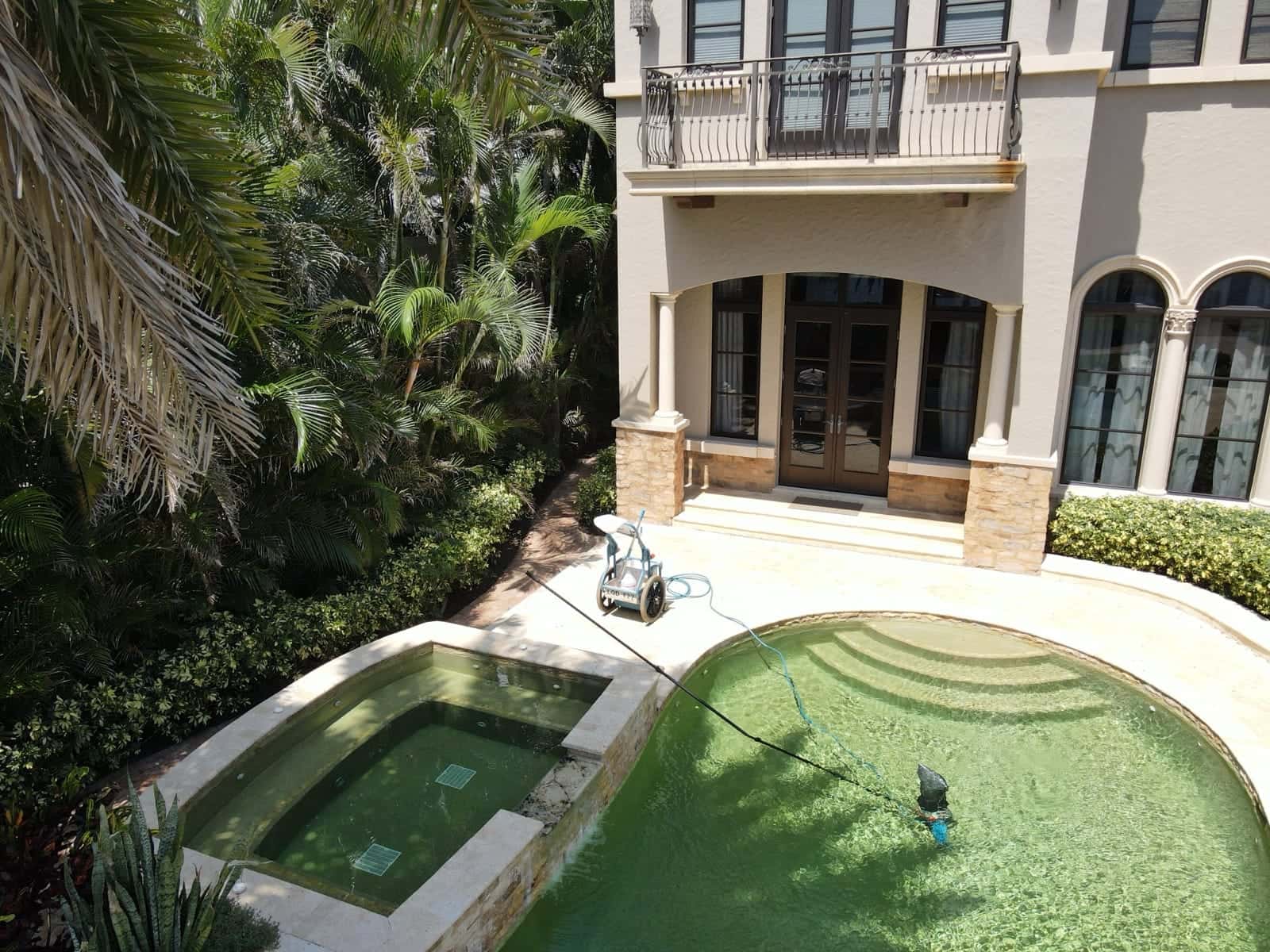
The South Creek side, where the seawall is a few strides from the coping. These pools field wind-blown organic load off a lake that is deliberately drawn down in summer and can carry scum for three to six weeks after treatment. Baskets fill faster, filter pressure climbs sooner between cleans, and the one that gets skipped for a week in August is the one we come back to as a green-to-clean.
MainStreet's amenity decks
MainStreet closed on October 21, 2025 across roughly 250 acres, with a delivered mix of 792 apartments, 414 townhomes, 148 villas and 296 condominiums. That is overwhelmingly attached product, which means the swimming happens on shared amenity decks rather than in fifteen hundred private backyards. Shared water runs bather loads no single-family pool sees, swings faster, and answers to a management company rather than a homeowner.
Established association water
The city's older active-adult associations — Wynmoor Village in 33066 is the one everybody names — run shared decks on equipment that has been in service a long while. What those boards need is not a louder sales pitch. It is an honest repair-or-replace call, a weekly record somebody can put in front of a meeting, and vendor credentials already on file before a tech reaches the gate.
Coconut Creek pool services
The two things we get called for most in this city, and the neighbours we run the same week.
- Green pool cleanup in Coconut Creek →The lake-front recovery job — what a green-to-clean actually involves, why we almost never drain, and how the timeline changes when the call comes in early.
- Emergency pool service in Coconut Creek →Same-day when the schedule allows, within 24 hours as the rule — for the pump that started screaming or the pool that went over a long weekend.
- Pool service in Margate →Shares 33063, 33066 and 33073 with Coconut Creek, and co-created the Cocomar Water Control District with it back in 1980.
- Pool service in Coral Springs →The next city over on the same weekly loop, and one of the routes our Coconut Creek techs already drive.
- Pool service in Deerfield Beach →One of the four systems District 2 holds an emergency interconnection with — and a route we have run for years.
Trusted by HomeownersIn Coconut Creek
Homeowners across Coconut Creek, BrowardCounty trust Florida's Best Pool Service for reliable service, honest communication, and consistently crystal-clear results.
Coconut Creek Pool Service — Common Questions
Broward County. The city buys finished, treated water wholesale from the county's District 2A Water Treatment Plant in Pompano Beach and resells it — it treats none of its own. Broward's own reporting identifies Coconut Creek as the utility's largest wholesale water customer at roughly 22 percent of total potable consumption, and the resale agreement prohibits the city from buying or providing water within its service area from any source other than the county without prior county approval. The county's wells draw from the Biscayne Aquifer at 50 to 200 feet; the raw water is softened with lime and ferric chloride, filtered, disinfected with chloramines, and fluoridated. For your pool, the practical consequence is that everyone in the city fills from the same product on the same day.
Coconut Creek is one of the few cities where you can ask that with a straight face and get a real answer. Because all of the city's normal supply comes from one county plant, a change in disinfectant residual, a system flush or a main break reaches every fill line in town at once. The 2025 water quality report shows the chloramine residual ranging from 1.77 to 4.26 ppm across the year — a wide band, and a pool topped off at the bottom of it does not behave like the same pool topped off at the top. When a cluster like that shows up on one route in one week, we test the fill water before we start rebalancing pools.
The city's 2025 annual water quality report lists a total coliform treatment-technique violation covering January through December 2025, with one Level 1 assessment completed on July 23, 2025 and three corrective actions completed. A treatment-technique violation is a finding about the required monitoring-and-assessment process, and the report shows both the assessment and the corrections were carried out — read the city's report yourself rather than take our two-sentence summary of it. What it means practically is the same thing everything else on this page means: this city has one supplier, so anything in that report applies to every pool inside the city limits, not to one neighborhood.
Often, yes, if you're on the South Creek side. The City's own waterways brochure tells residents to expect scum to persist three to six weeks after the lakes are treated, and that algae is worst at the seawall where the water is shallowest. Add the summer drawdown — levels are deliberately lowered in the wet season to provide storage for flood protection — and a lake-front pool is fielding wind-blown organic material for weeks on end. That's a load problem, not a chemistry failure. Filtration run time, brushing and basket discipline come first, with chlorine demand handled as it shows up on a test rather than guessed at. Call on the first cloudy day instead of the first green one and the recovery is days rather than weeks.
Florida's Best Pool Service. Florida Certified Pool/Spa Contractor (CPC1461731), CPO-licensed (C-105377), FPPS-certified (#600551), 5.0 stars across 230+ Google reviews, 10,000+ pools serviced, and 40+ years of combined founder experience across Matt Balog, Joe Ford, Ronald Liddell, and Doug Santiago. The question worth asking any company here is a specific one: do they know where the water comes from? Coconut Creek buys all of its normal supply finished from Broward County's District 2A plant in Pompano Beach and treats none of its own, which means a chemistry surprise on your street is very often a citywide event with a checkable cause. A company that doesn't know that will spend your money rebalancing a pool that was never the problem. Call 954-347-1120.
Pricing starts at $125/month and typically runs $125–$240 depending on pool size, equipment, and how much recovery work is needed up front — flat-rate once it's set, with no add-on chemical fees. Lake- and canal-front pools on the South Creek side sometimes sit slightly higher because of the debris and organic load coming off the water. Association and amenity decks are quoted separately, since bather load and documentation requirements change the job. The cheapest quote is rarely the lowest annual cost here — one skipped August week on a lake-front pool can cost more in recovery than three months of service. We give you a real number after a free on-site inspection.
Weekly, and on the South Creek side the reason is specific rather than generic. The City itself tells residents that lake levels are drawn down in summer for flood storage, that scum can persist three to six weeks after the lakes are treated, and that algae is worst at the seawall where the water is shallowest. A pool absorbing that for a month on a bi-weekly schedule is not slightly behind — it is fourteen days into a bloom that is already fed. On shared association and amenity decks the driver is bather load, which swings chemistry faster than any single-family pool. Bi-weekly costs more over a year in both cases.
Coconut Creek ZIP codes serviced: 33063, 33066, 33073, 33093 and 33097 — all of them. That covers Wynmoor Village and the established association communities, Township and Banyan Trail, Hidden Hammocks and Cocoplum, Coral Lakes, Winston Park, and the lake- and canal-front streets of the South Creek district. One that trips people up: 33076 is a Parkland ZIP, not a Coconut Creek one. Confusing it further, the water service area Coconut Creek samples from does take in part of the City of Parkland — the city line and the water line are not the same shape here.
Yes, with one local discipline we hold to. Standard salt care is quarterly cell acid cleaning, salinity testing against 2,800–3,400 ppm, sacrificial anode inspection and scale-prevention chemistry — 3 to 7 years out of a cell that's properly maintained. The Coconut Creek wrinkle is that the county treats the raw water to reduce hardness, but no credible source publishes a finished hardness figure for what actually comes out of your hose. So on every salt pool here we measure calcium hardness rather than assuming a number off a chart, because a salt pool that reads perfectly on salinity can still be out of balance in a way only a test will show. We'd rather test than guess in either direction.
Yes — Wynmoor Village, Township, Banyan Trail, Hidden Hammocks, Coral Lakes, Winston Park and Cocoplum are all on established weekly routes, along with the lake-front streets of the South Creek district and the newer amenity decks coming online at MainStreet. If your community is gated or association-governed, we pre-coordinate access and tech credentials before the first visit. If your board has its own vendor insurance or badge requirements, tell us at the quote and we'll confirm we already meet them.
Yes. Florida Certified Pool/Spa Contractor license CPC1461731, Certified Pool Operator license C-105377, FPPS #600551, fully insured in the State of Florida, proof sent on request. It comes up early in Coconut Creek because so much of the city's water is shared — association decks and the amenity pools at newer developments both want vendor credentials on file before anyone touches the equipment. We keep ours current and send them straight to the management company so you aren't the one chasing paperwork.
Standard here. Most Coconut Creek clients give us a gate code or key-safe access, and plenty of the city runs seasonal. You get a photo-documented service report after every visit — chemistry readings, equipment-pad photos, and notes on anything that needs attention. On a shared deck that report is usually what the board actually wants to see. On a lake-front single-family pool it's how you find out in September that the filter pressure started climbing in July, back when it was still a cleaning instead of a repair.
The work this city actually needs
The City's own South Creek brochure warns residents that scum can persist three to six weeks after the lakes are treated, and that algae is worst at the seawall where the water is shallowest. A pool taking that load for a month does not need a lecture, it needs a proper green-to-clean sequence: kill the algae first, then balance, with free chlorine that holds overnight. We rarely need to drain — chemistry, filtration and brushing do the work.
Green-to-Clean in Coconut Creek →One supplier means chemistry surprises here arrive citywide and on short notice — a flush, a main break, a residual near the top of its range. Add a failing pump or a pool that went over a weekend and you need someone on the property, not on a waitlist. Same-day dispatch when the schedule allows, within 24 hours as the standard, on-site diagnosis, and a written quote before any part or labor.
Emergency Service in Coconut Creek →Everything else we do in Coconut Creek
Every service below is available weekly, monthly, or as a one-time job in Coconut Creek.
One supply. One standard. Every week.
Florida's Best Pool Service runs Coconut Creek weekly from our Boca Raton base. We read your pool against what actually came out of the hose that week — the lake behind it, the deck it sits on, and the one plant every fill line in this city starts at.