


Pool Leak Detection
Find it before anyone cuts concrete. The bad guess costs more than the detection.
What Leak Detection includes
A pool that keeps dropping is either evaporating or leaking, and the difference is a bucket and 24 hours. Once a leak is confirmed, finding it is the whole job — we run a staged diagnostic (bucket test, dye at the suspect fittings, pump-on versus pump-off isolation, then pressure-testing the suction and return lines separately) to narrow the source before anything gets opened up. Detection is our work. The repair itself is performed by our trusted licensed partners, quoted in writing and approved by you before it starts.
- ✓Bucket test confirmation — leak versus evaporation, so you are not paying to chase weather
- ✓Loss-rate measurement to size the problem and set urgency
- ✓Pump-on / pump-off isolation to separate pressure-side from suction-side from shell
- ✓Dye testing at skimmer throats, light niches, returns, and main-drain fittings
- ✓Equipment-pad inspection — unions, seals, valves, filter and heater connections
- ✓Pressure testing of suction and return lines individually where the leak is underground
- ✓A written finding with the location, the likely cause, and photos
- ✓Repair quoted in writing and performed by our trusted licensed partners
South Florida pool owners losing more than a quarter-inch a day, watching a water bill climb with an autofill quietly covering the loss, or seeing a soggy patch in the yard, wet equipment pad, or deck settling near the pool.
What to expect: how we find it
Leak work is a process of elimination, and the order matters. Every step below is chosen to rule out a whole category before spending money on the next one — because the expensive mistake in this trade is not the detection fee, it is opening the right-looking piece of deck over the wrong pipe.
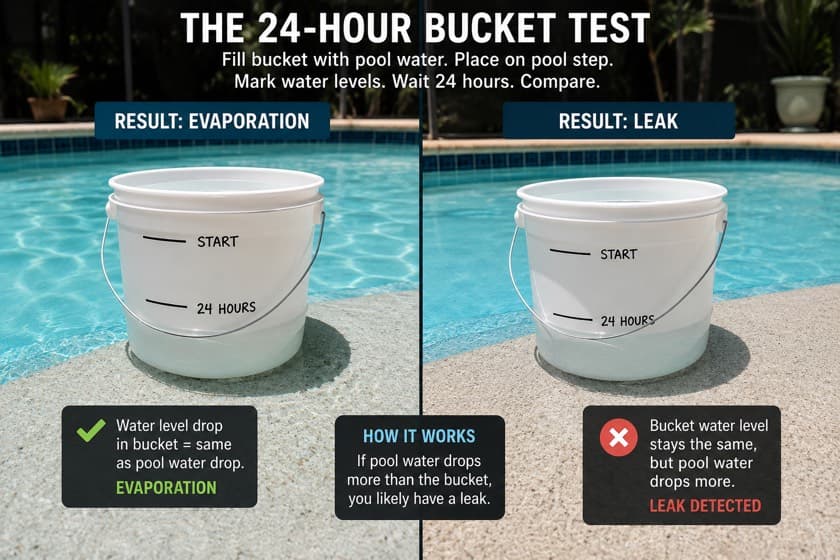
- 1Confirm it is actually a leak
A bucket on the step, filled to match the pool, both levels marked, 24 hours. If the pool drops more than the bucket, you have a leak. If they drop together, you have Florida — evaporation here runs roughly a quarter-inch a day in summer, more on a heated or screened pool. We will tell you to run this before we come out, because it costs you nothing and it is the difference between a service call and a shrug.
- 2Measure the loss rate
How fast it drops sizes the problem and sets urgency. Under an eighth of an inch a day is usually a shell or fitting seepage. A quarter to a half inch is a confirmed plumbing or skimmer-throat leak. An inch or more is significant — a broken main-drain line or a split at the pad — and it can undermine decking and crack plaster, so that one does not wait.
- 3Isolate the side: pump on versus pump off
Run the test again with the pump off and compare. Losing water only while the pump runs points to the pressure side, because the return plumbing is pressurized and any crack in it gets pushed open. Losing only with the pump off points to the suction side or the shell — suction lines sit under vacuum while the pump runs and draw air rather than push water, then drain by gravity once it stops. Losing both ways usually means the shell itself.
- 4Read the level where it stabilizes
A pool that drops and then stops has told you the elevation of the leak. Stopping at the skimmer mouth is a classic Florida skimmer-throat crack. Stopping at the light niche points at the niche conduit or gasket. This single observation eliminates most of the plumbing before we test any of it.
- 5Dye test the suspects and inspect the pad
With the pump off and the water still, dye at a crack or fitting draws in visibly if that is the path. We work the skimmer throats, returns, light niches, and main drain, and we walk the equipment pad — a weeping union, a failed shaft seal, or a leaking valve is a far more common answer than a broken underground line, and far cheaper.
- 6Pressure test the lines individually
If it is underground, the suction and return lines get isolated and pressure tested one at a time to find which line fails and where along it. This is what makes the difference between opening two feet of deck and opening twenty.
- 7Written finding, then a quoted repair
You get the location, the likely cause, and photos in writing. Repair work is performed by our trusted licensed partners, quoted before it begins and approved by you — we are not incentivised to find an expensive leak, which is the point.
Leak Detection — Common Questions
A detection visit runs $300–$600. The low end covers confirming the leak, isolating the side, dye testing the accessible suspects, and inspecting the equipment pad — which is where a large share of leaks turn out to be. The top of the range is where the leak is underground and the suction and return lines have to be isolated and pressure tested individually. We quote before we come out, and if the bucket test you run first shows evaporation rather than a leak, there is nothing to come out for.
Run the bucket test. Fill a bucket and set it on a pool step so the water inside sits at the same level as the pool. Mark both levels, turn the autofill off, and wait 24 hours. Both drop about the same amount, it is evaporation — South Florida loses roughly a quarter-inch a day in summer, and more on a heated pool or one under a screen enclosure. The pool drops noticeably more than the bucket, you have a leak. It costs nothing and it is the single most useful thing you can do before calling anyone.
That points to the pressure side — the return plumbing carrying water from the filter back to the pool. It is under pump pressure, so any crack in it gets actively pushed open while the system runs and seals up again when it stops. Common sources are a cracked return line under the deck, a leaking jet fitting, or a failure at the heater or filter outlet. The reverse case tells you the opposite: a pool that only loses water with the pump off is usually a suction-side or shell leak, since suction lines are under vacuum while the pump runs and only drain by gravity once it stops.
We do the detection ourselves. The repair is performed by our trusted licensed partners, quoted in writing and approved by you before any work starts — the same arrangement we use for all repair work, and the same reason: the trades that cut concrete and re-plumb underground lines should be the people licensed to do exactly that. It also means the person telling you how bad the leak is has no stake in how big the repair turns out to be.
Yes, and this is the one people miss for months. Most South Florida pools have an autofill valve plumbed to city water. If the pool is leaking and the autofill is replacing the loss in real time, the level never visibly drops — the leak shows up on your water bill instead. Shut the autofill off for the 24-hour bucket test. If the level falls once the autofill is not covering for it, that is your answer.
It can, and that is the reason not to sit on a fast one. Water escaping a broken line washes out the soil supporting the deck and the shell, which shows up later as settling cracks in the deck, separation at the coping, and stress cracks in the plaster — all of which cost multiples of the original repair. A slow seep at a fitting is not an emergency. An inch a day is, and it is worth a phone call the same week.
Why Homeowners Choose Florida's Best Pools
Want a number for your pool? Run yours through our pool service cost calculator.
Ready to get started?
Free on-site evaluation. Flat-rate pricing. Same-tech, same-day weekly service.