
I've been dosing chlorine on South Florida routes since the mid-1990s, and the question behind half the green pools I get called to is never “did you chlorinate?” It's “did you know what your chlorine was also doing?” Every product on the shelf is chlorine plus a passenger — calcium, stabilizer, or acid riding along with every dose. Run your numbers through the calculator, then read on, because the product you pick matters as much as the ounces.
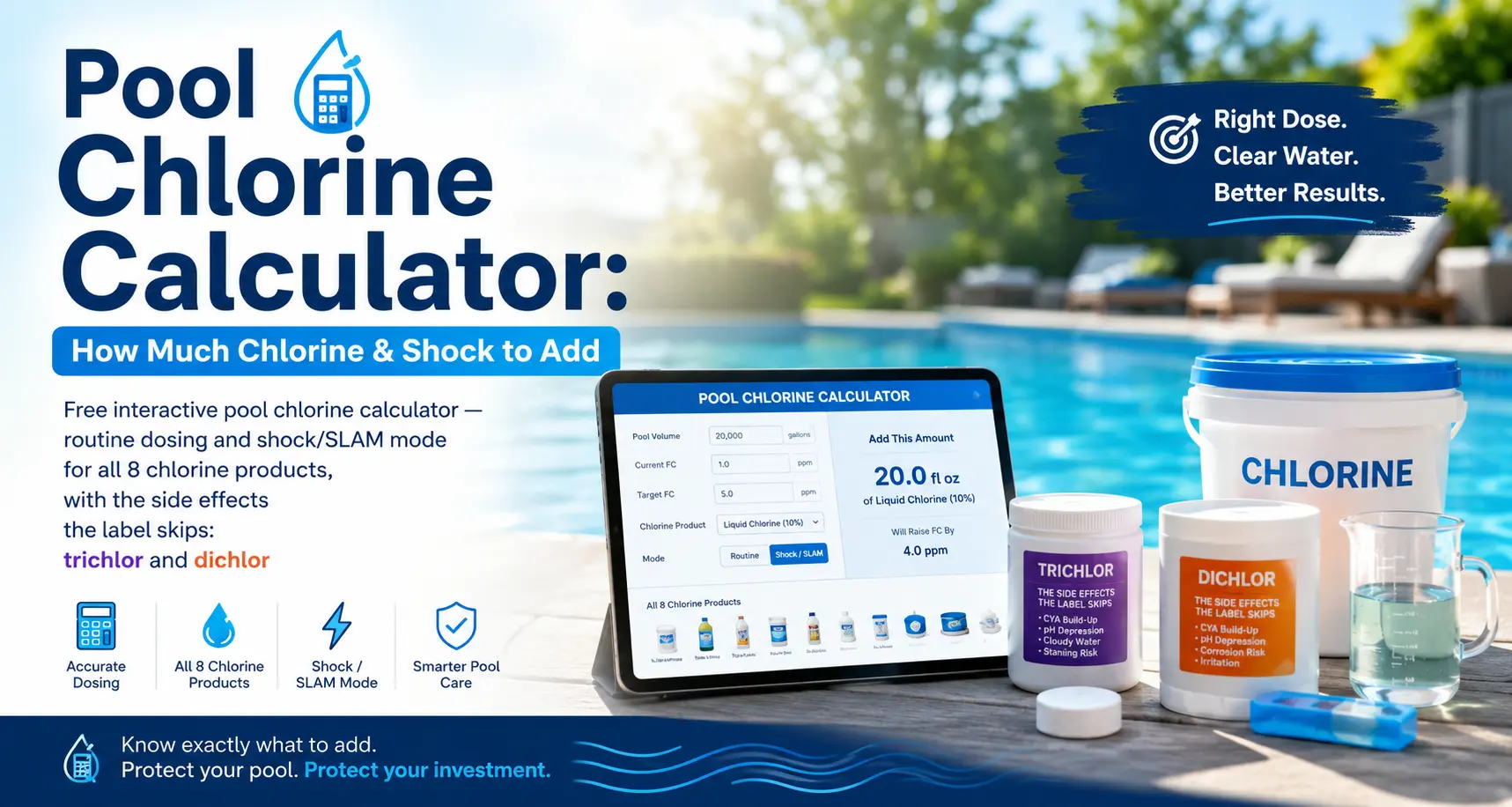
Pool chlorine calculator
Pick your product, enter your numbers — get the dose plus the side effects the label doesn't mention.
Add 30.6 fl oz
Raises free chlorine by 2 ppm in 15,000 gallons using liquid chlorine 12.5% (pool grade). Add in the evening (sunlight burns unstabilized chlorine), pump running, then retest.
Cheapest per ppm — what service routes use. Loses ~10% strength per month in Florida heat; buy fresh, store shaded.
Never mix chlorine products — trichlor + cal-hypo react violently. One product, one dose, water moving.
Liquid chlorine, tabs, cal-hypo: every product in one honest table
Same sanitizer, very different side effects. Dose figures are per 1 ppm of free chlorine per 10,000 gallons:
| Product | Dose per ppm / 10k gal | What it also adds | Best for |
|---|---|---|---|
| Liquid 12.5% (pool grade) | 10.2 fl oz | Nothing that matters | Routine dosing — cheapest per ppm; what routes use |
| Liquid 10% | 12.8 fl oz | Nothing that matters | Routine dosing |
| Liquid 8.25% (store jug) | 15.5 fl oz | Nothing that matters | Routine dosing, small pools |
| Bleach 6% | 21.3 fl oz | Nothing that matters | Emergencies — pricey per ppm |
| Cal-hypo 65% | 2.05 oz dry | +0.7 ppm calcium per ppm FC | Shock in soft-water pools |
| Cal-hypo 73% | 1.83 oz dry | +0.65 ppm calcium per ppm FC | Shock, commercial feeders |
| Dichlor 56% | 2.38 oz dry | +0.9 ppm CYA per ppm FC | New fills, spas — short-term only |
| Trichlor 90% (tabs) | 1.48 oz dry | +0.6 ppm CYA per ppm FC, drags pH down | Slow feed via floater — with eyes open |
Read the third column twice. Liquid chlorine adds chlorine and basically nothing else. Every dry product is chlorine plus a passenger — calcium or stabilizer — and the passengers accumulate.
What number are you actually aiming for?
| Situation | Target free chlorine |
|---|---|
| Normal week, chlorine pool | 1–4 ppm |
| Saltwater pool | 3–5 ppm (the cell maintains it — you top up) |
| Shock / SLAM (algae, post-party, post-storm) | 10–20 ppm |
| High CYA pool | Higher than you think — chlorine effectiveness scales with stabilizer; see our free vs. combined chlorine guide |
The math, out loud
One worked example so the calculator isn't a black box. Pool: 15,000 gallons. Test says 1 ppm free chlorine; you want 3. That's a 2 ppm rise. With 12.5% liquid: 10.2 fl oz × 2 ppm × 1.5 (because 15,000 is 1.5 × 10,000) = 30.6 fl oz — call it a quart. With store-shelf 8.25% bleach the same rise costs 46.5 fl oz, a third more volume for the same chlorine. That's why routes buy pool grade by the case.
The stabilized-chlorine trap (read this before buying tabs)
Trichlor tablets are seductive: cheap, slow-dissolving, set-and-forget in a floater. Here's the cascade nobody mentions at checkout. Every 10 ppm of chlorine your tabs deliver also banks ~6 ppm of CYA. CYA doesn't evaporate, doesn't get used up, doesn't leave. Six months of tab-only chlorination and your stabilizer is past 100 — at which point the same 3 ppm of free chlorine sanitizes a fraction of what it used to. Water looks fine, reads fine, and then one hot week it isn't. Pool goes green, and a green-pool recovery runs $400–$1,500. The tabs were never cheap.
Full story in our CYA creep deep-dive and the cyanuric acid technical reference. Short version: tabs are a tool, not a lifestyle.
Why the number has to be right — not just “some chlorine”
Free chlorine does two jobs at once: it sanitizes (kills bacteria and pathogens on contact) and it oxidizes (burns up sweat, sunscreen, leaves, and everything else swimmers bring in). Both jobs consume chlorine continuously — which is why the number is a balance, not a checkbox. Here's what each zone actually costs you:
| Free chlorine | What's happening in the water | What it costs you |
|---|---|---|
| 0 ppm | Nothing is being killed. Bacteria double in minutes in 85°F water; algae spores germinate. | A green pool in 24–72 summer hours — and water that can genuinely make swimmers sick. |
| Under 1 ppm | Sanitizer can't keep up with the kill demand. Combined chloramines build — that “chlorine smell” is actually spent chlorine, not excess. | Red eyes, the smell everyone blames on too much chlorine, algae getting a head start every afternoon. |
| 1–4 ppm | Both jobs covered with reserve. No meaningful irritation — properly balanced water feels like nothing. | This is the zone. Boring on purpose. |
| 10–20 ppm (shock) | Deliberate, temporary overdose to reach breakpoint and incinerate algae + chloramines. | Pool's closed to swimmers until it drifts back under ~5. That's the deal you signed. |
| Sustained 10+ ppm | Oxidizer starts working on things you own: swimsuits, vinyl, rubber seals, heat-exchanger metal. | Bleached liners, crispy o-rings, corroded heater cores — equipment money spent fixing enthusiasm. |
The myth worth killing: a pool that reeksof chlorine doesn't have too much — it almost always has too little. That smell is chloramines, the exhaust fumes of chlorine that already died fighting. The fix is more chlorine (a shock to breakpoint), not less. Pools at a proper 3 ppm smell like water.
And the safety floor is real. Chlorine at zero isn't a cosmetic problem — warm stagnant water grows things that put kids in the hospital. It's why public pools are required by law to hold a residual. Your backyard doesn't get an inspector, so the test kit is the inspector.
Shocking it right
Shock isn't a product, it's a dose — pushing free chlorine to 10–20 ppm to burn out algae and combined chlorine. Use the Shock/SLAM mode in the calculator above. Three rules from the route:
- Shock at dusk. The Florida sun eats unstabilized chlorine — in summer an unstabilized pool can burn through its chlorine in 4–6 hours. Evening dose gets a full night of contact time.
- Liquid for shock in most Florida pools. Cal-hypo works but loads calcium into water that's usually already hard here.
- Hold it there. One dose that decays overnight isn't a SLAM. Retest, re-dose, stay elevated until the water holds chlorine overnight. The chemistry behind that is in our how to shock a pool and breakpoint chlorination math guides.
What can go wrong (and does)
| Mistake | What happens | Instead |
|---|---|---|
| Mixing trichlor and cal-hypo | Violent reaction — fire/explosive gas | One product per dose, never share scoops or buckets |
| Tabs in the skimmer, pump off | Acid soup pools at your equipment and eats it | Floater or inline feeder only |
| Shocking at noon | Sun burns the dose before it finishes the job | Dose at dusk, pump running overnight |
| Dry chemical straight into the pool | Bleached plaster / crisped vinyl | Pre-dissolve cal-hypo in a bucket of pool water |
| Chasing an overshoot with chemicals | Money spent fixing patience | Sun burns excess FC in a day or two; thiosulfate only for big misses |
The margin math nobody shows you
Wholesale chemistry on a serviced chlorine pool runs $60–$90 a month. The same chemicals at retail run $90–$140 — a 30–60% markup before you've spent a Saturday hauling jugs. I'm not telling you DIY is wrong; plenty of owners do it well with a calculator like this one. I'm telling you the gap between doing it yourself and having a pro do it is smaller than the marketing on either side claims — and the full comparison is in our pool service cost calculator.
The 30-second checklist
- Test before you dose — free chlorine, not total.
- Liquid for routine and shock; dry products only when their passenger (calcium or CYA) is something your water actually needs.
- Dose at dusk, pump running.
- Never mix products. Ever.
- Salt pool? The cell is your doser — see our pool salt calculator instead.
- Watch CYA monthly if anything stabilized touches your water.
The low-risk first step
If your pool eats chlorine no matter what you add — or the test numbers don't make sense together — the cheapest move is a free on-site evaluation. We'll test your water on site, check your CYA before anything else, and tell you honestly what the water needs. Whether you hire us or not.
Florida's Best Pool Service is family-owned, CPO C-105377, fully insured, and runs weekly routes through Boca Raton, Delray Beach, Fort Lauderdale, Highland Beach, Boynton Beach, Pompano Beach, Coral Springs, Coconut Creek, Wellington, and the surrounding South Florida corridor. Your regular tech, same day every week, once your route is established. Built around 40+ years of combined founder experience between Matt Balog, Joe Ford, Ronald Liddell, and Doug Santiago.
Request a free evaluation or call 954-347-1120.
Watch: Chlorine Is Not Your Pool's Number One Problem
Florida sun can burn the chlorine out of an unprotected pool in a day. Why stabilizer, flow and consistency decide whether what you added does anything at all.
Frequently Asked Questions
With 12.5% pool-grade liquid, about 10.2 fl oz per 1 ppm per 10,000 gallons — so raising 15,000 gallons by 2 ppm takes ~31 fl oz (a quart). With 8.25% store bleach the same rise takes ~46 fl oz.
Shock means dosing to 10–20 ppm free chlorine, not a fixed number of bags — a 15,000-gallon pool at 0 ppm needs roughly 1.2–2.4 gallons of 12.5% liquid. Hold the level elevated (retest and re-dose) until the water holds chlorine overnight; one decaying dose isn't a SLAM.
For routine dosing, usually yes in Florida: liquid adds chlorine and nothing else, while every 10 ppm of chlorine from trichlor tablets also banks ~6 ppm of CYA stabilizer that never leaves the water. Tabs are fine as a managed supplement — not as the only source, season after season.
Dusk, with the pump running. Summer sun can burn through an unstabilized pool's chlorine in 4–6 hours, so an evening dose gets a full night of contact time before UV starts eating it.
Trichlor and cal-hypo — together they react violently (heat, fire, toxic gas). Never share scoops or buckets between dry chlorine products, and never add a new product through a feeder that held a different one.
Usually: wait. Sunlight burns excess free chlorine down within a day or two. For serious overshoots, sodium thiosulfate reduces FC at roughly 2.6 oz per ppm per 10,000 gallons (it also nudges pH down).
Counterintuitively, that smell means too little chlorine, not too much. It's chloramines — chlorine that already died fighting contaminants. The fix is shocking to breakpoint to burn them off; a properly sanitized pool at 3 ppm smells like water.
Need a pro to handle this?
Florida's Best Pool Service has serviced South Florida homes for 40+ years. CPO-licensed. Fully insured. 230+ five-star reviews.