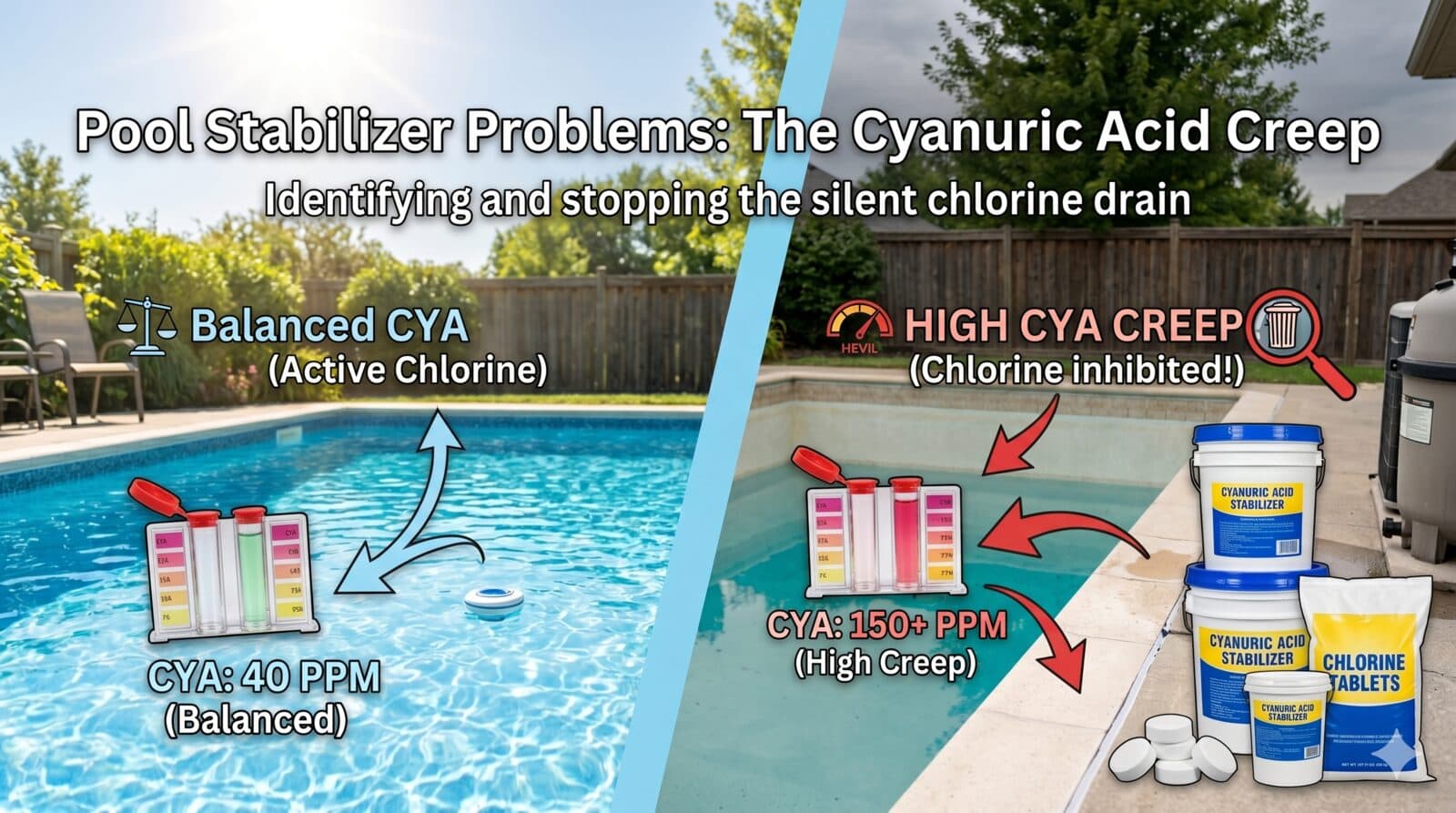
I've been a licensed Florida Swimming Pool Maintenance & Repair Contractor since 1989 — 37+ years on Florida pool decks, three decades running my own service company before I handed it to my son Matt in 2019, and these days the advisor and troubleshooter the Florida's Best Pools team calls when a pool stumps standard diagnostics. Cyanuric acid creep — CYA creep — is the single chemistry problem I've watched break more Florida pools, more quietly, over more years than anything else in this trade. It takes 18 to 36 months to build up, hides behind “normal” chlorine readings the whole time, and then breaks the pool all at once. About 15% of the summer green-pool emergency calls FBP's route team handles trace back to it — at pools whose owners swear they've been “keeping the chlorine up.”
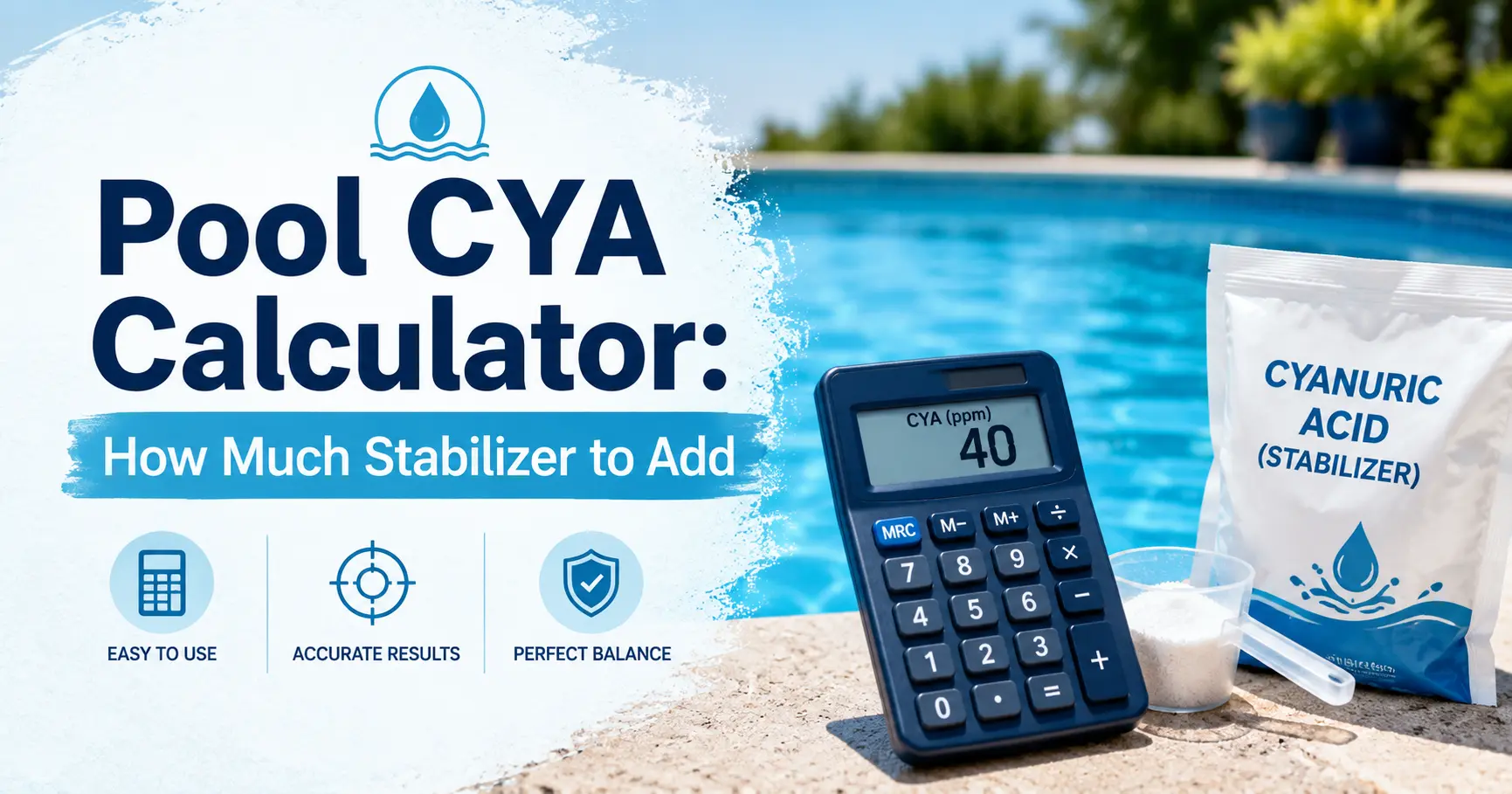
What CYA does, and why Florida needs it
Unstabilized free chlorine in direct Florida sun has a half-life of about 45 minutes. Without CYA, a fresh shock dose is gone in 4–6 hours and your pool runs at zero sanitizer all afternoon. CYA bonds reversibly to chlorine and shields it from UV photolysis — with 30–50 ppm CYA, chlorine residual lasts most of 24 hours. In a state where 8 hours of summer sun is the norm, CYA isn't optional. The problem is what happens when there's too much of it.
The creep math — why it's inevitable on tab feeders
A standard 3” trichlor tablet weighs about 8 ounces. By weight, trichlor is roughly 90% available chlorine and includes ~57% CYA by molecular structure of the chlorinated cyanurate. Every tab that dissolves releases both chlorine (consumed in seconds to days) and CYA (which stays in the water essentially forever unless physically removed). The arithmetic for a typical 15,000-gallon South Florida pool:
| Tabs used per week (summer) | CYA added per month | CYA in 12 months | CYA in 24 months |
|---|---|---|---|
| 2 tabs (light feeder) | ~6 ppm | ~72 ppm | ~144 ppm |
| 3 tabs (typical) | ~9 ppm | ~108 ppm | ~216 ppm |
| 4–5 tabs (heavy feeder, big pool, full sun) | ~12–15 ppm | ~144–180 ppm | ~288–360 ppm |
| Starting at 30 ppm CYA | You hit the 80 ppm lock threshold in 5–8 months on a typical feeder schedule | ||
Rain dilution helps a little. A full pool drained 25% by hurricane-level rain (rare) drops CYA proportionally. But normal Florida afternoon rain runs off the deck and barely changes pool volume. The mass balance is one-way: tabs add, dilution is the only escape.
The lock — what happens above 80 ppm CYA
CYA bonds chlorine reversibly. At 30–50 ppm CYA, the equilibrium leaves about 4% of your free chlorine as active hypochlorous acid (HOCl) — the form that actually kills algae and bacteria. At 80 ppm CYA, active HOCl drops to about 1.5%. At 120 ppm CYA, it's below 1%. Your test kit still reads FC 3–5 ppm because total chlorine is there — it's just chemically unavailable. The pool runs perpetually on the edge of bloom. One hot weekend with a heavy bather load and the algae population outpaces the locked chlorine in 48 hours.
This is why the FC:CYA ratio — not absolute FC — is the real chemistry target. The Trouble Free Pool community popularized the 7.5% rule: FC should be at least 7.5% of CYA. At 30 ppm CYA, target FC is 2–3 ppm. At 80 ppm CYA, target FC is 6 ppm and shock to 31 ppm. At 120 ppm CYA, you'd need to maintain FC 9 ppm and shock to 47 ppm. At that point you're burning through cal-hypo at twice the rate of a normal pool. It is cheaper to drain.
How to test CYA correctly (a strip is only a rough read)
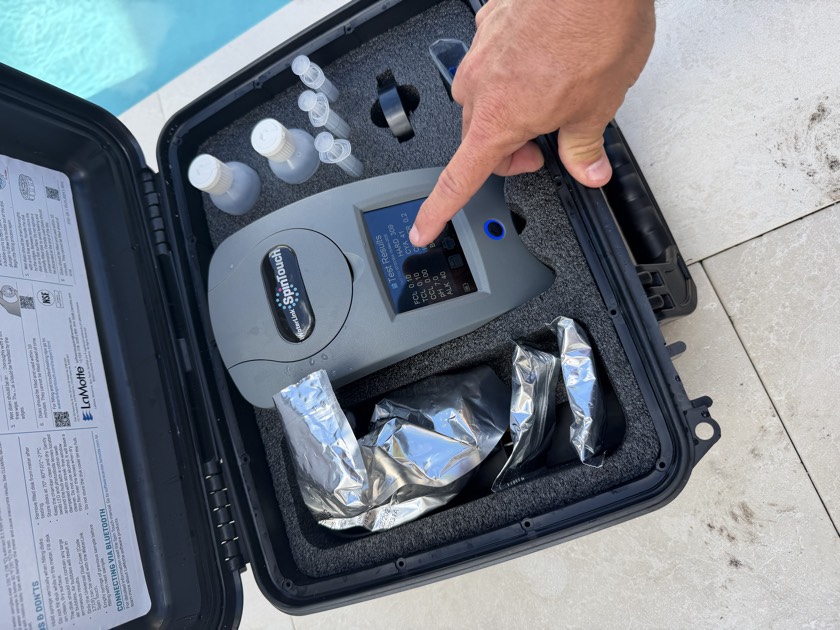
A test strip gives only a rough read on CYA, and a pool well past the lock threshold can still look “OK” on one. That's one of the biggest reasons CYA creep goes undiagnosed for years. For a reliable number, use a reagent-based turbidity test:
- Taylor K-2006 (~$80) — includes the CYA cylinder and reagent #13. Industry standard.
- LaMotte ColorQ Pro 7 or 11 — digital, $130–$220, also runs CYA.
- Pool store electronic kits — usually reliable on CYA if a name-brand spectrophotometer is used. Ask which kit and which reagent — not all pool stores test CYA on every panel.
For a full technical reference on CYA chemistry, lock math, and Florida-specific dosing, see our library article on cyanuric acid, the pool stabilizer that breaks pools quietly.
The route data: what the FBP team actually finds when they test
The Florida's Best Pools team started logging CYA on every new-client onboarding visit in 2024 — in part because I've been saying for years that this is the number nobody tests. Across 218 first-visit onboarding tests in 2024–2025 in the South Florida service corridor, the breakdown of CYA at intake:
| CYA reading at intake | % of new clients | What it told us about the prior service |
|---|---|---|
| 0–30 ppm (under-stabilized) | 9% | Salt pool with cell off, or recent drain/refill, or chlorine-burn-through pool the homeowner didn't know was un-CYA'd |
| 30–50 ppm (target) | 22% | Active maintenance, recent service change, or DIY-tracked |
| 50–80 ppm (borderline) | 31% | 12–18 months of tab use, prior service not testing CYA |
| 80–120 ppm (locked, intervention needed) | 26% | Classic 24–36 month tab-feeder pool, prior service not addressing |
| 120–200+ ppm (severe lock) | 12% | Tabs in skimmer for years, no testing, often coincides with the green-pool call |
Read that again: 38% of new clients showed up with CYA over 80 ppm.Their pools were running on the lock edge and they didn't know it. The pool store told them their FC was “fine” because the strip turned the right color.
CYA lock is one of the four root causes the FBP route team isolates as a green-pool driver — the chlorine-effectiveness vs. stabilizer-ratio datawe compiled quantifies why a “normal” FC reading on a high-CYA pool predicts a bloom inside 60 days.
The fix — partial drain and refill arithmetic
CYA cannot be neutralized chemically in a homeowner-practical way. Reverse osmosis filtration exists but isn't cost-effective for residential pools. The fix is dilution: drain a fraction of the water, refill with city water, and the new CYA reading is the old CYA times (1 minus the drain fraction).
| Starting CYA | Target after refill | Drain fraction needed | Approximate cost (15,000 gal pool) |
|---|---|---|---|
| 80 ppm | 40 ppm | 50% | $110–$220 water + $30–$60 rebalance |
| 120 ppm | 40 ppm | 67% | $140–$280 water + $40–$80 rebalance |
| 160 ppm | 40 ppm | 75% | $160–$330 water + $50–$100 rebalance |
| 200+ ppm | 40 ppm | 80%+ | $180–$400 water + $60–$120 rebalance — or full drain |
Florida pools should never be fully drained without a hydrostatic relief valve check — high water tables can lift an empty pool out of the ground. Partial drain (under the deepest skimmer mouth) is safe; full drain requires a pro who knows the geology. Hurricane drain-down is a different operation.
How to stop the creep from coming back
- Stop using trichlor tabs as your primary chlorine source. The single change that prevents creep entirely. Switch to liquid chlorine (sodium hypochlorite), cal-hypo, or a salt chlorine generator — none of which add CYA. Most weekly-service routes in our corridor are liquid-or-salt for exactly this reason.
- If you must use tabs (vacation feeders, etc.), stabilize separately and switch off tabs early. Add CYA directly to 30–40 ppm via a stabilizer product, then use tabs only as a low-rate booster. Stop tabs by month 9–12 and finish the year on liquid.
- Test CYA quarterly with a reagent kit. March, June, September, December. Quarterly catches creep at 60 ppm instead of 120 ppm — a much cheaper correction.
- Build dilution into the annual cycle. Hurricane season in South Florida occasionally drops pools 4–8” from heavy rain runoff or precautionary drawdown. A planned 25% drain-and-refill once a year in spring — before peak chlorine demand starts — takes CYA from 80 down to 60 and resets the runway.
- Salt pools still need quarterly CYA tests. Salt cells produce chlorine without CYA, but if you ever toss in a stabilizer puck or a stick of trichlor “just to be safe,” you've introduced creep into a system that has no dilution mechanism. Test anyway.
Want a number for your specific pool?
Run yours through our pool service cost calculator— it asks size, salt vs chlorine, spa, screen, and coastal proximity, and returns the band a fair 2026 quote should land in. Weekly clients get a quarterly stabilizer (CYA) test, included — that's the prevention layer.
The low-risk first step
If you haven't tested CYA in 12+ months and you're running tabs in a skimmer or floater, the lowest-risk first step is a free on-site water testfrom the Florida's Best Pools team. They'll test your water on site, tell you where your CYA sits, and quote the drain-and-refill if it's past the lock threshold. Whether you hire them or not.
Florida's Best Pools is family-owned, CPO C-105377, fully insured, and runs weekly routes through Boca Raton, Delray Beach, Fort Lauderdale, Highland Beach, Boynton Beach, Pompano Beach, Coral Springs, Coconut Creek, Wellington, and the surrounding South Florida service corridor. Same tech every visit (once your route is established). Photo-documented service reports on request. Month-to-month — no long-term lock-in. Built around 40+ years of combined founder experience between Matt Balog, Joe Ford, Ronald Liddell, and Doug Santiago — with the family pool-service lineage tracing back to my Florida pool contractor license from 1989.
Request a free CYA test or call 954-347-1120.
Frequently Asked Questions
CYA (stabilizer) protects chlorine from Florida UV — essential, but trichlor tablets leave it behind every dissolve; Accumulates 5–10 ppm/month from typical tab feeders — drifts from target 30–50 ppm to chlorine-locking 80–150 ppm in 18–36 months; Above 80 ppm, chlorine is chemically "locked" — present on test, not active; Only fix: drain and refill 25–50%, then switch to liquid chlorine or salt; Cost: $80–$200 DIY or $200–$400 pro — vs. $400–$1,500 for the green-pool recovery you'll otherwise need; Test CYA quarterly with a reagent kit — a test strip gives only a rough read.
Cyanuric acid (CYA), also called pool stabilizer or conditioner, is a chemical that bonds reversibly to free chlorine and shields it from UV photolysis. Without CYA, unstabilized free chlorine in direct Florida sun has a half-life of about 45 minutes — a fresh shock dose is gone in 4–6 hours, leaving the pool at zero sanitizer all afternoon. With 30–50 ppm CYA, chlorine residual lasts most of 24 hours. In Florida's intense sun, CYA isn't optional — but it's a double-edged tool, because too much of it locks chlorine into a chemically inactive state.
A 3-inch trichlor tablet is roughly 90% available chlorine and contains about 57% CYA by molecular structure. Every tab that dissolves releases both — chlorine is consumed in days, but CYA stays in the water indefinitely unless physically removed by dilution. For a typical 15,000-gallon South Florida pool: 2 tabs/week (light feeder) adds about 6 ppm CYA per month; 3 tabs/week (typical) adds about 9 ppm/month; 4–5 tabs (heavy feeder in summer) adds 12–15 ppm/month. Starting at 30 ppm CYA, a typical tab-feeder pool hits the 80 ppm chlorine-lock threshold in 5–8 months and can reach 150+ ppm in 18–24 months.
Above approximately 80 ppm CYA, chlorine becomes chemically 'locked' — present on the test but not active. At 30–50 ppm CYA, roughly 4% of free chlorine exists as active hypochlorous acid (HOCl), the form that kills algae and bacteria. At 80 ppm CYA, active HOCl drops to about 1.5%. At 120 ppm, below 1%. Your test kit still reads FC 3–5 ppm because total chlorine is present — it just can't sanitize. The pool runs perpetually on the edge of an algae bloom, and one hot weekend with heavy bather load can tip it green within 48 hours. This is the main cause of summer green-pool calls at homes where the owner swears they've been 'keeping chlorine up.'
Only roughly. A test strip gives a rough read on CYA, and a pool well past the lock threshold can still look 'OK' on one — one of the biggest reasons CYA creep goes undiagnosed for years. For an accurate reading, use a reagent-based turbidity test — the Taylor K-2006 kit (~$80) with reagent #13 is the industry standard, or a LaMotte ColorQ Pro 7 or 11 ($130–$220). Many pool stores can run an accurate CYA reading on an electronic spectrophotometer if you ask specifically — not all panels include CYA by default. Test quarterly: March, June, September, and December.
CYA cannot be neutralized chemically in a homeowner-practical way. Reverse osmosis filtration exists for commercial pool reclamation but isn't cost-effective for residential. The fix is dilution: partial drain and refill. The arithmetic is straightforward — new CYA equals old CYA times (1 minus drain fraction). To take a 15,000-gallon pool from 80 ppm down to 40 ppm requires a 50% drain and refill ($110–$220 in water plus $30–$60 in rebalance chemicals). From 120 ppm to 40 ppm requires 67% drain. Florida pools should never be fully drained without a hydrostatic relief valve check — high water tables can lift an empty pool out of the ground. Partial drain (below the skimmer mouth) is safe.
For year-round primary sanitization in a South Florida pool, yes — switch to liquid chlorine (sodium hypochlorite), cal-hypo, or a salt chlorine generator, none of which add CYA to the water. Tab feeders are convenient but cause CYA creep that costs you a $200–$400 drain-and-refill every 18–24 months. Most weekly-service routes in our corridor have moved to liquid or salt for exactly this reason. If you still want to use tabs for vacation feeders or short-term boosters, stabilize the pool to 30–40 ppm CYA separately (via a direct stabilizer product), then use tabs only for 6–9 months and finish the year on liquid chlorine.
The Trouble Free Pool community popularized the 7.5% rule: maintained free chlorine should be at least 7.5% of CYA, and shock-level free chlorine should be about 40% of CYA. At 30 ppm CYA, that's maintenance FC of 2.3 ppm and shock FC of 12 ppm — a normal pool. At 80 ppm CYA, you need maintenance FC of 6 ppm and shock to 31 ppm. At 120 ppm CYA, maintenance FC 9 ppm and shock to 47 ppm. The math shows why high-CYA pools are not just 'inconvenient' — they require burning through cal-hypo at two to three times the rate of a normal pool to keep up. Cheaper to drain and refill once than to fight the lock all summer.
Salt pools don't have the same accumulation problem because salt cells generate chlorine without adding CYA. However, salt pools still need 30–50 ppm CYA to protect the chlorine from UV — owners stabilize once at startup or after a fresh-fill refill, then the level stays roughly constant for years (small drift from rain dilution and refill events). The creep problem appears in salt pools only when an owner adds trichlor tabs or chlorinated cyanurate stabilizer products 'just to boost' the pool — that introduces CYA without any dilution mechanism. We still test CYA quarterly on salt-pool routes for this reason.
For a typical 15,000-gallon pool in 2026: a 50% partial drain and refill costs $110–$220 in city water at current rates (depending on county and tier pricing) plus $30–$60 in rebalance chemicals (chlorine, alkalinity, calcium). A 67% drain runs $140–$280 in water plus $40–$80 in chemicals. As a pro one-time service call (drain, vacuum, refill management, rebalance) it's $200–$400. For weekly-route clients in our corridor, annual planned partial drain-and-refill is included in the flat monthly rate as part of CYA management. The math against the alternative: $200–$400 once a year vs. $400–$1,500 for a summer green-pool recovery you wouldn't have needed.
Quarterly at a minimum: March, June, September, and December. CYA drift is slow but monotonic — if you only test annually, you can miss the 60-to-90 ppm jump that sets up a green-pool emergency. Quarterly testing catches creep at 60 ppm (still manageable with a 25% drain) before it reaches 100+ ppm (requires 60%+ drain). Test more often if: you're using trichlor tabs as primary sanitizer, you just changed pool services, you bought the house in the last 12 months and don't know the prior owner's chemistry history, or you've recently had a green-pool recovery. Use a reagent kit for a reliable number — a strip is only a rough read on CYA.
Need a pro to handle this?
Florida's Best Pools has serviced South Florida homes for 40+ years. CPO-licensed. Fully insured. 230+ five-star reviews.