
CYA is sunscreen for your chlorine — and like sunscreen, the right amount is protective and triple the right amount is a problem you wear all season. I've tested thousands of South Florida pools since the mid-1990s, and stabilizer is the reading owners get wrong in bothdirections. Run your numbers below, then I'll show you why both mistakes cost real money.
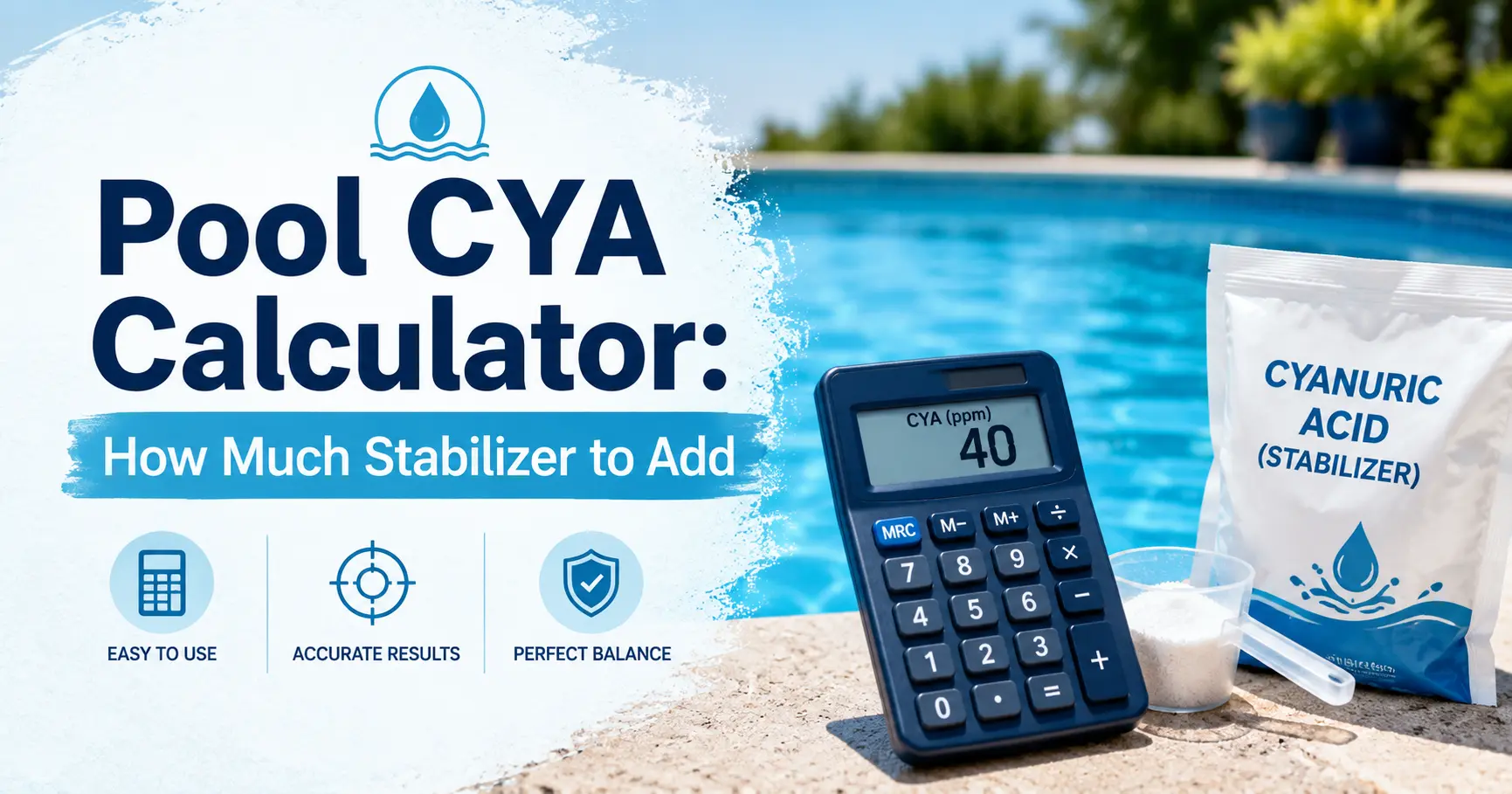
Pool CYA / stabilizer calculator
Enter pool size, current CYA, and pool type. Math: 1 lb per 10,000 gallons raises CYA 12 ppm.
From a turbidity (black-dot) test — strips read CYA poorly.
Add ≈ 2.5 lbs of cyanuric acid
Raises CYA by 20 ppm in 15,000 gallons. Use the sock method: granules in an old sock, hung in front of a return jet — CYA dissolves slowly (up to a week) and dumping it loose etches plaster. Don't retest for 3–7 days.
Higher CYA needs higher free chlorine to sanitize the same water — don't chase a big number. More stabilizer is not more protection.
What stabilizer actually does
Cyanuric acid bonds loosely with chlorine and shields it from UV. The difference isn't subtle: in summer sun, an unstabilizedpool can burn through its entire chlorine residual in 4–6 hours. With CYA in the 30–50 band, that same chlorine survives the day. No stabilizer means you're pouring chlorine into a UV incinerator; too much means the chlorine that survives is too “wrapped up” to sanitize aggressively.
Targets by pool type
| Pool | CYA target | Why |
|---|---|---|
| Outdoor chlorine pool | 30–50 ppm (aim 40) | Full UV protection without handcuffing the chlorine |
| Saltwater pool | 60–80 ppm (aim 70) | Cells make chlorine slowly all day — it needs longer UV survival; check your cell manual |
| Indoor / screened & shaded | 0–30 ppm | Less UV, less need |
| Any pool | Never “more is better” | Higher CYA demands proportionally higher free chlorine to sanitize at all |
The dose, pre-computed
Pounds of cyanuric acid (granular, 100%) to raise CYA:
| Raise by | 10,000 gal | 15,000 gal | 20,000 gal | 25,000 gal |
|---|---|---|---|---|
| +10 ppm | 0.8 lbs | 1.3 lbs | 1.7 lbs | 2.1 lbs |
| +20 ppm | 1.7 lbs | 2.5 lbs | 3.3 lbs | 4.2 lbs |
| +40 ppm (fresh fill) | 3.3 lbs | 5 lbs | 6.7 lbs | 8.3 lbs |
Note how small these numbers are next to a salt dose. Stabilizer is potent — which is exactly why a season of trichlor tabs quietly wrecks the balance.
How to add it: the sock method
- Test CYA first with a turbidity (black-dot) test — strips guess.
- Weigh out the dose from the calculator above. Round down — you can add more; you can only drain out an overdose.
- Pour granules into an old sock or stocking, tie it off.
- Hang it in front of a return jet (or in the skimmer basket only if you'll babysit the pump).
- Squeeze it every few hours if you're impatient. Full dissolution takes up to a week.
- Don't retest for 3–7 days — early readings under-report and bait you into double-dosing.
The creep: how pools end up at 150 ppm
Nobody pours five pounds of stabilizer in by accident. It arrives a gram at a time: every 10 ppm of free chlorine from trichlor tabs banks ~6 ppm of CYA; from dichlor, ~9. Tab floater runs all season → CYA passes 100 → the chlorine that reads “fine” on your strip is mostly handcuffed → one hot week and the pool flips green anyway. Then somebody sells you an algaecide when the actual fix is water. We wrote the full South Florida version of this story in the CYA creep deep-dive; the chemistry reference lives in our cyanuric acid guide and long-term stabilization.
Too high? The only fix is a hose
CYA cannot be chemically destroyed in any practical way — dilution is the whole toolbox. Drain fraction = 1 − (target ÷ current):
| Current CYA | Target 40 | Water out of a 15,000-gal pool |
|---|---|---|
| 60 ppm | Drain ~33% | ~5,000 gallons |
| 80 ppm | Drain 50% | ~7,500 gallons |
| 100 ppm | Drain 60% | ~9,000 gallons |
| 150 ppm | Drain ~73% | ~11,000 gallons |
That last row is a season of tabs, priced in water. In coastal South Florida, drain partial and slow — high water tables can float a shell.
Why the window is so narrow
CYA is the only number in pool chemistry where both directions fail toward the same outcome — a pool that won't hold sanitizer performance — for opposite reasons. The mechanism: chlorine bound to CYA is protected from sunlight, but bound chlorine is also slower to kill. Your free-chlorine reading counts both the fast killers and the handcuffed ones. So:
| CYA level | What's happening | What it costs you |
|---|---|---|
| 0 ppm | Every ray of UV hits naked chlorine. In summer the whole residual burns off in 4–6 hours. | You're buying chlorine for the sun, not the pool — and the pool is unprotected by mid-afternoon. |
| 10–20 ppm | Partial protection. Chlorine survives the morning, dies by evening. | Constant top-ups; chemistry that never feels stable. |
| 30–50 ppm | Full UV protection; chlorine stays mostly active and available. | Nothing. This is the zone — chlorine lasts the day and still kills fast. |
| 80–100 ppm | Most of your chlorine reading is handcuffed. The test says 3 ppm; the water behaves like a fraction of that. | Algae that “shouldn't” be possible, shock doses that underperform, money spent on chlorine that can't work. |
| 150+ ppm | Sanitizer effectively locked. Some test strips can't even read this high — they cap out and lie to you. | Chronic green, swimmer-safety risk hiding behind a “fine” chlorine reading, and a ~73% drain to fix it. |
That last column is why “the chlorine reads fine” is the most dangerous sentence in pool care. A 3 ppm reading at 40 CYA and a 3 ppm reading at 150 CYA are two different pools — one is sanitized, one is wearing a costume. The higher your stabilizer, the higher your free chlorine has to run to do the same job; the ratio math is in the creep deep-dive.
Reading the symptoms
| Symptom | CYA too low | CYA too high |
|---|---|---|
| Chlorine reading day to day | Vanishes by evening | Looks stable but pool still struggles |
| Chlorine spend | Climbing — you're feeding the sun | Normal, yet algae anyway |
| Algae pattern | After sunny stretches | Chronic, shrugs off “shock” |
| Fix | Add CYA (calculator above) | Drain math (table above) |
The 30-second checklist
- Test CYA monthly — turbidity test, not strips.
- Chlorine pool 30–50; salt pool 60–80; never “more for the summer.”
- Sock method, round down, wait a week before retesting.
- Using tabs? You're adding CYA every week whether you meant to or not — pair this with our pool chlorine calculator and watch the warning it gives you.
- Over ~80 on a chlorine pool? Start the drain math before it's 150.
The low-risk first step
If your chlorine disappears by dinnertime — or holds steady while the pool turns anyway — the cheapest move is a free on-site evaluation. We'll test your CYA on site and tell you honestly whether your pool needs stabilizer, fresh water, or neither. Whether you hire us or not.
Florida's Best Pool Service is family-owned, CPO C-105377, fully insured, and runs weekly routes through Boca Raton, Delray Beach, Fort Lauderdale, Highland Beach, Boynton Beach, Pompano Beach, Coral Springs, Coconut Creek, Wellington, and the surrounding South Florida corridor. Your regular tech, same day every week, once your route is established. Built around 40+ years of combined founder experience between Matt Balog, Joe Ford, Ronald Liddell, and Doug Santiago.
Request a free evaluation or call 954-347-1120.
Frequently Asked Questions
1 lb per 10,000 gallons raises CYA 12 ppm, so a 15,000-gallon pool needs about 1.3 lbs per 10 ppm of rise. A fresh fill targeting 40 ppm takes roughly 5 lbs.
30–50 ppm for an outdoor chlorine pool (aim 40), 60–80 for saltwater pools (aim 70 — confirm in your cell's manual), 0–30 for indoor or heavily shaded pools. More is not better: higher CYA requires proportionally more free chlorine to sanitize the same water.
Dilution only — cyanuric acid cannot be chemically removed in any practical way. Drain fraction = 1 − (target ÷ current): going from 80 to 40 ppm means replacing half the water. In coastal South Florida, drain partial and slow; high water tables can float a shell.
Usually low or zero CYA. In summer sun an unstabilized pool can burn through its entire chlorine residual in 4–6 hours. Test CYA with a turbidity test and bring it to the 30–50 band before blaming the chlorine.
Barely. It doesn't evaporate or get consumed — it leaves only with water (splash-out, backwash, rain overflow, intentional draining). That's why tablet-fed pools creep upward all season.
Granular CYA in an old sock or stocking, hung in front of a return jet. It dissolves slowly — up to a week — without etching plaster the way loose granules can. Round the dose down and don't retest for 3–7 days; early readings under-report.
Need a pro to handle this?
Florida's Best Pool Service has serviced South Florida homes for 40+ years. CPO-licensed. Fully insured. 230+ five-star reviews.