Coral Springs Pool Service, Routed by Water District
Your regular tech weekly — no contracts.
- Service
- Weekly pool service in Coral Springs, FL — your regular tech, same day every week
- Phone
- 954-347-1120
- Base
- Licensed pool service company based in Boca Raton, serving Coral Springs and South Florida
- Service area
- Coral Springs (ZIP 33065, 33067, 33071, 33073, 33076) · Broward County, FL
- Water providers
- Four inside the city line — City of Coral Springs, CSID, NSID, and Royal Water Works
- Neighborhoods
- Eagle Trace, Heron Bay, Coral Springs Country Club, The Pines, Whispering Woods, Forest Hills
- Local note
- All four providers switch to free chlorine together each year — July 13 to 27 in 2026
- Contracts
- No long-term contracts — month to month
- Rating
- 5.0 stars across 230+ Google reviews
- Experience
- 40+ years combined founder experience · 10,000+ pools serviced
- Licenses
- CPO C-105377 + FPPS 600551
Your street address decides your water chemistry
Most cities have one water utility. Coral Springs has four, and the city publishes the map itself — Public Works color-codes the service territories by district. Blue is the North Springs Improvement District, at 9700 NW 52 Street. Yellow is Royal Water Works, at 8900 NW 44 Court. Green is the Coral Springs Improvement District, at 10300 NW 11th Manor. Pink is the City of Coral Springs' own utility. Four providers, four sets of pipes, one set of city-limit signs.
This is not a paperwork distinction. Every one of the four is a self-supplied groundwater system — EPA's federal drinking-water database lists all four with groundwater as the primary source, none of them buying finished water from a neighbor. Each pulls its own raw water out of the Biscayne Aquifer and treats it in its own plant, to its own process. That means “Coral Springs tap water” is not one product. It is four.
The scale is real on all four, not just the big one. The City's system serves roughly 65,000 people. CSID serves about 40,000. NSID serves a little over 37,000. Royal Water Works is the small one at about 4,500 people across 1,384 service connections, and it is a privately owned system, which is why most residents on it have never heard of it until they read their own bill.
So when a pool company tells you what Coral Springs water does to pools, ask which Coral Springs. The honest answer starts with your utility bill.
The four providers and what each one does to the water
These descriptions come from the utilities' own published water quality reports and supply plans, not from a summary of them. Read the one that applies to you and skip the rest — that is the whole point of this page.
City of Coral Springs — conventional lime softening
The City's 2025 water quality report describes 18 production wells drilled as deep as 145 feet into the Biscayne Aquifer, with the raw water then put through a conventional lime softening process that, in the report's words, removes or lowers dissolved minerals and other impurities such as iron, hardness and organics. Its combined chlorine-and-chloramines row reads 2.7 ppm across a range of 0.8 to 3.6, and sodium tested at 30.6 ppm — the highest sodium of the systems that publish it. Local news reported in January 2026 that the roughly 58-year-old plant is slated for a nanofiltration conversion, about $150 million, construction from 2027 to 2029, with around three new raw water wells added to the existing 18 and PFAS cited as the driver. That is a news report, not a city document, so treat the timeline as reported rather than final — but if you are on the City system, your fill water is likely to change during the life of your current pool surface.
CSID — low-pressure reverse osmosis, then blended back
The Coral Springs Improvement District has run low-pressure reverse osmosis for over ten years across 11 wells, using cross-linked, fully aromatic, polyamide composite membranes behind 50-micron sand strainers and 5-micron cartridge filters, at roughly 100 psi, rejecting down to 0.0005 micron. It produces about 6.75 million gallons a day of permeate against a 7.4 MGD permit. Then comes the sentence that matters for your pool, straight out of CSID's own report: they bypass 10 to 15 percent of the water to blend with the permeate to raise the alkalinity and hardness to desirable drinking water standards. RO water on its own is aggressive; CSID is deliberately adding some of it back. Its chloramines row reads 2.9 ppm across 1.5 to 3.3, and sodium 13.6 ppm — less than half the City's.
NSID — lime softening and nanofiltration in parallel
The North Springs Improvement District's own supply plan documents nine raw water production wells drawing about 7.16 million gallons a day from the Biscayne, three lime-softening up-flow clarifiers totaling 6.8 MGD, and a nanofiltration plant placed into service in the last quarter of 2017. Disinfection is chloramination using ammonium sulfate and sodium hypochlorite — NSID states that outright. In April 2019 the district began drilling a 2.0 MGD alternative supply well into the Floridan Aquifer. Two treatment trains running side by side is not a common arrangement, and it is a good reason not to assume a single fixed profile for NSID fill water either.
Royal Water Works — the one nobody publishes
Royal Water Works appears on the city's own district map at 8900 NW 44 Court, and federal records confirm it serves 4,481 people across 1,384 connections in Coral Springs from its own groundwater. What we could not find is its treatment process. It does not publish one we could locate, and we are not going to invent it. If you are on Royal, we test your fill water at the hose rather than working from a document — which, frankly, is the correct approach on any of the four, and the only available one here.
Working out which one you are on
Nobody needs to become an expert on this. You need to answer one question once, and then it stops being a mystery for as long as you own the house.
Look at who bills you for water, not at the city on the envelope. A Coral Springs mailing address tells you nothing about which of the four utilities actually treats your water — the improvement districts bill separately and predate a lot of the neighborhoods they serve.
Find your community on the city's Public Works water districts map. It is color-coded by provider, and it is the only authority we will point you to for boundaries. We will not guess your district from your street name and neither should anybody quoting you.
If you are in NSID territory, know that your irrigation water and your pool fill water may be two entirely different products. Under a 2017 settlement, NSID buys up to 3 million gallons a day of reclaimed water from Broward County and resells it for irrigation to roughly 3,500 homes and common areas. Reclaimed water is not what should be going in your pool, and a mis-set hose bib is a problem worth catching before it becomes a chemistry mystery.
Mark mid-July on the calendar. The City announced that from July 13 through July 27, 2026, the City of Coral Springs, Royal Water Works, CSID and NSID would all temporarily change their chlorinating method to free chlorine at the same time. All four. Simultaneously.
Expect hydrant flushing in that same window, and expect your fill water to behave like a different product for those two weeks. Combined-chlorine readings move, demand shifts, and nothing you did explains it. It is temporary and it is harmless — but it gets misdiagnosed as a failing chlorinator by anyone who does not know the schedule.
Once you know your provider, tell whoever services your pool. It should change what they test for and what they expect. If it does not change anything for them, that is worth knowing too.
Why this shows up first at the salt cell
A salt chlorine generator is an electrolysis cell with water running through it, and it scales according to what is in that water. In Coral Springs the input differs by district by design. One utility softens with lime. One strips nearly everything out with membranes and then blends raw bypass back in specifically to raise alkalinity and hardness. A third runs lime softening and nanofiltration in parallel. Those are not small differences in a component whose whole job is passing current through dissolved minerals.
That is why a cell that lasted eight years at one address gives up at five a mile away, with the same brand, the same pool size, and the same owner habits. It is also why we test and inspect rather than replacing parts on a schedule. A cell that has lost output because it is scaled is a cleaning. A cell that has lost output because the plates are eroded is a replacement. Those look identical on a control panel and cost very different amounts.
Now the part most companies will not say out loud: nobody publishes a hardness number for Coral Springs. We went looking. The City's 2025 report mentions hardness only in the narrative sentence about what lime softening lowers. CSID's report mentions it only in the bypass-and-blend sentence. Neither has a hardness row in its table, in mg/L or in grains. Every specific Coral Springs hardness figure in circulation traces back to a water-softener retailer's marketing page. We are not going to repeat one of those to you and then bill you against it.
What we will tell you is the direction, because that much is sourced: all three treatment technologies in this city are reducing hardness, and one of the four utilities is deliberately putting some back. Which means your pool's calcium is a number to measure at your own hose and manage on purpose — not one to assume from a city name. That is the difference between managing calcium hardness and guessing at it, and it is why we acid-clean cells on evidence rather than on a calendar.
The credentials are easy to check — CPO C-105377, FPPS #600551, 230+ Google reviews at 5.0 stars. The part that decides whether your equipment lasts is narrower than any of that: does the person at your pad know which of four utilities filled your pool?
The other Coral Springs rulebook
Coral Springs was planned around aesthetic standards from the start, and some of that is still written down. Here is what actually applies — stated narrowly, because the version people repeat to each other is usually broader than the rule.
The city publishes a restricted exterior paint palette. Off the list: blue in all shades or any color with a blue undertone, red, orange, purple, black, certain green shades, and anything too dark, deep or bright.
Paint applications are not required for single-family homes. Going outside the palette anyway is what risks a code citation. Applications are required for commercial and multifamily property.
The city's own instruction is to check with your HOA as well, and in a city this heavily associated that is usually the tighter constraint of the two.
That palette governs house paint. We have seen it cited at homeowners as though it covered screen cages, deck coatings and equipment pads. It does not say that, and we are not going to tell you it does — ask your HOA about those instead.
Six drainage districts operate here: CSID, NSID, Pine Tree Water Control District, Sunshine Water Control District, the Turtle Run District, and the privately run Crossings HOA district.
District approval is required for all fences, residential and commercial, bordering a waterway — the city's wording is approval or a letter of no objection. It is also required for all commercial new construction and alteration projects prior to building permit issuance.
That is the extent of it. A residential deck job, a resurface, or an equipment swap on a canal lot does not automatically require district sign-off unless a fence is involved. Anyone telling you otherwise is either guessing or padding.
A city in the country, fully built out
Coral Springs was chartered on July 10, 1963, on land Coral Ridge Properties bought from the Lions family — a green bean farm and a cattle field. James Hunt and Charles Taravella ran the development, and they called for strict city code to maintain aesthetics, homes on ample lots, and public buildings in a brick colonial style. That instinct is still visible on the paint palette sixty years later.
The first thing they built was the Covered Bridge at 4544 NW 95th Avenue. Forty feet of single steel span, designed by George Hodapp and built by Lewie Mullins, George Porter and other Coral Ridge Properties employees in 1964 — the first structure built in the city, and still the only covered bridge in Florida sitting in a public right-of-way. The eye wall of Hurricane Cleo passed over it in August 1964 and left it relatively undamaged. The city says the bridge demonstrated the future style of what would become, in its own phrase, A City in the Country. Johnny Carson hosted the land sale barbecue there in 1965. Westinghouse bought Coral Ridge Properties the following year.
Mullins turns up more than once in that story: he was Coral Ridge Properties' vice president and the city's first elected mayor, he built the bridge, he established the Museum of Coral Springs History, and Mullins Park at 10000 Ben Geiger Drive carries his name. The city's first park, Lions Park, was dedicated June 6, 1970. The Sawgrass Expressway arrived in 1986 and brought another wave of growth with it.
What that history leaves behind is a housing stock with a shape. About 47,300 housing units, roughly three-quarters of them built between 1970 and 1999 — those are one-year Census survey estimates, so round them and don't bet a decision on the last digit. The city's own description of itself today is fully built-out, across roughly 24 square miles.
For a pool, that concentration matters. A city that built most of itself inside a thirty-year window has most of its pools aging on the same clock — shells on their second or third surface, pads on their second or third generation of equipment, and a lot of them coming due at once rather than spread across the decades. It is the reason acid wash and cell replacement are the two things this city calls us for most, and the reason we would rather tell you a surface has another decade in it than sell you a resurface you don't need yet.
Coral Springs pool services
The two jobs this city asks for most, plus the neighboring routes we run the same week:
- Salt cell replacement in Coral Springs →Output diagnostic first, because a scaled cell and a spent cell read the same on the panel. Right-sized to your gallons, quoted in writing, output verified after install.
- Pool acid wash and drain service in Coral Springs →Drain, wash, refill and a real startup protocol — for a surface that has gone past what chemistry can fix. We will tell you honestly if yours isn't there yet.
- Pool service in Coconut Creek →Directly east across the city line, and a different utility picture again.
- Pool service in Margate →Older Broward housing stock and equipment reaching end of life together.
- Pool service in Pompano Beach →The coastal end of the same weekly route.
Trusted by HomeownersIn Coral Springs
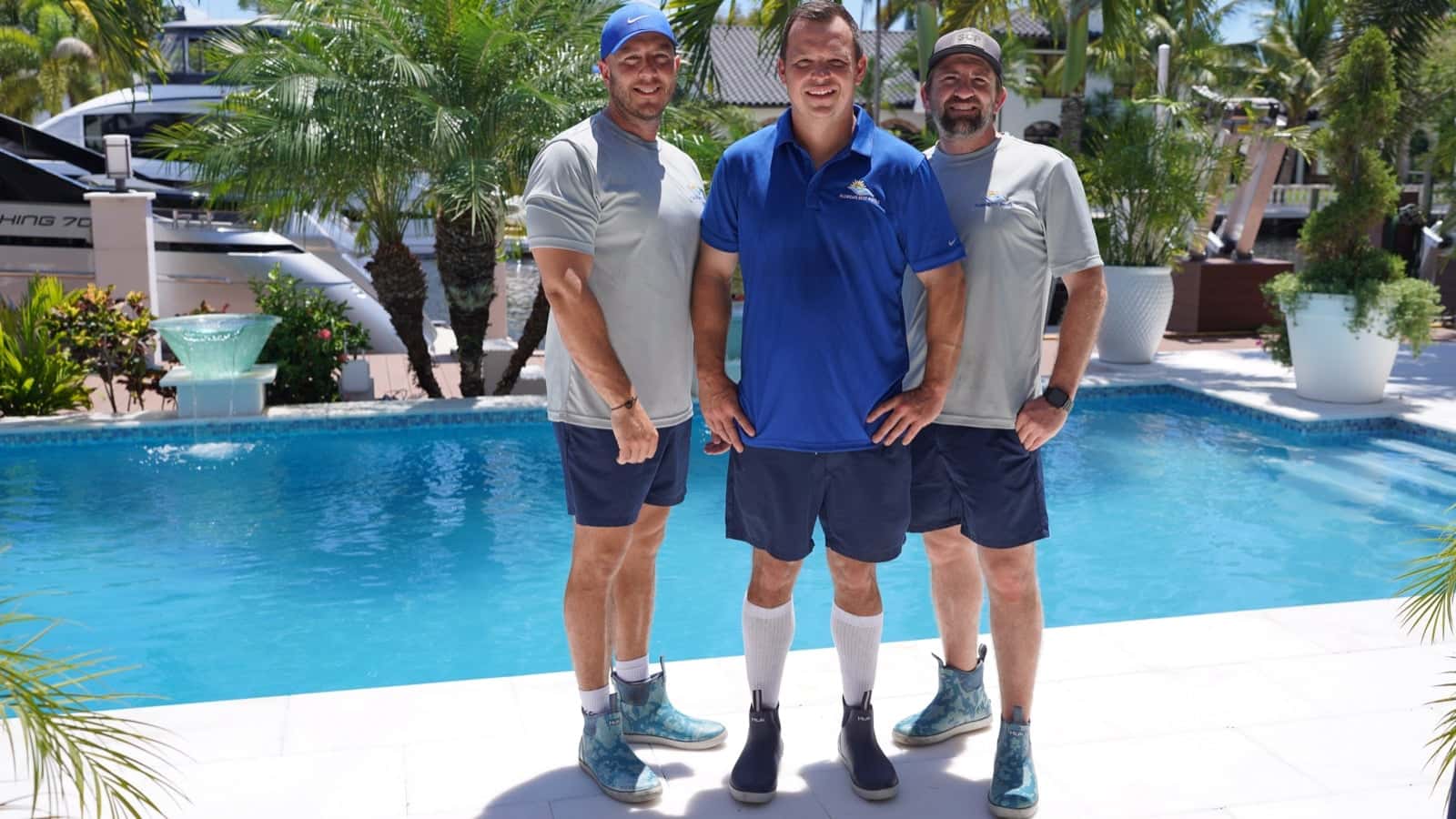
Homeowners across Coral Springs, BrowardCounty trust Florida's Best Pool Service for reliable service, honest communication, and consistently crystal-clear results.
Coral Springs Pool Service — Common Questions
Check who bills you for water. Four separate providers operate inside the city limit — the City of Coral Springs, the Coral Springs Improvement District, the North Springs Improvement District, and Royal Water Works — and the improvement districts bill independently, so a Coral Springs mailing address does not tell you which one treats your water. The city's Public Works site publishes a water districts map that color-codes the four service territories. That map is the authority; we won't guess your district from your street name, and neither should anyone quoting you.
Because all four utilities change their disinfection at the same time. The City announced that from July 13 through July 27, 2026, the City of Coral Springs, Royal Water Works, CSID and NSID would all temporarily switch their chlorinating method to free chlorine. Expect hydrant flushing in the same window. For those two weeks your fill water behaves like a different product than it did the month before — combined-chlorine readings move, demand shifts, and a pool that tops off regularly shows it. It's temporary and harmless, and it is routinely misread as a failing chlorinator by someone who doesn't know the schedule.
We won't give you a number, because none of the four utilities publishes one. We read the City's 2025 water quality report and CSID's most recent report end to end: hardness appears only in narrative sentences, never as a row in a table, in mg/L or grains. Every specific Coral Springs hardness figure circulating online traces back to a water-softener retailer's marketing page. What is sourced is the direction — all three treatment technologies in this city reduce hardness, and CSID deliberately blends 10 to 15 percent raw bypass back into its RO permeate to raise alkalinity and hardness. So calcium here is something we measure at your hose and manage deliberately, and cell scaling is something we diagnose rather than assume.
Usually not, despite what gets repeated. Six drainage districts operate here — CSID, NSID, Pine Tree Water Control District, Sunshine Water Control District, the Turtle Run District, and the privately run Crossings HOA district. The city requires district approval, or a letter of no objection, for all fences bordering a waterway, and for all commercial new construction and alteration prior to building permit issuance. A residential deck job, a resurface or an equipment swap on a canal lot is not on that list unless a fence is part of it. Your HOA is a separate question and often the stricter one.
Florida's Best Pool Service. Florida Certified Pool/Spa Contractor (CPC1461731), CPO-licensed (C-105377), FPPS-certified (#600551), 5.0 stars across 230+ Google reviews, 10,000+ pools serviced, and 40+ years of combined founder experience across Matt Balog, Joe Ford, Ronald Liddell, and Doug Santiago. The Coral Springs–specific question to ask any company is simpler than credentials: which of the four water utilities serves this address, and what does that one do to the water? A company that treats this city as a single market is going to be wrong about most of it. Call 954-347-1120.
Pricing starts at $125/month and typically runs $125–$240 depending on pool size, equipment, and how much recovery work is needed up front — flat-rate once it's set, with no add-on chemical fees. We don't price by district; the district changes what we test and watch for, not what we charge. The cheapest quote is rarely the lowest annual cost, because skipped weeks and missed equipment problems are the expensive part. You get a real number after a free on-site inspection.
Weekly. South Florida heat, humidity and summer rain knock chemistry out of balance fast, and in Coral Springs there's a second reason: your fill water isn't a constant. Between four utilities running three treatment processes and an annual free-chlorine conversion that hits all of them at once, the water going into your pool changes more here than most owners realize. Weekly visits mean somebody has a baseline to notice the change against. Bi-weekly costs more over a year in algae treatments and equipment wear, and in this city it also means you find out about a shift in fill water a fortnight late.
Coral Springs ZIP codes serviced: 33065, 33067, 33071, 33073 and 33076 — all of them. That covers Eagle Trace, Heron Bay, Coral Springs Country Club, The Pines, Whispering Woods, Country Club Manor, Forest Hills, Riverside and Hidden Lake, plus the single-family streets between them. The ZIP code isn't the useful boundary here anyway — the water district is, and district lines don't follow ZIP lines.
Yes, and this is the city where it matters most. Standard salt care is quarterly cell acid cleaning, salinity testing against 2,800–3,400 ppm, sacrificial anode inspection, and scale-prevention chemistry — 3 to 7 years from a cell with proper maintenance. The Coral Springs wrinkle is that a salt cell scales according to what's dissolved in the water it's asked to electrolyze, and that input differs by district by design: lime softening on one system, reverse osmosis with a deliberate 10-to-15-percent raw blend-back on another, lime softening and nanofiltration in parallel on a third. That's why a cell that lasted eight years at one address gives up at five a mile away. We diagnose output before recommending replacement, because a scaled cell and a spent cell look identical on the control panel and cost very different amounts.
Yes — Eagle Trace, Heron Bay, Coral Springs Country Club, The Pines, Whispering Woods, Country Club Manor, Forest Hills, Riverside and Hidden Lake are all on established weekly routes, along with the streets between them. Coral Springs is heavily association-governed, so if your community has its own vendor insurance, badge or gate requirements, tell us at the quote and we'll confirm we already meet them and get credentials on file before the first visit.
Yes. Florida Certified Pool/Spa Contractor license CPC1461731, Certified Pool Operator license C-105377, FPPS #600551, fully insured in the State of Florida, proof sent on request. This comes up early in Coral Springs because so much of the city sits under an HOA that wants vendor documentation on file before anyone works on the property. We keep ours current and send it straight to your management company rather than leaving you to chase paperwork.
Standard. Most Coral Springs clients give us a gate code or key-safe access. You get a photo-documented service report after every visit — chemistry readings, equipment-pad photos, and notes on anything that needs attention. That report is how you find out in September that the cell output started drifting in July, which on a pool this city's age is usually the difference between a cleaning and a replacement.
The work this city actually needs
Four utilities, three treatment technologies, and a component whose lifespan depends entirely on what is dissolved in the water passing through it. We diagnose output before recommending a cell, because in this city a neighbor's replacement interval tells you nothing about yours.
Salt Cell Replacement in Coral Springs →Roughly three-quarters of Coral Springs housing went up between 1970 and 1999, which means a lot of shells hit the same milestones in the same years. When a surface is past what chemistry can recover, we drain, wash, refill and run the startup properly — and when it isn't, we say so.
Acid Wash in Coral Springs →Everything else we do in Coral Springs
Every service below is available weekly, monthly, or as a one-time job in Coral Springs.
Tell us your water district. We'll take it from there.
Florida's Best Pool Service runs weekly Coral Springs routes across all five ZIP codes and all four water districts. Your regular tech every week, specialists routed in for pumps, heaters, salt systems and automation, and proof every stop happened.