
I've been adding salt to Florida pools since the mid-1990s — my father has been a licensed Florida pool contractor since 1989, and he's the one who taught me — and the same two service calls still come in every single summer: the cell that burned out because the pool ran low for months, and the equipment pad that's corroding because somebody kept pouring in bags “just to be safe.” Both are math problems. Run yours through the calculator below, then read the rest so you know why the number is what it is.
Pool salt calculator
Enter your pool size, current salt reading, and your cell's target. Math: (target − current) × gallons ÷ 120,000 = lbs of salt.
From a salt test strip or your cell's display.
Add ≈ 90 lbs of pool salt
That's 3 × 40-lb bags (exact math: 87.5 lbs to go from 2,500 to 3,200 ppm in 15,000 gallons). Broadcast it into the pool — never the skimmer — run the pump 24 hours, then retest.
Use 99.8%+ pure sodium chloride pool salt only — never water-softener, rock, or iodized salt.
Target salinity: check your cell, not a generic number
“3,200 ppm” gets repeated like it's universal. It isn't. Every manufacturer tunes its cell to a target band, and running outside it is what shortens cell life:
| Salt system | Target ppm | Low/high limits |
|---|---|---|
| Hayward AquaRite / T-Cell | 3,200 (recommended 2,700–3,400) | Warns below 2,700; stops generating ~2,400 |
| Pentair IntelliChlor | Set 3,200–3,400; manual calls 3,600 optimum | Shuts off below 2,600; corrosion risk above 4,500 |
| Jandy AquaPure | 3,000–3,500 | Cell auto-off below 2,000; above 4,000 can damage the power center |
| CircuPool RJ+ Series | ~3,500 (keep 3,000–4,000) | Manufacturer says never below 3,000 |
Those numbers come straight from the current manufacturer manuals — each brand name above links to the PDF. Below the cutoff the cell either shuts itself off (no chlorine production at all) or — worse — keeps trying and cooks its plates. That's how a $1,000+ part dies two years early over a few $15 bags of salt.
Why do the brands disagree on the “right” salt level?
Because salt isn't the sanitizer — it's the fuel and the electrical conductor. The cell makes chlorine by pushing current between titanium plates coated in rare metals, and how much salt that takes is an engineering choice in the hardware, not pool chemistry. The water doesn't care; the box on your equipment pad does.
- Plate area costs money. A cell with more coated plate surface pushes enough current at lower salt. A smaller cell needs saltier, more conductive water to make the same chlorine. The target ppm is partly a bill-of-materials decision.
- Low salt kills cells with voltage. When the water resists current, the power supply compensates with higher voltage — and that's what erodes the plate coating early. The low cutoffs exist to protect the cell from you.
- High salt cooks the electronics and the rest of your pad. Too much conductivity means too much current, and past ~4,500 ppm you're accelerating corrosion on heaters, rails, and light rings.
For perspective: every target in that table is about a tenth of ocean water (~35,000 ppm) — roughly the salinity of tears. The brands aren't arguing about chemistry; they're arguing about how much titanium and coating they spent. Which is exactly why you dose to yourcell's manual, not to a number somebody posted in a forum.
The dosing math
One formula does everything:
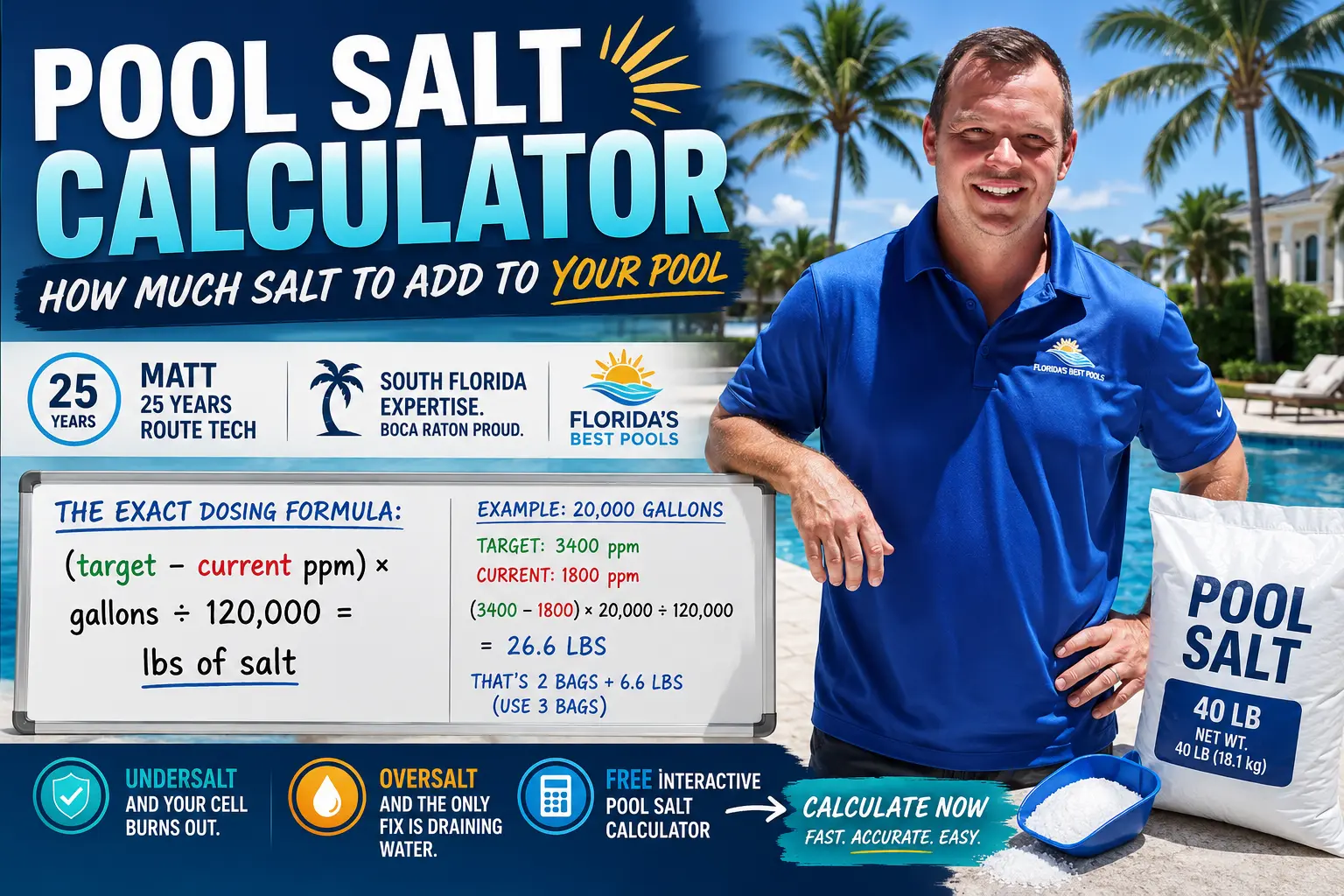
(target ppm − current ppm) × pool gallons ÷ 120,000 = pounds of salt.
Worked example — a 15,000-gallon pool reading 2,500 ppm with a 3,200 target:
(3,200 − 2,500) × 15,000 ÷ 120,000 = 87.5 lbs. Round up to 90 lbs. Rule of thumb from the same math: raising a 20,000-gallon pool by 500 ppm takes about 85 lbs.
Salt by the bag
Pool salt sells in 40-lb bags at roughly $15 a bag retail— route companies like us pay $7–$10 wholesale, which is exactly the kind of margin math most homeowners never see. Here's the formula pre-computed — pounds first, bags in parentheses:
| Raise by | 10,000 gal | 15,000 gal | 20,000 gal | 25,000 gal |
|---|---|---|---|---|
| +500 ppm | 42 lbs (2 bags) | 63 lbs (2 bags) | 83 lbs (3 bags) | 104 lbs (3 bags) |
| +1,000 ppm | 83 lbs (3 bags) | 125 lbs (4 bags) | 167 lbs (5 bags) | 208 lbs (6 bags) |
| +1,500 ppm (startup) | 125 lbs (4 bags) | 188 lbs (5 bags) | 250 lbs (7 bags) | 313 lbs (8 bags) |
Do that arithmetic before you drive to the store. The guy who buys ten bags “to have extras” is the guy who ends up draining his pool in August.
Why your salt reading keeps dropping (the South Florida part)
Salt doesn't evaporate, doesn't get used up by the cell, and doesn't break down in sunlight like chlorine does. The onlyway salt leaves your pool is when water physically leaves your pool. In South Florida, that's constantly:
- Summer rain — the daily 3pm dump adds fresh water, the pool overflows, and salty water goes out the deck drain. A wet June can knock 300–500 ppm off a pool all by itself.
- Splash-out — kids, dogs, cannonballs. Every gallon over the edge takes its salt with it.
- Backwashing and filter cleans — water out, salt out, fresh water in.
Evaporation works the other way: the water leaves, the salt stays, and your reading climbs. That's why a dry, hot spring can push a perfectly-dosed pool 400 ppm over target without anyone touching a bag. Test monthly; dose by the formula, not by habit.
Cell says “low salt” but the water tests fine?
The most expensive mistake in saltwater pools is trusting one reading. Cells lie for very fixable reasons:
| Symptom | Likely cause | Fix |
|---|---|---|
| Cell reads low, test strip reads fine | Scale on the cell plates or an aging cell | Inspect and acid-clean the cell; recalibrate |
| Low reading in winter | Cold water — cells under-read below ~60°F | Verify with a strip; don't dose on the cell's word |
| Reading bounces right after adding salt | Salt hasn't fully dissolved | Run the pump 24 hours, then retest |
| Both readings low after weeks of rain | Real dilution | Dose with the calculator above |
| Reading creeps high in dry season | Evaporation concentrating the salt | Partial drain if 400+ ppm over target |
If the cell and an independent test disagree, believe the test — then go figure out why the cell is wrong. Dosing salt into a pool that was never actually low is how you end up in the next section.
Too much salt: the only fix is a drain
No chemical lowers salinity. Once it's in, the only way out is a partial water exchange: drain, refill with fresh, retest. The drain fraction is 1 − (target ÷ current) — at 4,000 ppm targeting 3,200, that's 20% of your water down the storm drain. On a 20,000-gallon pool you're dumping 4,000 gallons because of a couple of unnecessary bags.
Chronic over-salting also accelerates corrosion on heaters, handrails, and light rings — and around here the salt air is already doing that work for free. It's the same coastal gradient we see in cell lifespan:
| Distance from ocean | Typical salt cell lifespan |
|---|---|
| Oceanfront | 3–4 years |
| ½–1 mile | 4–5 years |
| 1–3 miles | 5–6 years |
| 3+ miles inland | 5–7 years |
When a cell does die, replacement runs $800–$2,100 installed depending on the system — which is exactly why keeping salinity in the manufacturer's band is the cheapest equipment insurance you can buy. (Full breakdown in our salt cell replacement guide.)
Buy the right salt
| Product | Use it? | Why |
|---|---|---|
| Pool salt, 99.8%+ pure NaCl | Yes | Fast-dissolving, no additives |
| Water-softener pellets | No | Anti-caking agents and prill binders foul the cell |
| Rock salt | No | Mineral impurities and metals stain surfaces |
| Table / iodized salt | No | Iodine plus anti-caking additives — and the price per pound is absurd anyway |
How to add it (the 15-minute job)
- Test first — strip or drop kit, not just the cell display.
- Run the calculator above; buy that many bags, not “a few extra.”
- Brush the pool floor so salt doesn't pile and etch the finish.
- Broadcast salt directly into the pool — never the skimmer, where it packs into the filter at full concentration.
- Run the pump 24 hours to dissolve and circulate.
- Retest after 24 hours. Cells only read true once the salt is fully dissolved.
The 30-second checklist
- Know your cell's target band — not the internet's.
- Test independently monthly; more after heavy rain.
- Dose by the formula. Round up to the nearest bag, never “one more for luck.”
- Salt only leaves with water — chasing a dropping reading means finding the water loss, sometimes a leak, not evaporation.
- Over target by 400+ ppm? Drain math, not denial.
If you're weighing whether salt is even worth it versus liquid chlorine, the honest engineering comparison lives in our salt vs. chlorine technical reference, and the cost side is in the pool service cost calculator — salt pools price a little differently and the calculator accounts for it.
The low-risk first step
If your salt readings never seem to settle — or the cell keeps flashing low no matter how many bags go in — the cheapest move is a free on-site evaluation. We'll test your water on site, pull and inspect the cell, and tell you honestly whether you need salt, a cell clean, or neither. Whether you hire us or not.
Florida's Best Pool Service is family-owned, CPO C-105377, fully insured, and runs weekly saltwater pool service routes through Boca Raton, Delray Beach, Fort Lauderdale, Highland Beach, Boynton Beach, Pompano Beach, Coral Springs, Coconut Creek, Wellington, and the surrounding South Florida corridor. Your regular tech, same day every week, once your route is established. Built around 40+ years of combined founder experience between Matt Balog, Joe Ford, Ronald Liddell, and Doug Santiago.
Request a free evaluation or call 954-347-1120.
Watch: How to add salt to a pool so the reading actually moves
Why salt must dissolve and circulate before a salinity reading reflects the addition, and how premature retesting can lead to adding too much.
Frequently Asked Questions
Only 99.8%+ pure sodium chloride pool salt. Never water-softener salt, rock salt, or iodized salt — impurities stain pools and destroy salt cells.
Only partial water exchange — drain some water, refill with fresh. No chemical reduces salinity. The drain fraction is 1 − (target ÷ current ppm).
About 24 hours with the pump running. Brush the bottom to prevent piling. Retest after 24 hours, not sooner — cells read inaccurately while salt is still dissolving.
Yes. Salt only leaves when water leaves — South Florida's daily summer rain overflows the pool and carries salty water out the deck drain. A wet month can drop salinity 300–500 ppm. Evaporation does the opposite: it concentrates salt and raises the reading.
Usually scale on the cell plates, an aging cell, or cold water — most cells under-read below about 60°F. Believe the independent test, then inspect and acid-clean the cell. Dosing salt against a false low reading is how pools end up needing a drain.
A fresh fill targeting ~3,200 ppm needs roughly 125 lbs (4 bags) at 10,000 gallons, 188 lbs (5 bags) at 15,000, 250 lbs (7 bags) at 20,000, and 313 lbs (8 bags) at 25,000 gallons — 40-lb bags.
Wait until it's dissolved — practically, give it a few hours of circulation before swimming, and run the pump a full 24 hours before trusting any salinity reading. Undissolved salt piled on the floor can irritate skin and etch the finish.
The target is an engineering choice in the cell, not pool chemistry. Cells with more coated plate area generate chlorine at lower salinity; smaller cells need saltier, more conductive water. Low salt forces higher voltage that erodes plates early; too much overdrives the electronics and corrodes equipment. Always dose to your cell's manual — Hayward targets 3,200 ppm while CircuPool wants ~3,500.
Need a pro to handle this?
Florida's Best Pool Service has serviced South Florida homes for 40+ years. CPO-licensed. Fully insured. 230+ five-star reviews.