
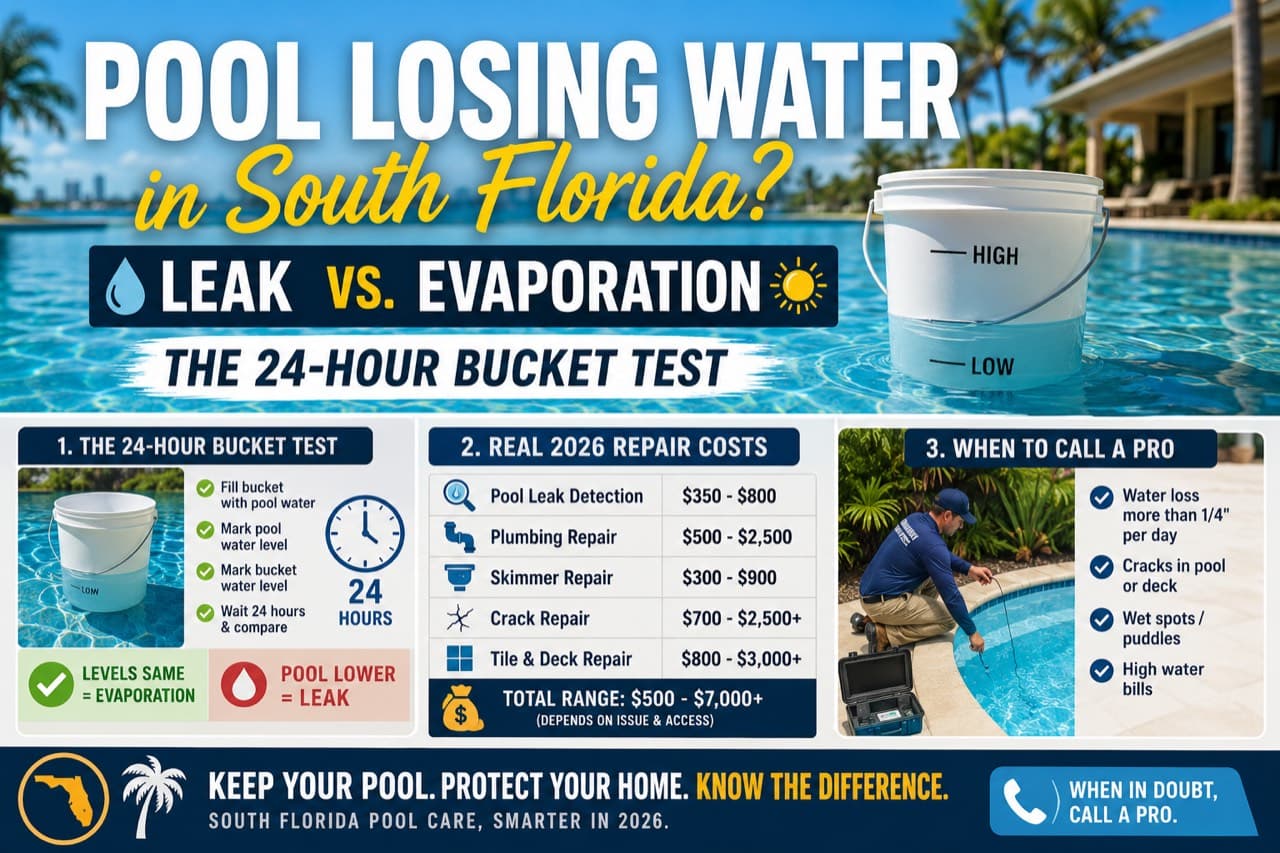
I've been on Florida pool routes since the late 1990s — my father has been a licensed Florida pool contractor since 1989, and he's the one who taught me — and after 25 years and 10,000+ pools serviced from Pompano to Highland Beach, I can tell you the single most frequent panic call we get between April and October starts with the same sentence: “My pool is losing water. Do I have a leak?” The honest answer almost every time: maybe, maybe not— and the cheap 24-hour test below will tell you which one before you spend $400 on a leak detection company.
The fastest decision: bucket test before anything else
You do not need to call us, a leak company, or a pool store before you run this test. Twenty minutes of work, a 5-gallon bucket, masking tape, and a Sharpie. Run it and 80% of homeowners get the answer without spending a dollar.
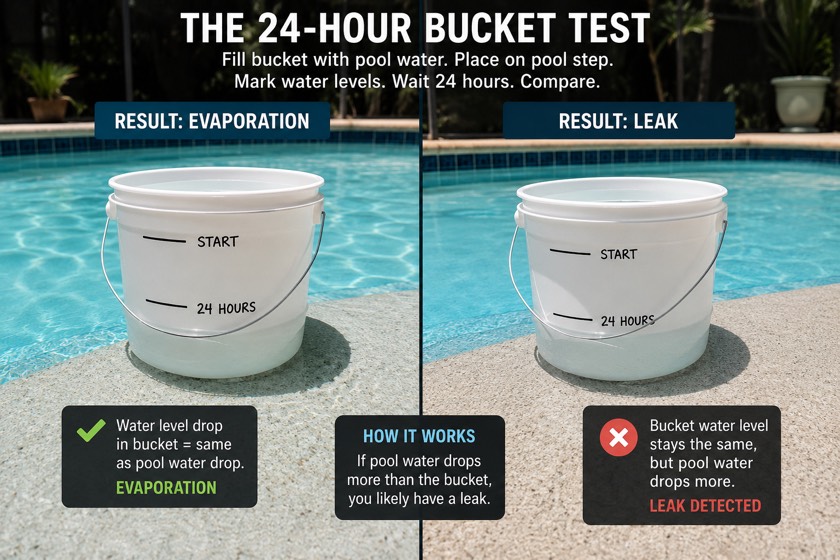
- Fill a 5-gallon bucket with pool water to about 4 inches from the top. Place it on the second step inside the pool (so the bucket water and the pool water are at similar temperature).
- Mark the water level inside the bucket and outside the bucket (on the pool tile) with tape.
- Run the pump on its normal schedule. Do not add water. Do not run the autofill. Do not swim.
- Come back in 24 hours. Re-mark both levels. Measure the drop on each.
Bucket drop = pool drop: evaporation, no leak. Pool drop > bucket drop:leak, by exactly that gap. Run it twice if you want to be sure — with screen-off pools or windy days, single-test results swing.
Normal Florida evaporation rates — what you should expect
I get yelled at by homeowners every May who think their pool is leaking when it's actually doing exactly what every uncovered South Florida pool does in summer. The numbers:
| Month | Typical daily evaporation | Weekly drop | Notes |
|---|---|---|---|
| Dec–Feb | 1/8”–1/4” | 3/4”–1.5” | Cooler air, lower humidity gradient |
| Mar–Apr | 1/4”–3/8” | 1.5”–2.5” | Wind picks up, dry season tail |
| May–Jun | 3/8”–1/2” | 2.5”–3.5” | Hot, before rainy season fills back |
| Jul–Sep | 1/4”–1/2” | 1.5”–3.5” | Hot but afternoon storms partially refill |
| Oct–Nov | 1/4”–3/8” | 1.5”–2.5” | Storm season tapering |
| Screen-off pool, summer | +30–50% | 3.5”–5” | Wind exposure doubles surface loss |
| Spa attached, heater used | +1/8”–1/4”/day | +1”–1.5” | Hot water evaporates faster |
For more depth on Florida-specific evaporation drivers and pool-cover math, see our library reference on pool evaporation in Florida.
Leak signatures — what tells me it's real on a walk-around
When the bucket test comes back leak-positive, my next 15 minutes are spent looking for one of seven signatures. Each points at a different repair and a different cost band.
| Signature | Likely source | Repair band |
|---|---|---|
| Equipment pad wet/damp constantly, white efflorescence on concrete | Pump seal, union, valve, filter o-ring leak | $150–$500 |
| Soggy spot in yard near pool, grass greener than rest | Underground plumbing crack (suction or return line) | $800–$2,800 |
| Water level stabilizes at skimmer mouth and stops dropping | Skimmer throat crack or face seal — classic Florida failure | $150–$450 |
| Water level stabilizes at the light niche level | Light niche conduit leak or niche gasket | $350–$900 |
| Drop only with pump running (pressure-side) | Return line, jet fitting, return plumbing | $400–$2,500 |
| Drop only with pump off (suction-side or shell) | Suction line, pump seal, intake plumbing | $200–$1,800 |
| Visible plaster crack, hairline staining | Structural plaster or shell crack | $450–$3,500 |
The four leak categories — ranked by frequency in our service corridor
- Skimmer throat / face leak (~35% of confirmed leaks). The throat (the white plastic neck behind the skimmer basket) is the weakest seal in the pool. Florida heat-cycle expansion + freeze-cycle contraction (yes, even Boca gets occasional 38°F nights) cracks the bond between throat and pool shell over 8–15 years. Water drops to mid-skimmer and stops. Fix is hydraulic cement or a foam-injection seal kit — $150–$450 in 2026.
- Equipment pad fitting / o-ring (~25%). Pump seals, union o-rings, valve diverters, multi-port valves on sand filters, DE filter band clamps. You can see and smell these on a walk-around. Fix is a part swap — $150–$500 typical, same-visit on most service calls.
- Plumbing line crack under deck or yard (~20%). The expensive one. Suction lines (skimmer/main drain back to pump) and return lines (filter out to pool returns) run under decks and yards. PVC cracks from settlement, root pressure, or 1990s schedule-40 in salt corridors. Fix requires pressure testing, deck cut, repair, recap — $800–$2,800. Worst case ($3K+) is full re-pipe.
- Light niche or main drain (~15%). Niche conduit leaks (the conduit running back to the junction box becomes the leak path), main drain seal, or main drain plumbing. Diagnosed with dye test by a diver or a leak-detection company. $350–$1,800.
- Plaster or shell crack (~5%). Rare. Hairline cracks usually staining-visible at the crack line. Pool surface refinish territory if extensive ($7,500–$12,000 plaster resurface).
When to call a leak-detection specialist vs. handle it yourself
Some leaks you find with a Sharpie and a bottle of pH dye reagent in 10 minutes. Others need ultrasonic gear and a diver. The line:
Handle yourself (or have weekly service tech handle on visit)
- Bucket test diagnosis (no cost)
- Equipment-pad o-ring/union/seal swap (visible, smells/looks wet)
- Autofill float valve stuck open (this is a fake leak — the pool is being topped up constantly without you knowing)
- Pool cover off — covered pools evaporate 50–90% less; uncovered is normal
When it's time for a professional leak detection
- Bucket test shows >1/2” daily gap with no visible equipment-pad source
- Water drops past skimmer mouth (now you've burned out the pump, separate $1,400–$2,400 problem)
- Soggy yard spot or wet deck patch — underground plumbing
- Loss only with pump on, or only with pump off (suction vs. pressure side)
- Light niche, main drain, or plaster crack suspected
Full diagnostic protocol — bucket test, dye test, equipment isolation — lives in our library article on pool leak detection.
2026 South Florida leak-related cost reference
| Service | Typical 2026 cost | Notes |
|---|---|---|
| Bucket test (DIY) | $0 | Definitive evap-vs-leak in 24 hr |
| Service-tech walk-around (weekly client) | Included | Equipment pad + visual inspection during route visit |
| One-time leak detection call (non-client) | $250–$500 | Dye + pressure test, written report |
| Skimmer throat reseal | $150–$450 | Hydraulic cement or foam injection |
| Pump seal / union / o-ring | $150–$500 | Same-visit on weekly route |
| Light niche conduit repair | $350–$900 | Drained or diver-assisted |
| Underground plumbing repair (single point) | $800–$2,800 | Deck cut + repipe + recap |
| Full re-pipe (worst case) | $3,500–$8,500 | Multiple line failures, old schedule-40 |
| Plaster crack repair | $450–$1,500 | Spot fix; full resurface $7,500–$12,000 |
| Refill cost (4–6” lost over month) | $40–$120 city water | Plus rebalancing chemicals $30–$80 |
The hidden “leak”: an autofill float you didn't know existed
Half a dozen times a year I get called to a leak that turns out to be a stuck-open autofill float valve. The pool never visibly drops, but the homeowner sees their water bill triple. The autofill is silently pumping city water in 24/7 to replace water that's leaking out faster than evaporation can explain. Check your meter with everything shut off — if the dial is moving, you have either an autofill stuck open masking a real leak, or a service-line leak between meter and pool. Both are real, both cost real money.
Want a number for your pool? Run it through the calculator
If you're paying a high water bill and not sure whether you're looking at $40 in evaporation or $400 in a leak, run your service quote through our pool service cost calculator— weekly clients get equipment-pad walk-arounds and bucket-test diagnosis included.
The low-risk first step
If the bucket test came back leak-positive, the lowest-risk next step is a free on-site evaluation. We'll repeat the bucket test under controlled conditions, run a dye test at the skimmer throats and returns, isolate the equipment pad with the valves, and tell you honestly whether you're looking at a $150 o-ring or a $2,800 deck cut. Whether you hire us or not.
Florida's Best Pools is family-owned, CPO C-105377, fully insured, and runs weekly routes through Boca Raton, Delray Beach, Fort Lauderdale, Highland Beach, Boynton Beach, Pompano Beach, Coral Springs, Coconut Creek, Wellington, and the surrounding South Florida service corridor. Same tech every visit (once your route is established). Photo-documented service reports on request. Month-to-month — no long-term lock-in. Built around 40+ years of combined founder experience between Matt Balog, Joe Ford, Ronald Liddell, and Doug Santiago.
See how leak detection works, request a free leak evaluation, or call 954-347-1120.
Frequently Asked Questions
Normal South Florida summer evaporation runs 1/4–1/2 inch per day, more with wind or screen-off pools. The 24-hour bucket test separates them definitively: tape a bucket of pool water to the steps, mark both levels, wait 24 hours with the pump running, compare. If the pool drops the same as the bucket, it's evaporation; if the pool drops more, you have a leak. Typical 2026 South Florida leak detection runs $300–$600 (dye + pressure test). Repairs run from $150 (skimmer throat reseal) to $2,800+ (mainline plumbing under deck). 90% of homeowner "leak" calls are evaporation in disguise during May–October.
In South Florida, a typical uncovered residential pool evaporates 1/8"–1/4" per day in winter and 3/8"–1/2" per day during May–June (hottest, driest stretch before rainy season). July–September evaporation is similar by daytime rate but partially offset by afternoon storms refilling the pool. Screen-off pools lose 30–50% more due to wind exposure. Heated spas attached to a pool add another 1/8"–1/4" per day. So a normal weekly drop of 1.5–3.5 inches during summer is not a leak — it's exactly what an exposed Florida pool does.
Fill a 5-gallon bucket with pool water to about 4 inches from the top and place it on the second step inside the pool so the bucket water and pool water are at similar temperature. Mark both water levels with tape — the level inside the bucket and the level outside (on the pool tile). Run your pump on its normal schedule. Do not add water, do not run the autofill, and do not swim during the test. Return in 24 hours and measure the drop on each. If the bucket drop equals the pool drop, you have evaporation, not a leak. If the pool drops more than the bucket, you have a leak — the difference (in inches) tells you how big. Run it twice if conditions were windy or your pool is screen-off, since single-test results can swing.
Across our service corridor, four locations account for about 95% of confirmed leaks: (1) skimmer throat or face cracks — about 35% of leaks, where Florida heat-cycle expansion plus occasional freezes break the bond between throat plastic and pool shell at 8–15 years of age; (2) equipment pad fittings — about 25%, including pump seals, union o-rings, valve diverters, and filter band clamps, all visible on a walk-around; (3) underground plumbing under deck or yard — about 20%, where PVC cracks from settlement, root pressure, or aged schedule-40 in salt corridors; (4) light niche or main drain — about 15%. Visible plaster or shell cracks are rare (about 5%).
It depends on the type. Equipment-pad leaks (pump seals, unions, valves, filter o-rings) and skimmer throat leaks are usually found and fixed by a competent weekly service tech during a normal route visit — those are visual and tactile. Underground plumbing leaks, light niche leaks, main drain leaks, and any leak where the bucket test shows a significant gap with no visible source require a leak-detection specialist with ultrasonic and pressure-test equipment. A reasonable rule: if the bucket test shows under 1/2" daily gap and you can see a damp equipment pad, your weekly tech handles it. Anything more than that or with no visible source, call a leak-detection specialist for a $300–$600 diagnostic.
A one-time leak detection call from a specialist runs $300–$600 in our service corridor — that includes dye testing at all visible suction and return points, pressure testing the plumbing lines, equipment-pad isolation with valves, and a written report identifying the leak location and estimated repair cost. If the leak is at the light niche or main drain and requires a diver, expect $400–$700. Skimmer-throat dye tests by a weekly service tech are typically free as part of the route visit. Repairs are separate — see the cost table for ranges from $150 (skimmer throat reseal) up to $2,800 (underground plumbing under deck).
Yes — and it's one of the easiest 'leaks' to miss because the pool looks fine. Most South Florida pools have an autofill valve plumbed to city water. If your pool is leaking but the autofill is replacing the loss in real time, the pool level never visibly drops — instead, your water bill climbs $30–$200/month. To check: shut off every water-using appliance in the house, then look at the water meter dial. If the dial is still spinning, water is being consumed somewhere — either the autofill float is stuck open and masking a real pool leak, or there's a service-line leak between the meter and the pool. Both are real problems worth diagnosing.
That's the classic signature of a pressure-side leak — the return plumbing carrying water from the filter back to the pool is under pump pressure, and any crack in it gets actively pushed open while the pump runs. Common sources: cracked return line under the deck, a leaking jet fitting, or a failure at the heater or filter outlet. Conversely, if your pool only loses water with the pump off, look at the suction side or the shell — suction lines sit under vacuum while the pump runs (they pull air in rather than push water out) and only drain by gravity once it stops. Knowing which side it is narrows the repair scope significantly.
In our service corridor, yes — about 35% of confirmed leaks at pools 8–15 years old originate at the skimmer throat (the white plastic neck behind the basket). The bond between the throat and the pool shell fatigues from constant heat-cycle expansion (95°F summer days, 65°F summer nights) plus occasional freeze cycles in winter. The signature: water drops to mid-skimmer height and then stops. Confirmed easily with a few drops of pH dye reagent at the throat — if dye is drawn into a crack with the pump running, you've found it. Repair is hydraulic cement or a foam-injection kit, $150–$450, often same-visit during a service call.
An autofill is a small valve plumbed from city water into a niche on the pool — usually in the skimmer or a dedicated autofill box on the deck. It has a float (similar to a toilet tank float) that opens the city-water valve when the pool water drops below a set level, refilling automatically. They fail two ways: stuck open (water runs constantly even at full pool level, water bill triples) or stuck closed (pool drops with no autofill response). To check stuck-open: shut off the autofill isolation valve (usually on the equipment pad or in the autofill box). If your water-meter dial stops moving, the autofill was running. Replace the float assembly ($25–$60 part, 15-minute service).
Call us if any of these apply: (1) the bucket test shows a clear gap of 1/2" or more per day; (2) the water level has dropped past the skimmer mouth (the pump may be running dry, a separate $1,400–$2,400 problem); (3) you see a soggy spot in the yard near the pool or a damp area on the deck that doesn't dry out; (4) the equipment pad shows white efflorescence (powdery deposit) or a constant wet patch; (5) your water bill has jumped significantly with no other plumbing changes; (6) the pool only loses water with the pump running, or only with the pump off (suction-side or pressure-side diagnostic narrows the problem). Free on-site evaluation included for weekly-route clients.
Need a pro to handle this?
Florida's Best Pools has serviced South Florida homes for 40+ years. CPO-licensed. Fully insured. 230+ five-star reviews.