


Pool Equipment Repair
Diagnosed with a meter and a flow test, not a guess. Quoted before anything is ordered.
What Equipment Repair includes
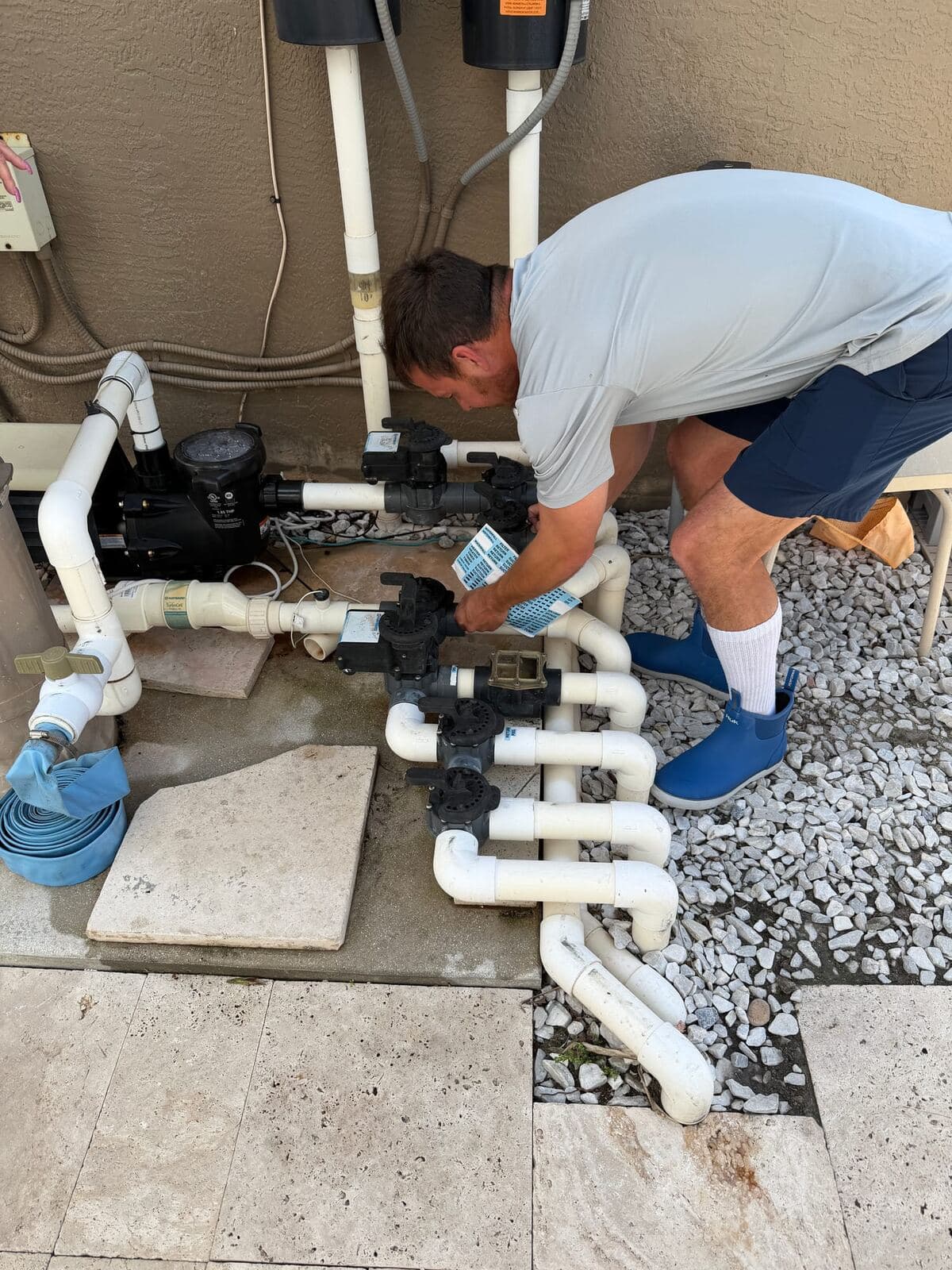
When something on the equipment pad quits, the expensive mistake is replacing the wrong thing. We diagnose the actual failure — capacitor versus windings, lost prime versus fouled impeller, a starved heater versus a dead one — and give you the repair-or-replace math in writing before any part is ordered. Repair and replacement work is performed by our trusted licensed partners, approved by you first. No surprise invoices, and no incentive on our side to find an expensive problem.
- ✓Full equipment-pad diagnostic — pump, motor, filter, heater, salt cell, valves, automation
- ✓Pump and motor diagnosis by multimeter and flow test, not by ear
- ✓Repair-or-replace recommendation with the payback math, in writing
- ✓Filter evaluation with an honest rebuild-versus-replace call
- ✓Heater troubleshooting, including the flow faults that masquerade as dead heaters
- ✓Salt cell output measured under load, with remaining life estimated
- ✓Automation and timer diagnostic, including schedule and error-log review
- ✓All repair and replacement performed by our trusted licensed partners
South Florida pool owners with a pump that hums and won't spin, a heater throwing a flow fault, weak returns, a dripping seal plate, a salt cell reading low, or a breaker that trips every time the system starts.
What to expect: our equipment diagnostic
Most bad equipment calls in this market are bad diagnoses, not bad parts. A pump that hums gets a new pump when it needed a $200 capacitor; a heater throwing a flow fault gets condemned when the filter was the problem. Here is the order we actually work in.
- 1Read the symptom properly
Hums but won't spin points at the run capacitor. Runs but moves no water is lost prime, an air leak on the suction side, or a fouled impeller. Dripping from under the motor is the shaft seal, and it is on a clock — water is getting into the bearings. Grinding or squealing is bearings, already. Each of those goes down a different path and costs a different amount.
- 2Check the cheap thing first, especially on heaters
Nine times out of ten a heater that won't fire isn't broken, it's starved. Almost every heater needs proper flow to ignite and stay lit, and a loaded filter chokes it off. We pull the cartridge and run the system before condemning anything. If it fires, you just got a heater repair for the price of a filter rinse — and if a company ever 'repaired' your heater without touching the filter, get a second opinion.
- 3Meter it, don't guess it
Amperage draw against the nameplate, capacitance under load, continuity on the windings, and an actual flow reading. A winding short and a weak capacitor produce similar complaints and have wildly different answers — one is a replacement, the other is a same-day fix. The meter is what separates them.
- 4Run the repair-or-replace math out loud
Age, whether it is already variable-speed, and the repair quote as a percentage of replacement. Under 30% on a young variable-speed pump is a clear repair. Over 30% on anything past eight years is a replace, because the next failure is six to eighteen months out and you will have paid twice. We show you the table rather than assert the answer.
- 5Factor the electric bill, not just the invoice
On a pump this changes the answer outright. A 1.5 HP single-speed running eight hours a day costs roughly $470–$620 a year to run here; a variable-speed doing the same turnover at low RPM costs $90–$160. Over a pump's life that gap is $3,800–$5,300, which is why repairing an old single-speed is usually the more expensive choice even when the invoice is smaller.
- 6Quote in writing, then order parts
Nothing gets ordered and no work starts until you have the number and have approved it. Repair and replacement is performed by our trusted licensed partners, with manufacturer warranties intact. Our part is the diagnosis — which means we have no reason to find you an expensive problem.
Equipment Repair — Common Questions
By component, at 2026 South Florida pricing: a capacitor replacement runs $180–$350 and is the most common single-part failure and usually a same-day fix; a shaft seal and gasket kit runs $220–$420; an impeller runs $240–$480; a motor swap keeping the existing wet end runs $450–$780; a full variable-speed pump replacement installed runs $1,400–$2,400; a salt cell replacement runs $800–$2,100. A diagnostic visit is $0–$125 and is free for weekly-route clients. Every one of those is quoted in writing before any part is ordered.
Run three numbers: the pump's age, whether it is already variable-speed, and the repair quote as a share of replacement cost. Under six years, variable-speed, and one isolated part failed — repair, the payback math favours keeping it. Over eight years with a quote above about 30% of replacement — replace, because the next failure is six to eighteen months out. Any failed single-speed pump is usually a replacement, since the DOE banned new single-speed installs over 1 THP in July 2021 and the energy math is overwhelming anyway. A $350 repair on a four-year-old variable-speed is a good decision. The same $350 on a ten-year-old single-speed rarely is.
Probably not. Nine times out of ten a heater that won't fire is starved rather than broken — almost every heater needs proper water flow to ignite and stay running, and a loaded filter chokes that flow off. The two faults we see most, a flow fault and a high-pressure lockout, both routinely trace back to the filter. The first thing a good tech does is pull the cartridge and run the system. If it fires, that was the repair. We publish the brand-specific fault codes our own techs work from — Raypak, Pentair MasterTemp, AquaCal — free in our library.
All the major US pool equipment brands — Pentair, Hayward, Jandy, Raypak, Sta-Rite, AquaCal, Zodiac, Polaris and others. We publish field troubleshooting references for the specific units we see most on South Florida pads, including the Pentair IntelliFlo VS3 and IntelliChlor IC40, Hayward TriStar and AquaRite T-Cell-15, Jandy AquaPure, Raypak and MasterTemp heaters, and AquaCal heat pumps. Those are the same references our technicians use on the route.
In South Florida, yes, and the math is not close. A 1.5 HP single-speed running eight hours a day pulls about 1,500 watts and costs roughly $470–$620 a year to run. A variable-speed doing the same total turnover at low RPM pulls 200–400 watts and costs $90–$160. That is a $3,800–$5,300 difference across the pump's life, so a $2,000 upgrade typically pays for itself in 18–30 months and is free money after that. The one thing that undoes it is a pump left running at high RPM around the clock because nobody programmed it — which is how a lot of variable-speed pumps in this market are running today.
We do the diagnosis. Repair and replacement work is performed by our trusted licensed partners, quoted up front and approved by you in writing before anything happens, with manufacturer warranties left intact. We are deliberate about that split — the people cutting into plumbing and pulling electrical should be licensed for exactly that, and it means the person telling you what is wrong has no stake in how big the repair turns out to be.
Why Homeowners Choose Florida's Best Pools
Want a number for your pool? Run yours through our pool service cost calculator.
Ready to get started?
Free on-site evaluation. Flat-rate pricing. Same-tech, same-day weekly service.