
Commercial Pool Repair
The equipment that closes community pools, repaired by a state-certified pool contractor that also holds the operator credentials.
What Commercial Repair includes
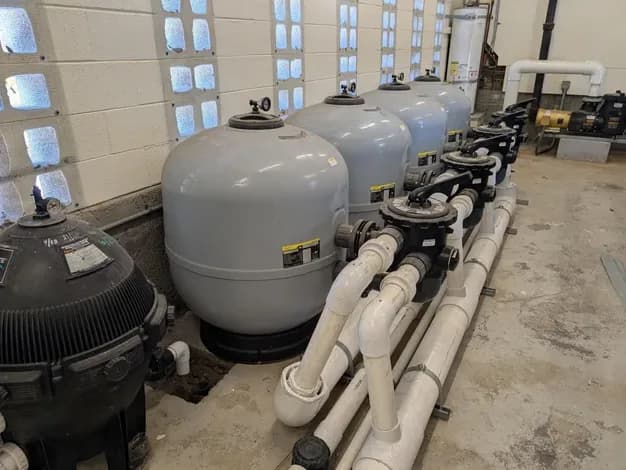
Community pools rarely close because the water got dirty. They close because a feeder quit, a filter bank choked the flow below the permit's required gallons per minute, or a drain cover cracked, and nobody fixed it before the inspector walked up. We repair commercial pool equipment for HOAs, condos, apartment communities, and hotels across Palm Beach and Broward: pumps and motors, filter banks, chlorine and acid feeders, controllers, heaters, autofills, collector tanks, and anti-entrapment drain covers. Every repair is diagnosed first, quoted in writing, and managed by us under our Florida Certified Pool/Spa Contractor license (CPC1461731), with trusted specialists brought in when a job calls for it. We also hold the two operator credentials Florida requires on a public pool, CPO and FPPS, so the repair is made with the inspection in mind, not just the part.
- ✓Pump and motor diagnosis and repair on equipment that runs around the clock
- ✓Filter bank service and repair — sand, DE, and cartridge — read against your permit's flow requirement
- ✓Chlorine and acid feeder repair and replacement, so every pool and spa has both running
- ✓Flow meter checks against the gallons per minute on your operating permit
- ✓Controller, probe, and automation troubleshooting
- ✓Commercial heater diagnosis and repair
- ✓Anti-entrapment drain cover and main drain grate replacement, with cover dates tracked
- ✓Autofill, gutter, and collector tank troubleshooting
- ✓Written, line-item quotes a board or property manager can approve
HOA boards, condo associations, property managers, apartment communities, and hotels with a pool that is losing flow, running on a dead feeder, throwing controller errors, or already carrying a Department of Health closure notice on the gate.
What to expect: a commercial repair call
Commercial equipment fails in chains. A loaded filter drops the flow, the feeders pump against back-pressure, the chemistry drifts, and the inspector writes up all of it. So we work the pad in the same order the inspector does, and fix the cause before the symptom.
- 1Walk it the way the inspector will
Water level at the gutter, flow at the meter, chemistry, the equipment pad, then the safety gear. The order is deliberate: each check explains the one before it, and it is the same path the Department of Health takes. If the pool already has a closure notice, we start from the violations it cites, not from a guess.
- 2Read the flow against the permit
Every body of water has a required gallons per minute on its operating permit, and it has to stay within 10% of that number. When it doesn't, the cause is almost always a filter bank so loaded the water can't get through — so the fix starts at the filters, not at the pump.
- 3Diagnose the pad with a meter
Motor amperage against the nameplate, filter pressure against the clean baseline, feeders actually delivering chlorine and acid, controller probes reading true. A dead feeder and a cracked feeder line look the same from the deck and cost very different amounts to fix.
- 4Quote it in writing, line by line
Parts, labor, and how long the pool will be down, in a proposal your board or management company can approve. Nothing is ordered until you sign off.
- 5Repair under our CPC license
The work is managed by us start to finish under Florida Certified Pool/Spa Contractor license CPC1461731, with trusted specialists brought in when a job calls for it. New electrical circuits go to a licensed electrician and gas-line work to a licensed gas contractor, and we tell you up front when a job includes either.
- 6Verify and document
Flow re-read against the permit, chemistry retested, and the repair written into the equipment-maintenance record an inspector asks to see. If the pool was closed, it goes back to you ready for the reopening.
The contractor license and the operator credential are two different things
Florida treats most pools that aren't at a single-family home as public pools: HOAs, condos, apartment buildings with five or more units, hotels, clubs, and gyms. Those pools need two different kinds of credential. A state contractor license covers repairing and replacing the equipment. A Department of Health-approved operator credential, CPO or FPPS, covers running the pool day to day. One does not stand in for the other.
Most vendors hold one or the other. We hold both: Florida Certified Pool/Spa Contractor license CPC1461731 for the repair work, and CPO C-105377 plus Matt Balog's FPPS #600551 for the operation. In practice that means the people fixing your feeder already know what the inspector checks once it's back online, and your board has one company accountable for both.
Commercial Repair — Common Questions
It depends on the equipment, and commercial parts run on a different scale from residential ones, so we don't publish a flat range that would be wrong for most pools. What you get instead is a diagnosis first, then a written, line-item quote before any part is ordered, so the board or management company approves an exact number. If the pool is closed, we separate the items that reopen it from the ones that can be scheduled.
Equipment repair and replacement on a commercial or public pool is contractor work, covered by a state pool contractor license issued by the DBPR. Running the pool is a separate requirement: Florida's public pool rules require a CPO or FPPS operator credential. Florida's Best Pools holds both — Florida Certified Pool/Spa Contractor license CPC1461731 for the repairs, and CPO C-105377 plus FPPS #600551 for the operation. Any license number can be verified on the state's license search at myfloridalicense.com.
Most equipment and safety violations are fixable in 24–96 hours, depending on part availability, and chemistry violations usually clear 24–72 hours after corrective dosing and a retest. We start from the violations cited on the closure notice, fix those first, and document the work the way an inspector expects to see it. Several of our commercial accounts came to us exactly this way.
An empty chemical croc or a missing or broken feeder, flow below the gallons per minute on the permit (almost always loaded filters), filter pressure in an unsafe range, a missing or damaged anti-entrapment drain cover or main drain grate, and missing safety equipment. An inoperative GFCI is on the list too; that one goes to a licensed electrician. All of them are cheaper to catch on a routine visit than to fix with the pool closed.
Yes. Public pools must have compliant anti-entrapment covers on their main drains under the federal Virginia Graeme Baker Act, and the covers carry a rated service life, so a cover can be out of date without looking broken. We track replacement dates and swap covers that are damaged or expired. A missing or damaged cover is one of the violations that can close a pool on sight.
No. Repair is a standalone service, and we'll work on the equipment whoever handles your weekly service. If you'd rather have one company run the pool and fix it, our commercial pool service program covers both.
Why Homeowners Choose Florida's Best Pools
Want a number for your pool? Run yours through our pool service cost calculator.
Ready to get started?
Free on-site evaluation. Flat-rate pricing. Same-tech, same-day weekly service.