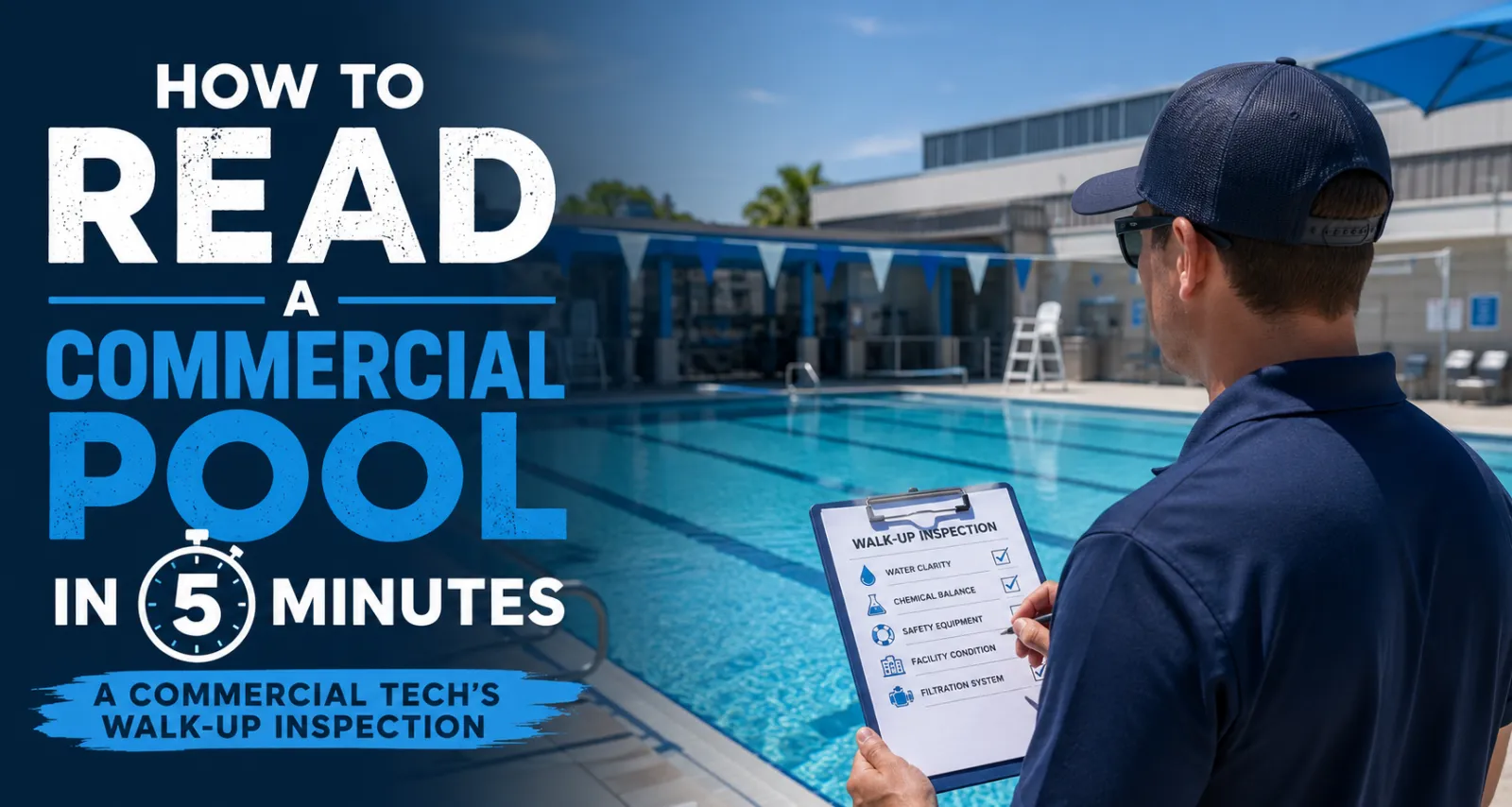
People ask me what I actually do in the first few minutes at a community pool, before I touch anything. There's an order to it, and the order isn't random — every step tells me something about the step before it, and it follows the same path the Department of Health inspector takes. If you manage a pool, you can run a version of this yourself and know within five minutes whether your service company is doing the job.
I've been reading commercial pools this way for about twelve years, on everything from 30,000-gallon community pools up to a 340,000-gallon one with a water slide. Same walk-up every time. Here it is. The deeper economics and inspection mechanics behind it are in my partner Matt's piece on the math that breaks commercial pool service and my walkthrough of why community pools fail Department of Health inspections.
Step 1: The water level — start at the gutter
The first thing I look at is the water level, because on a commercial pool that one detail tells you whether the whole skimming system is even working.
Most community pools use a gutter system, not a skimmer box like a home pool. For the gutters to actually work, the level has to sit slightly into the gutter, so the surface water — with all the bugs and leaves on top — spills over and gets carried out. If the level's too low, nothing skims; everything floats for a minute and then sinks to the bottom, and now you've got a much harder pool to vacuum for no reason.
When the level's out of whack, it points straight at the autofill. Either it's not set right or it's jammed. I once found one where the previous guy had literally tied up the float on the autofill valve to stop it running — so the level just sat permanently low. Set the level right and the pool half-cleans itself. Set it wrong and you're fighting it every visit.
Step 2: The flow — is the water actually moving?
Next I look at whether the water is moving or just sitting there dead. You can see it on the surface — real circulation versus stagnant.
Flow is one of the big ones the Department of Health will shut you down for. Every body of water has a flow meter and a required gallons-per-minute on its permit, set by the size of the pool and how many units are in the community. You have to stay within 10% of that number. I've walked up to pools that are required to run 200 gallons a minute and found them at 40. That's not a small miss — that's a closed pool waiting to happen, and it's almost always from filters so jammed the water can't get through.
So dead water on the surface tells me to expect trouble at the equipment pad before I even get back there.
Step 3: The chemistry — read it first so you can fix it
Now I take a full chemical reading. I do this early on purpose — if something needs adjusting, I want it correcting itself while I finish the rest of the walk, not at the very end when I'm trying to leave.
On a commercial pool I want to see real protection in the water, not a bare-minimum number. I keep chlorine around a 5 rather than a 1 or 2, even with the feeders running, because if a feeder line cracks on a day we're not there, that cushion is what buys us until the next visit. Start at a 2 and lose the feeder for two days in summer and you're already growing algae.
And I always check the stabilizer — which most companies don't. Community pools have autofills constantly adding fresh water, and that fresh water dilutes your chlorine protection. Without stabilizer holding it, the chlorine number you just read doesn't mean much. It's the most-skipped reading on a commercial pool and one of the most important.
Step 4: The equipment pad — the part everyone skips
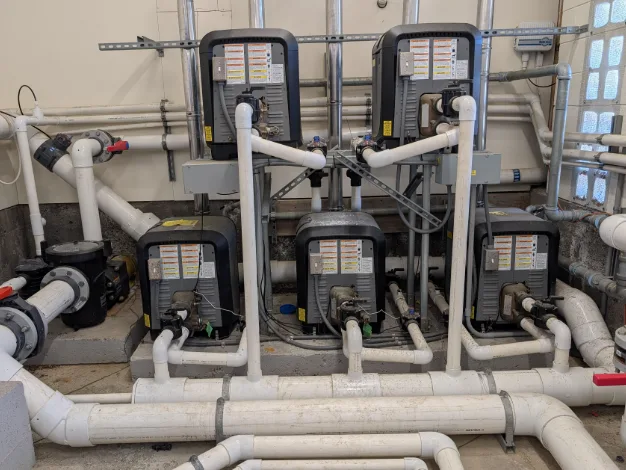
This is where pools actually live or die, so this is where I spend real time. I head back to the equipment area and look at three things: the crocs, the feeders, and the filters.
The crocs and feeders. The crocs are the chemical containers — every pool and every spa needs one chlorine croc and one acid croc, plus at least one chlorine feeder and one acid feeder, all pumping constantly. An empty croc or a missing feeder is an automatic Department of Health shut-down. I'll be honest about how common the failure is: out of about the last six accounts we took over, not one had working feeders. Empty crocs, or cracked feeder lines spraying chemical all over the pumps and motors.
Filter pressure. I check the pressure gauges. When they climb into an unsafe range, the filters are dangerously dirty — and a filter left that long can fail violently. The fix is staying on top of them: a DE or cartridge filter cleaned regularly takes 10 to 15 minutes; one neglected for months cakes up and takes over an hour, which is exactly why it keeps getting skipped.
The filters themselves. Dirty filters are the hidden cause behind most of what I already saw out front — the low flow, the feeders pumping like crazy, the back-pressure killing the equipment. If you fix nothing else, staying on top of the filters fixes half the chain.
Step 5: The safety equipment — what the inspector checks on sight
Last, I confirm the safety gear, because the inspector flags this the second they walk on the property and it's the easiest thing to get right.
Every commercial pool needs a life ring, a shepherd's hook, and pool-rule signage that's up and correct to code. None of it is expensive or hard. It just has to be there — and on neglected pools it routinely isn't.
The quick-inspection short list
If you want the five-minute version a property manager can run without being a tech, here's what I'd check, in order:
- Autofill and water level — is it set right, working at all, and sitting into the gutter?
- Flow — is the water moving, and does the flow meter read within 10% of the required GPM?
- Filter pressure — are the gauges in a safe range, or climbing into the red?
- Crocs and feeders — are both containers full and both feeders actually pumping chlorine and acid?
- Safety gear — life ring, shepherd's hook, code signage all present?
Run that and you'll know more about your pool's real condition than most service contracts ever surface. For what each of these failures actually means at inspection time, my walkthrough of why community pools fail Department of Health inspections goes deeper — and if you've ever wondered why no single company seems able to keep up, Matt's piece on the math that makes commercial service impossible explains the structural reason.
Why staying on top of it is the whole job
None of this is complicated once you know the order. That's the part I want property managers to understand: a commercial pool, run right, really does take care of itself. If you use the equipment the way it's meant to be used — feeders loaded and pumping, filters clean, level set, flow in spec — the pool stays clear and you never meet the inspector by surprise.
The disasters don't come from hard problems. They come from easy things, skipped, until they pile up. The whole job is just not letting that happen. That discipline is exactly what our commercial & HOA pool service is built around — a dedicated equipment-and-chemical route on top of the cleaning visit.
Certified for Florida public pools
Florida classifies HOA and condo pools as public pools, so they must run under a named Certified Pool Operator — Florida's Best Pool Service holds CPO C-105377. Our lead tech Matt Balog also carries the FPPS, Florida Public Pool Specialist (#600551), a Florida-specific credential built around exactly this equipment and these inspections. Verify both at our credentials page, and for the difference between the two operator credentials see FPPS vs CPO.
Want us to run this inspection on your pool?
If you manage an HOA, condo, or community pool in Boca Raton, Delray Beach, Boynton Beach, Pompano Beach, Lighthouse Point, or Fort Lauderdale, we'll do this walk-up as a site assessment and tell you exactly where your pool stands. Send us the details through our contact form to set it up.
Have a question first? Text or call 954-347-1120 — we usually reply within a few hours.
Frequently Asked Questions
Check in this order: water level, flow, chemistry, equipment pad, then safety gear. Water level should sit slightly into the gutter so the surface skims — out-of-whack level means a broken or mis-set autofill. Flow must be within 10% of the permit's required gallons-per-minute; dead, still water is the first red flag. At the equipment pad: crocs full, feeders pumping, filter pressure in range — every pool and spa needs a working chlorine and acid feeder. Confirm stabilizer is being checked, since autofills dilute chlorine. Then check the life ring, shepherd's hook, and code signage, which inspectors flag on sight.
The level has to sit slightly into the gutter so surface water — with the bugs and leaves on top — spills over and gets carried out. If it's too low, nothing skims and everything sinks to the bottom. An out-of-whack level almost always points at a broken or mis-set autofill.
Every body of water has a flow meter and a required gallons-per-minute on its permit, set by pool size and the number of units in the community. You have to stay within 10% of that number. Flow far below spec — we've found pools required to run 200 GPM running at 40 — is a Department of Health shut-down, almost always caused by filters too jammed for the water to circulate.
Community pools have autofills constantly adding fresh water, which dilutes your chlorine protection. Without cyanuric acid (stabilizer) holding it, the chlorine reading you take doesn't mean much. It's the most-skipped reading on a commercial pool and one of the most important — most companies never check it.
Need a pro to handle this?
Florida's Best Pool Service has serviced South Florida homes for 40+ years. CPO-licensed. Fully insured. 230+ five-star reviews.