
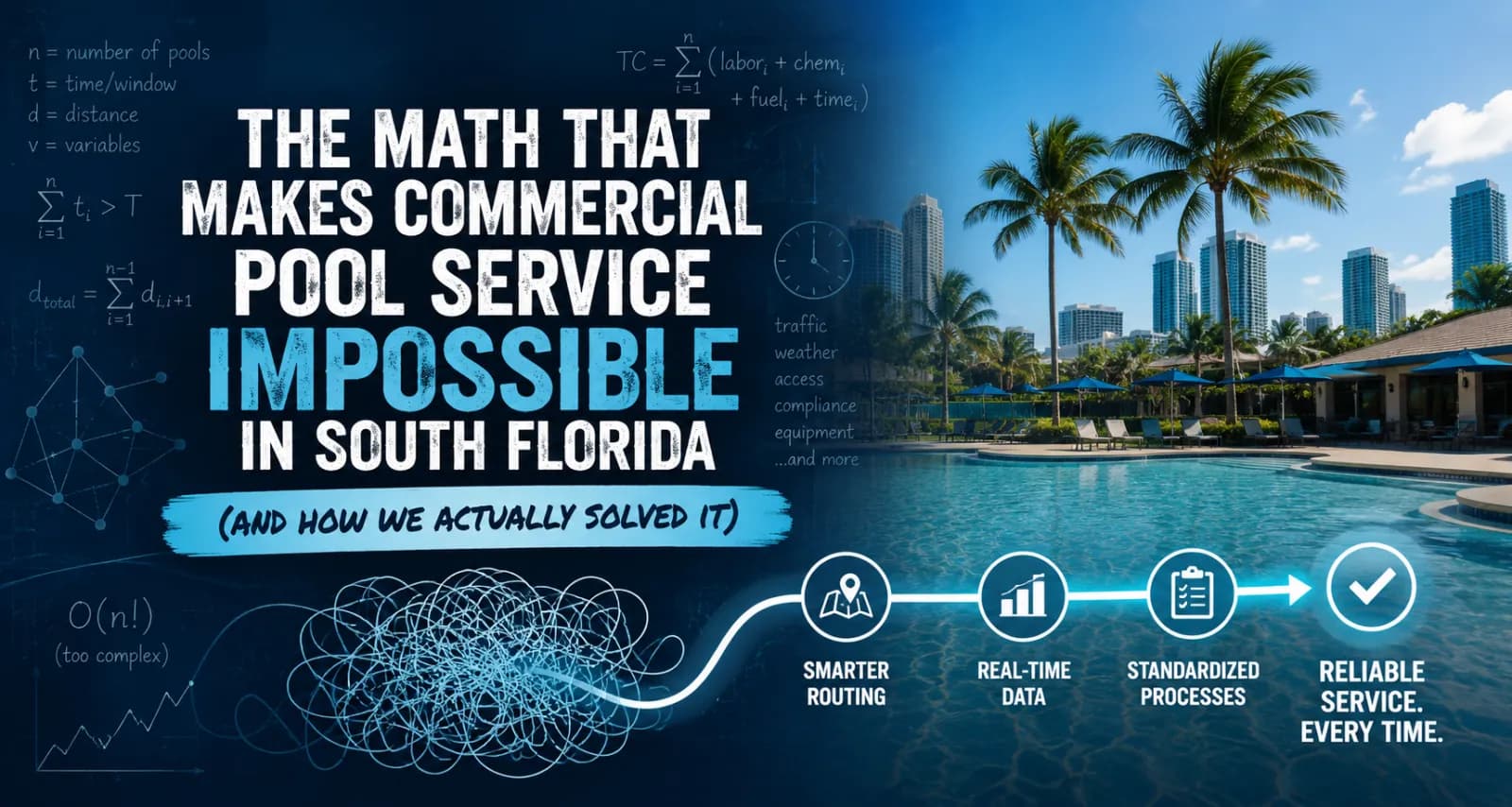
I'll give you the one number that explains the entire commercial pool industry down here. A guy running community pools for a big company does 10 to 20 of them a day. Now do the math on what it takes to keep 20 pools chlorinated — and watch the whole thing fall apart before lunch.
Because once you see the math, you stop blaming the pool guy and you start looking at the system he's stuck inside. That system is broken almost everywhere. Here's the breakdown.
Start with the chlorine you can't carry
A community pool runs 24 hours a day on chemical feeders — chlorine and acid pumping into the water constantly out of containers we call crocs. Keep those loaded and working and the pool basically runs itself. Let them run empty and you've got about three days in summer before the water turns.
So to service 20 community pools right, you'd refill the crocs at all 20 stops. Sounds simple. It's not.
You legally can't carry enough chlorine on one truck to do it. Once you're hauling more than about a thousand pounds of chemicals on a vehicle, you're into special-license territory. The normal chlorine drums are 30 to 50 gallons. Do the arithmetic on filling crocs at even 10 pools and you've blown past what your truck can legally — or physically — hold. I could empty my entire truck into one or two big community crocs and still not be done.
So what does the tech actually do? He dumps a jug or two straight in the pool, jacks the chlorine way up past safe levels, and prays it lasts till next week. Residents standing at the edge wondering if it's safe to get in. And the feeders — the system that's supposed to handle this automatically — sit there empty and broken.
That's not a lazy tech. That's a tech doing the only thing the math allows.
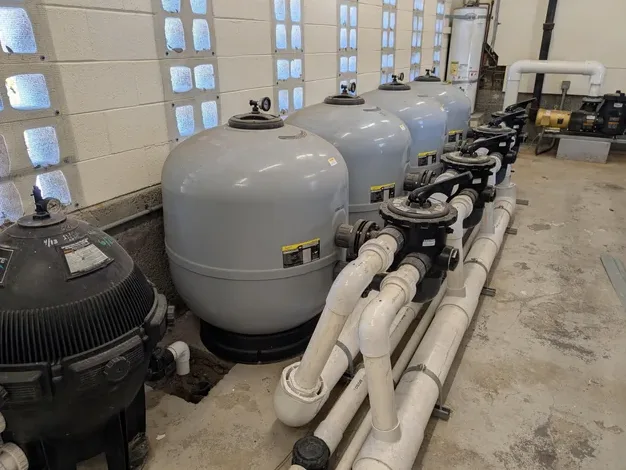
Then add the heat, and the filters get skipped
Now put that same guy in a Florida July. It's 97 degrees. He's got 20 stops. At every pool he's supposed to brush the tiles, vacuum, balance the water, AND pull and clean a caked filter.
You clean a whole pool in that heat, you've got leaves all over you — you do NOT want to then pull a filter apart. I wouldn't either. So it gets skipped. Once. Then again. Then for months.
And here's where the cost shows up, because skipping the filter isn't free — it just sends the bill somewhere worse:
- Dirty filters choke the flow, so the feeders pump like crazy to keep up and you're burning way more chemical than the pool needs
- The water stops circulating — I've seen pools that are supposed to run 200 gallons a minute crawling along at 40
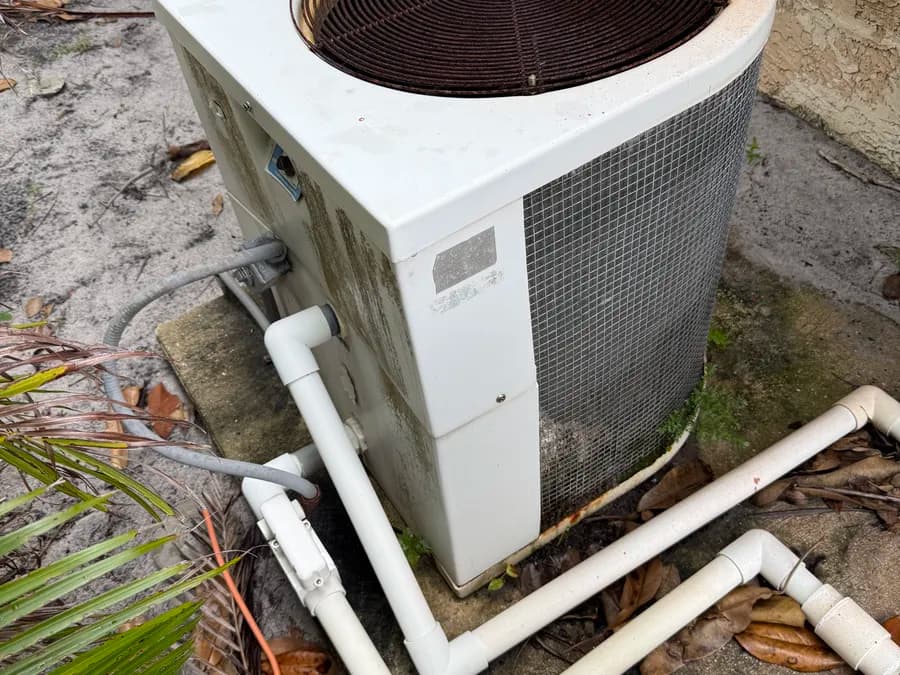
- Back-pressure builds across the whole system, and that's when pumps and heaters start dying
We took over a community pool recently where the last guy put in a brand-new four-cartridge filter set and never cleaned it once. A couple months later they were brown, orange, destroyed. At $150 to $175 a cartridge, that's a four-figure replacement the HOA eats — to dodge a 15-minute cleaning. Stay on top of a filter and it's ten minutes. Let it cake up and it's an hour-plus, so it never gets done. The cheap shortcut is always the expensive one.
If you want the full breakdown of what those neglected feeders and filters do to your inspection, my partner Doug walks through it here: why community pools fail Department of Health inspections.
You can't out-hustle bad math
This is the part people don't want to hear. It doesn't matter how good the tech is.
You could hand me the best pool guy in the state, give him 20 community pools a day and one truck, and he will fail — not because he's bad, but because the job is impossible as designed. You can't carry the chemical. You can't clean every filter. You can't be there when the feeder line cracks on a Thursday and you're not back till the following Wednesday. Six days with a dead feeder in a Florida summer and that pool is green no matter whose name is on the truck.
Same thing happens on residential, by the way. A customer tells me “my pool guy is great.” I believe you. But I was at your pool Wednesday, it rained Wednesday night, then it was 97 degrees Thursday through Tuesday and your pump was down. What color did you think it was going to be? That's not the pool guy. That's chemistry and Florida and a visit schedule that can't keep up.
The good guy gets beat by the system every time. So you don't fix the guy. You fix the system.
How we actually solved it
We stopped asking one person to do an impossible job. We split it.
The service tech does the visible work — brush, vacuum, balance, check the flow, check the filters.
A dedicated maintenance tech runs a completely separate route across all our commercial accounts, and his only job is the part everyone else skips: clean the filters and load every croc so the feeders never run dry. He's basically a roving inspector. He's not stretched across 20 cleanings — he's focused on the equipment that actually keeps the pools alive. That's the core of our commercial & HOA pool service.
That breaks the math problem in half. No single truck has to haul a week of chemical for 20 pools. One person dedicated to delivery and equipment keeps every account's feeders loaded and working — and feeders working is the entire ballgame on a South Florida commercial pool.
And because we're on these pools multiple times a week with real eyes on the equipment, when a controller goes out of whack or a salt cell quits or a feeder line cracks, somebody catches it in a day or two — before 30 kids show up Saturday and the pool can't keep up. We even run the chlorine a touch high on purpose, so if something fails when we're not there, there's a cushion to cover it till we're back. Doug's five-minute walk-up inspection is the exact routine that roving tech runs at every stop.
What it would cost to do residential this well
Here's the thing that always gets me. If a homeowner actually paid for commercial-level service — three days a week, eyes on it constantly — their pool would be cleaner than any community pool in the county. Crystal. You could keep it perfect.
Run the number: three visits a week on a standard pool under 10,000 gallons, you're around $400 a month. That's not even unreasonable for what you'd get. But almost nobody pays for that on a home pool, and that's fine — it's a backyard toy, not a 200-unit condo deck.
The point is the opposite direction. Community pools NEED that frequency, because the bathing load is brutal — 50 people on a weekend instead of a family of four — and the equipment is commercial-grade and unforgiving. One visit a week with a dead feeder doesn't cut it. The math that makes residential a luxury makes commercial a necessity.
We're built for the Florida version of this
Florida classifies HOA and condo pools as public pools, so they have to run under a named Certified Pool Operator — we hold CPO C-105377. And I carry the FPPS, Florida Public Pool Specialist (#600551) — a Florida-specific cert that's heavy hands-on equipment training: they bring in the feeder and pump manufacturers to certify you directly, plus electricians and an attorney for the legal side. It's night and day from the online CPO course, which teaches you basically nothing about chemical feeders. The full breakdown of the two credentials is in FPPS vs CPO; verify both at our credentials page.
If your community pool keeps turning on you
If you manage an HOA, condo, or community pool in Boca Raton, Delray Beach, Boynton Beach, Pompano Beach, Lighthouse Point, or Fort Lauderdale and you're tired of the green-pool-then-scramble cycle, send us the details through our contact form and we'll set up a site assessment. We take over problem pools all the time — usually the ones the last company let go too far.
Got a question first? Text or call 954-347-1120 — we usually answer within a few hours.
Frequently Asked Questions
A commercial tech runs 10 to 20 community pools a day. To keep them chlorinated you'd have to refill the chemical crocs at every stop, but one truck can't legally carry that much chemical — over about 1,000 pounds requires a special license. So the tech dumps a jug straight in the pool, spikes the chlorine to unsafe levels, and hopes it holds until next week. In a South Florida summer, a pool with no chemical feeding it turns in about three days. You can't out-hustle the math — the only fix is a dedicated chemical-delivery and equipment route separate from cleaning.
Once you're hauling more than about a thousand pounds of chemicals on a vehicle, you're into special-license territory. Normal chlorine drums are 30 to 50 gallons — fill the crocs at even 10 pools and you've blown past what a single truck can legally or physically hold. You could empty an entire truck into one or two big community crocs and still not be done, which is why feeders sit empty and techs dump chlorine straight into the pool instead.
About three days in a South Florida summer once the chemical stops feeding in. A community pool runs 24 hours a day on chemical feeders pumping chlorine and acid constantly; let the crocs run empty and the bathing load plus heat turns the water within a few days — faster than a residential pool because of the volume of swimmers.
We split the job into two roles. A service tech does the visible work — brush, vacuum, balance, check flow and filters. A separate dedicated maintenance tech runs his own route across all our commercial accounts with one job: clean the filters and load every croc so the feeders never run dry. No single truck has to haul a week of chemical for 20 pools. We're on the pools multiple times a week, so a cracked feeder line or failing salt cell gets caught in a day or two, and we run chlorine slightly high as a cushion against failures between visits.
Need a pro to handle this?
Florida's Best Pool Service has serviced South Florida homes for 40+ years. CPO-licensed. Fully insured. 230+ five-star reviews.