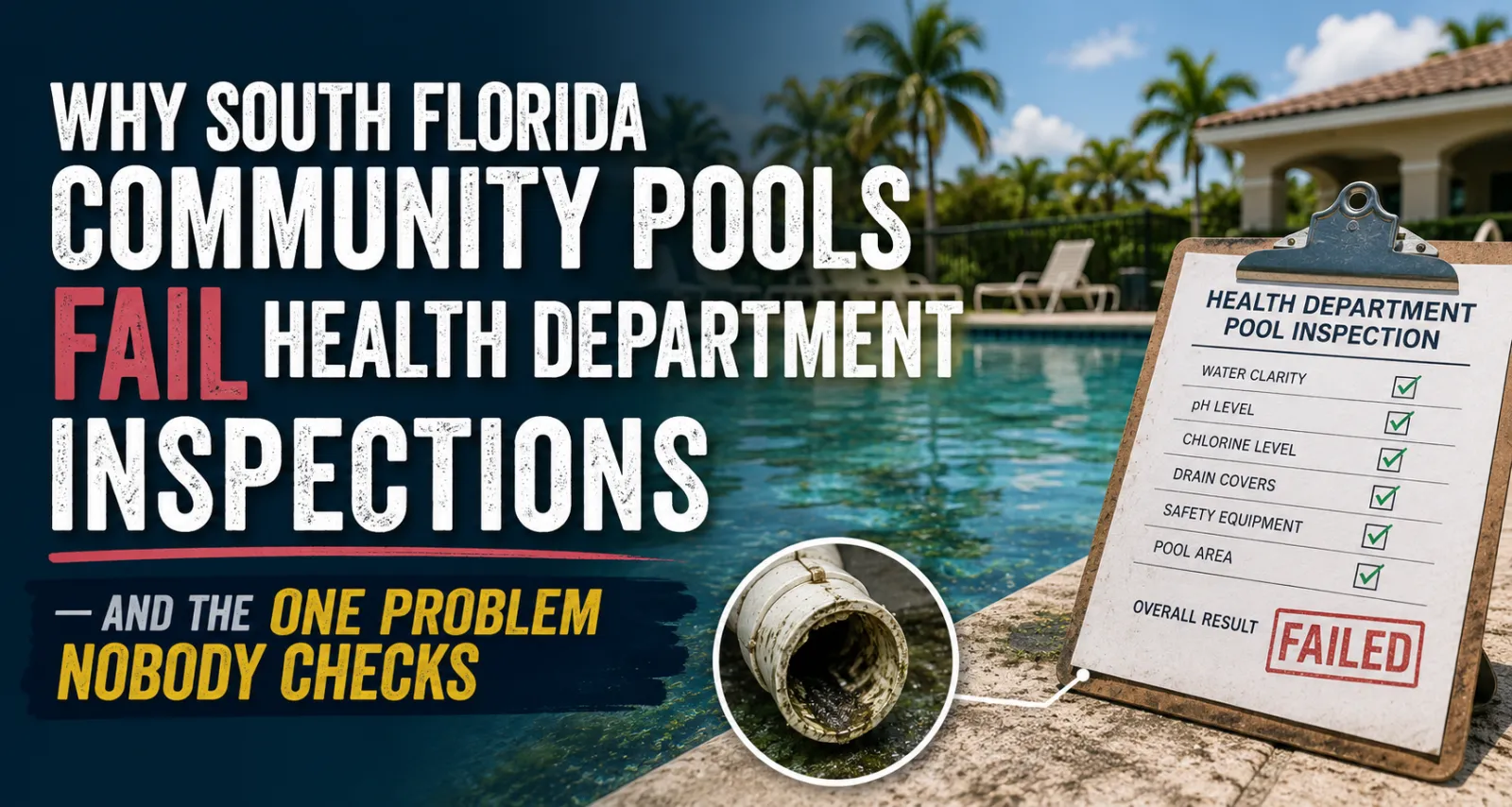
When the Department of Health closes a community pool, the property manager's first assumption is usually that the water got dirty. It almost never is. I've been servicing commercial pools in South Florida for about twelve years, and I can tell you the water is the symptom. The thing that actually fails the inspection is sitting on the equipment pad — and it's the one part of the job most companies skip.
Let me walk you through what really happens, because if you manage an HOA or condo pool, knowing this is the difference between catching a problem and getting a pool closed out from under you. If you'd rather have the field version, my five-minute walk-up inspection turns all of this into a checklist you can run yourself.
The water is the symptom — the equipment pad is the cause
When I walk up to a commercial pool, I don't start with the water for show. I check the chemicals first so I can make any adjustment right away, then I read the flow — is the water actually moving, or is it just sitting there? Then I head back to the equipment area and look at the filters, the chlorine and acid crocs, and the feeders.
That equipment area is where pools live or die. A community pool runs 24 hours a day with chemical feeders constantly pumping chlorine and acid into the water. When that system is working, the pool basically runs itself. When it's not, the water turns — and in a South Florida summer, that happens in about three days.
The inspector knows this too. So that's what he checks.
The chemical feeders nobody is checking
Here's the number that should bother every property manager: out of roughly the last six commercial accounts we've taken over, not one had working chemical feeders.
Not one. Every single time, the crocs — the chlorine and acid containers — were either completely empty, or the feeder lines were cracked and spraying chemical all over the pumps and motors. One pool we took over recently had chlorine shooting straight out of the tube across the entire equipment pad, and the croc was nearly empty. When it had been full, it was just spraying onto the equipment, corroding everything it touched.
Why is this so common? Partly because nobody trains for it. The standard CPO course — the one most techs take online — teaches you almost nothing about chemical feeders. So you've got licensed techs walking up to a feeder system they were never really taught to run. (That gap between the online CPO course and real Florida public-pool training is exactly what FPPS vs CPO gets into.)
But the bigger reason is math, and it's worth understanding because it explains the whole industry.
The reason it keeps happening: the math doesn't work
A commercial tech at a big company runs 10 to 20 community pools a day. New guys start around 10; experienced guys push 20.
To keep those pools properly chlorinated, you have to refill the crocs at each stop. But a single truck can't legally carry enough chemical to do that. Once you're hauling more than a thousand pounds of chemicals on a vehicle, you're into territory that requires a special license. There's no way to load a week's worth of chlorine for twenty community pools onto one truck.
So the overworked tech does the only thing he can: dumps a jug or two of chlorine straight into the pool, jacks the level up to unsafe numbers, and hopes it holds until the next visit. Residents stand at the edge wondering if it's safe to get in. And the feeders — the system that's supposed to be doing this automatically — stay empty and broken. My partner Matt lays out the full economics in the math that breaks commercial pool service.
It's not that these guys are lazy. When it's 97 degrees out and you're expected to vacuum, brush the tiles, and clean a caked filter at twenty stops, the feeders are the first thing to go. The job, run that way, is impossible.
How dirty filters cascade into a shut-down
Once the filters get neglected — and they always do, because cleaning a caked DE or cartridge filter in summer heat is brutal work — everything downstream breaks in sequence:
- The feeders have to pump like crazy to keep up, injecting far more chemical than the pool needs
- The ORP reading climbs because debris is trapped in the system
- Flow drops. This is the big one. I've walked up to pools that are required to run 200 gallons per minute and found them running at 40. That's not close — that's a shut-down. And it's purely from filters so jammed the water can't circulate.
- Back-pressure builds across the whole system, and that's when the expensive equipment — pumps, heaters — starts failing
I saw it on a pool we took over recently. The previous tech had put in a fresh four-cartridge filter set just a couple months earlier, then never cleaned it once. When we pulled the cartridges, they were completely brown and orange — the bodies were still structurally fine, but they were chemically destroyed from never being touched. At $150 to $175 a cartridge, that's a needless four-figure replacement, all to avoid a 15-minute filter clean. If you stay on top of a filter, it takes ten, fifteen minutes. Let it sit for months and you're spending over an hour digging caked debris out — so it gets skipped, and the cycle feeds itself.
What the Department of Health actually shuts pools down for
This is the checklist I run every visit, because it's the checklist the inspector runs once or twice a year:
Feeders and crocs. Every body of water — pool and spa — needs at least one chlorine feeder, one acid feeder, one chlorine croc, and one acid croc, all constantly pumping. Empty croc or missing feeder: automatic violation.
Flow. Every body of water has a flow meter and a required gallons-per-minute on its permit, set by the size of the pool and the number of units. You have to stay within 10% of it. Far below spec is a shut-down.
Filter pressure. Gauges climbing into unsafe ranges mean filters that are dangerously dirty — and those can fail violently if ignored.
Water level and autofill. On a gutter-system pool the level has to sit slightly into the gutter so the surface skims properly. I once found an autofill where the previous guy had literally tied up the float to stop it running, so the level sat permanently low and every leaf that landed sank to the bottom instead of going into the gutter. Set the level right and the pool half-cleans itself; set it wrong and you've made vacuuming twice as hard for no reason.
Stabilizer. Community pools have autofills constantly adding fresh water, which dilutes your chlorine protection. Most companies never check stabilizer — so their chlorine number means nothing. We keep an eye on it because without it, the chlorine reading is a lie.
Safety equipment. Code-correct pool-rule signage, a life ring, and a shepherd's hook. Inspectors flag these the moment they walk on property.
What it looks like when nobody catches it in time
The worst part is that the failure is almost always preventable, and the people involved usually know it's coming.
At one community we took over, the pool had black algae across the walls and floors. Residents and the property manager had been complaining for a while — this wasn't a board refusing to pay for repairs, it was the previous company simply not sending anyone. Then the Department of Health came, saw the algae, and closed the pool. Only then did the old company send their owner out to treat the stains. By that point we'd already met with the property manager, taken over the account, and gotten the equipment running right. It's been clean ever since.
I talked to the tech who'd had that route before us. He told me he'd flagged the problem to his boss five separate times and never got what he needed to fix it — until the Department of Health forced the issue. That's the pattern on almost every account we take over: very obvious things, completely wrong, left that way until something external forced a fix.
How we run it instead
We split the work so the impossible part becomes possible. Our service techs do the visible job — brush, vacuum, balance, check flow and filters. Then a dedicated maintenance tech runs a separate route across all our commercial accounts whose only job is the equipment pad: cleaning filters and loading every croc so the feeders never run dry. He's essentially a roving inspector, checking everything and reporting back, never stretched across a twenty-pool cleaning route. That two-role structure is the heart of our commercial & HOA pool service.
That fixes the math. No single truck has to carry a week of chemical for twenty pools. And because we're on these pools multiple times a week with eyes on the equipment, a cracked feeder line or a controller going out of whack gets caught in a day or two — before 30 kids show up on a Saturday and the pool can't keep up with the load. We also run our chlorine a bit higher than the bare minimum on purpose, so if something fails on a day we're not there, there's a cushion of protection in the water to buy us until the next visit.
None of this is heroics. It's just staying on top of the part of the job that actually matters. If you use the equipment the way it's meant to be used, a commercial pool really does run itself.
Certified specifically for Florida public pools
Florida classifies HOA and condo community pools as public pools, which means they must operate under a named Certified Pool Operator. Florida's Best Pool Service holds CPO C-105377, and our lead tech Matt Balog also holds the FPPS — Florida Public Pool Specialist (#600551), a Florida-specific credential built around exactly this equipment: feeder and pump manufacturers brought in to certify techs hands-on, plus the electrical and legal side most courses skip. You can verify both at our credentials page.
If your community pool needs a service that checks the equipment
If you manage an HOA, condo, or community pool in Boca Raton, Delray Beach, Boynton Beach, Pompano Beach, Lighthouse Point, or Fort Lauderdale — and you want a service that stays ahead of the Department of Health instead of behind it — send us the details through our contact form and we'll set up a site assessment. If your pool has already been closed for violations, that's exactly the situation we take over most.
Have a question first? Text or call 954-347-1120 — we usually reply within a few hours.
Frequently Asked Questions
Almost never because the water looks dirty — it's the equipment pad that fails. The most common causes are empty chemical crocs or missing/broken feeders (every pool and spa needs at least one working chlorine and one acid feeder, constantly pumping; an empty croc is an automatic shut-down), flow below the required gallons-per-minute (usually from filters not cleaned in months — we've seen 200 GPM pools running at 40), unsafe filter pressure, a mis-set autofill or water level, unchecked stabilizer that makes the chlorine reading meaningless, and missing safety equipment (life ring, shepherd's hook, code signage). The root cause is structural: one tech running 10 to 20 pools a day physically cannot keep every croc loaded and every filter clean.
Crocs are the chemical containers on the equipment pad — every pool and spa needs one chlorine croc and one acid croc. Feeders are the pumps that meter chlorine and acid out of those crocs into the water continuously, 24 hours a day. Every body of water needs at least one working chlorine feeder and one acid feeder. An empty croc or a missing/broken feeder is an automatic Department of Health violation, because without it the pool has no continuous sanitation.
Yes. The water is the symptom, not what the inspector grades. A pool can look clear the day of inspection and still be shut down for empty crocs, a broken feeder, flow below the permitted gallons-per-minute, unsafe filter pressure, or missing safety equipment. Conversely, the equipment failures that cause closures are exactly what turn the water in two to three days once they're left unaddressed.
Yes — that's the situation we take over most. We assess the cited violations, get the equipment pad working correctly (feeders, crocs, filters, flow, autofill), reset the chemistry, and get the pool back to compliant and open. Several of our current accounts came to us exactly that way, after the previous company let obvious equipment problems go until the Department of Health forced the issue.
Need a pro to handle this?
Florida's Best Pool Service has serviced South Florida homes for 40+ years. CPO-licensed. Fully insured. 230+ five-star reviews.