Pool Chemical Dosage & Cost Calculator
Exact doses for your Palm Beach County pool, priced at full pool-store retail — including the whole bag you have to buy for a six-ounce dose.
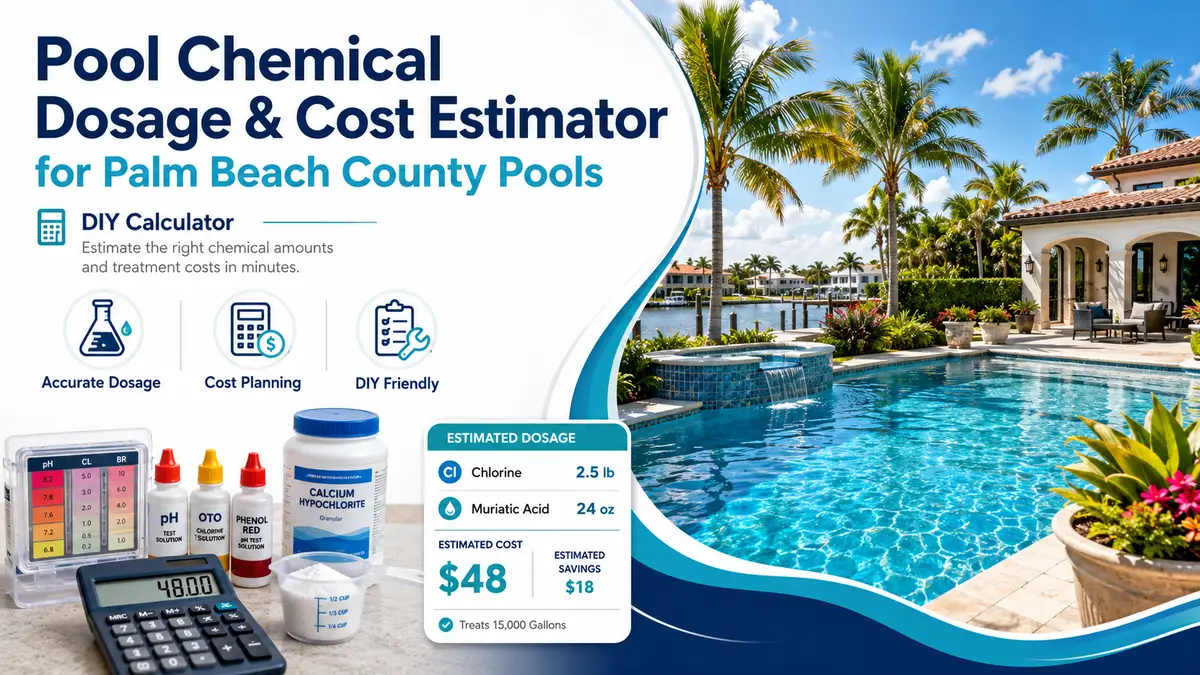
Pool chemical dosage & cost estimator
Exact doses for a Palm Beach County pool, priced at what the pool store actually charges — including the bag or jug you're forced to buy for a six-ounce dose.
Not sure? Length × width × average depth × 7.5 for a rectangle. Most Boca and Delray family pools land between 12,000 and 20,000 gallons.
Routine target is 1–4 ppm (3–5 on a salt pool). Shock/SLAM is 10–20 ppm. If your CYA is high, your minimum FC goes up with it — roughly 7.5% of your CYA reading.
Add 30.6 fl oz
Raises free chlorine by 2 ppm in 15,000 gallons using liquid chlorine 12.5% (pool grade). Pump running, retest before you add more.
Chemical actually used
$1.05–$1.63
At pool-store retail. What this dose is worth if you already have the product open.
What you pay at the register
$11–$17
1 × 2.5-gal jug — the smallest quantity the store will sell you.
You'll use about 10% of what you buy. The other 90% sits in your garage — which is fine for salt and stabilizer, and a slow loss for liquid chlorine, which drops roughly 10% strength a month in Florida heat.
Cheapest chlorine per ppm — what service routes run. Low end of the range is the jug-exchange/refill price; you pay the high end for a new carboy. Loses ~10% strength a month in Florida heat, so buying six jugs on sale is not the deal it looks like.
How the prices work:shelf prices are 2026 Palm Beach County ranges for the pool-store aisle — Pinch A Penny, Leslie's, and the big-box pool section. Pinch A Penny locations are individually franchised and set their own prices, so we publish a range instead of pretending to know what your store charges today. Dosing math follows our verified dosing reference; pH doses are approximations that depend on alkalinity, which is why the tool tells you to add half and retest. Never mix chlorine products — trichlor and cal-hypo react violently. One product, one dose, water moving.
What the shelf tag doesn't tell you
Every DIY chemical calculator on the internet stops at “add 18 ounces.” That number is the easy half. Here's the part that decides whether DIY actually saves you money in Boca Raton, Delray Beach, and the rest of Palm Beach County.
- You buy packages, not doses. A pool needing 8 ounces of stabilizer buys a 4-lb bag. A pool needing 20 fl oz of acid buys a gallon. On small corrections the register price is 5–10× the value of the chemical you actually use — and that gap is where the DIY savings quietly go.
- Retail runs 30–60% over wholesale. The same jug a service route pays wholesale for costs you retail at the pool store. That's not a knock on the store — it's the margin that keeps a storefront open. It just means the chemical half of DIY starts a third to two-thirds behind.
- Florida heat eats your inventory. Liquid chlorine loses roughly 10% of its strength a month in South Florida, faster in a hot garage. Buying six jugs on sale in June means dosing with weak chlorine in August and wondering why the pool went cloudy.
- The cheap chlorine has a bill attached. Trichlor tabs are the cheapest per pound and the most expensive per year: every 10 ppm of chlorine adds about 6 ppm of cyanuric acid, and CYA only leaves a pool by draining it. The calculator shows you that side effect on every dose.
- Our fill water is already hard. Palm Beach County tap water frequently arrives at 250–350 ppm calcium hardness. Most local pools never need calcium increaser — and cal-hypo shock quietly pushes an already-high number higher every week you use it.
Matt Balog wrote the full breakdown behind these numbers — what every dose actually costs at Palm Beach County retail — including the shelf-price table, the CYA math that makes cheap tablets expensive, and a full month itemized.
Want the dosing chemistry explained rather than calculated? Start with our water chemistry library. Comparing DIY against a flat monthly rate? Run the pool service cost calculator.
Why Homeowners Choose Florida's Best Pool Service
Chemical cost FAQs
For a typical 15,000-gallon Boca Raton or Delray Beach chlorine pool in summer, buying at pool-store retail, expect roughly $70–$110 a month in chemicals alone — liquid chlorine is the biggest line at $48–$74, followed by shock, muriatic acid, alkalinity increaser, stabilizer, and test reagents. Salt pools spend less on sanitizer but carry a salt cell replacement that averages $10–$58 a month once you amortize an $800–$2,100 installed cell over the 3–7 years it lasts (3–4 oceanfront, 5–7 well inland). Those figures are chemicals only — no labor, no filter cleaning, no equipment care. Month one runs higher than any of it, because you buy full packs. A licensed service company buys the same chemicals at wholesale, which is 30–60% cheaper, and folds them into a flat monthly rate.
They're ranges, not a price list. Pinch A Penny stores are individually franchised and each one sets its own shelf prices, so a jug of liquid chlorine can differ by several dollars between the Boca Raton and Delray Beach stores in the same week. We publish a low-to-high band that covers what the Palm Beach County pool aisle — Pinch A Penny, Leslie's, and the big-box pool section — typically charges in 2026. Use the range to plan; use your receipt for the exact number.
Because the pool store won't sell you six ounces of stabilizer. The first number is the value of the chemical you actually use. The second is what the register rings up, because the smallest unit on the shelf is a 4-lb bag, a 1-gallon jug, or a 25-lb sack. On small corrections the gap is enormous — a $2 dose can cost $28 at checkout. That's the single biggest reason DIY chemistry costs more than the label math suggests, and no other pool calculator shows it.
On chemicals alone, DIY is cheaper — you're paying retail instead of wholesale, but you're not paying anyone's labor. The comparison changes once you count everything: retail markup of 30–60%, the packs you're forced to over-buy, a real reagent test kit, 45–60 minutes a week of your own time, and the repairs that get caught early when a technician looks at the equipment pad every week. Most Palm Beach County owners find the gap between a properly run DIY program and flat-rate weekly service is far smaller than either side's marketing claims. Run the monthly tab in the calculator against our pool service cost calculator and decide with real numbers.
Liquid chlorine at 12.5% is the cheapest per ppm and adds nothing to the water but a trace of salt — it's what service routes run. Trichlor tablets look cheaper per pound but add roughly 6 ppm of cyanuric acid for every 10 ppm of chlorine, and CYA never leaves the water except by draining. In Florida heat, tablet-fed pools routinely cross 100 ppm CYA within a season or two, at which point chlorine stops working and the real cost is a drain and refill. The calculator flags the CYA and calcium a product adds alongside the dose so you can see the whole bill, not just the shelf price.
Chlorine, alkalinity, stabilizer, calcium, and salt doses are straight linear chemistry and are accurate. pH is different: acid demand depends heavily on total alkalinity, which is why the tool asks for your TA and why it warns you on any move larger than about 0.4. Best practice with pH is always the same — add half the calculated dose, run the pump for an hour, retest, then decide. Overshooting pH downward is far more expensive to fix than taking two afternoons to get there.
For a rectangular pool: length × width × average depth × 7.5. For an oval or kidney shape: length × width × average depth × 5.9. Average depth is (shallow end + deep end) ÷ 2. Most Boca Raton and Delray Beach family pools land between 12,000 and 20,000 gallons; screened dip pools run 6,000–10,000; country-club and estate pools run 25,000–40,000. If you're guessing, guess high — under-dosing a big pool is the more common mistake.
Not sure your numbers are right?
Free on-site water analysis — a water test at the pool, an equipment-pad walkthrough, and an honest read on what your pool needs. Whether you hire us or keep doing it yourself.