I've been on Florida pool routes since the mid-1990s — my father has been a licensed Florida pool contractor since 1989, and he's the one who taught me — and in 30 years on the route I've had the same conversation in a hundred driveways. A homeowner tells me they're going to handle the chemicals themselves, and six weeks later they show me a drawer full of half-used bags and ask where the money went.
It didn't go into the pool. Most of it is still sitting in the garage.
Every pool chemical calculator on the internet will tell you to add 18 ounces of something. None of them tell you that the pool store won't sell you 18 ounces. That gap — between the dose and the receipt — is the entire reason DIY chemistry costs more than the label math says it should. So we built a calculator that shows you both numbers.
Put your pool in it, then read the rest. Everything below is Palm Beach County specific: our sun, our afternoon storms, our hard fill water, and what the pool aisle actually charges in 2026.
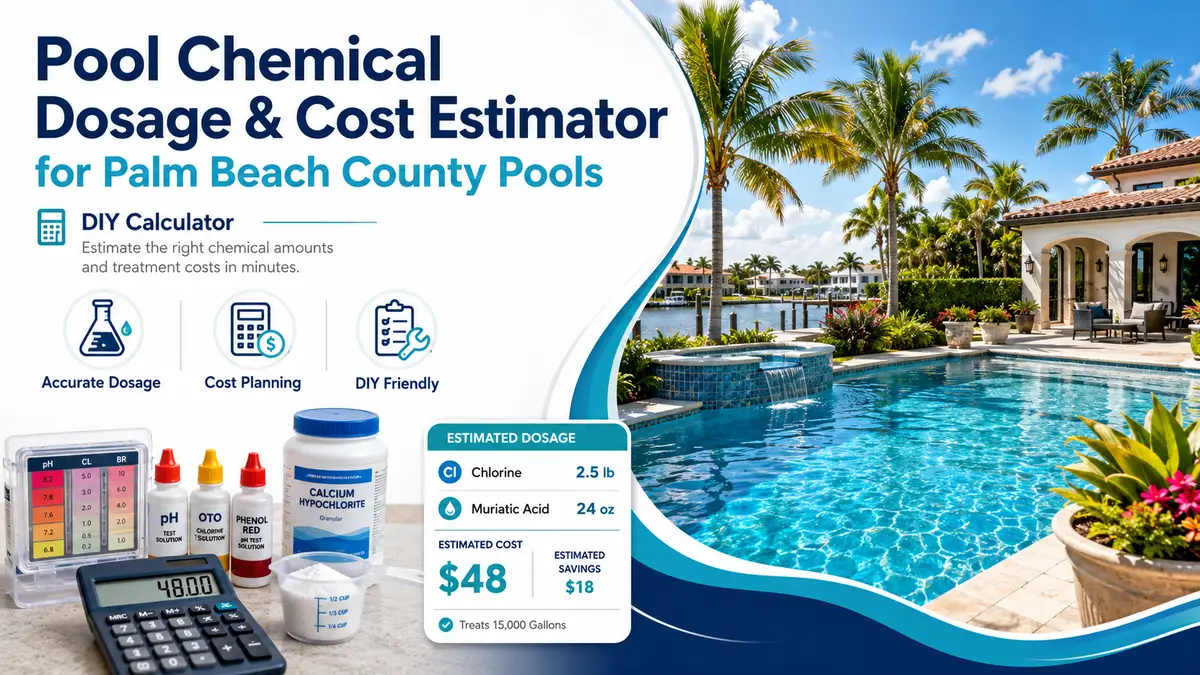
Pool chemical dosage & cost estimator
Exact doses for a Palm Beach County pool, priced at what the pool store actually charges — including the bag or jug you're forced to buy for a six-ounce dose.
Not sure? Length × width × average depth × 7.5 for a rectangle. Most Boca and Delray family pools land between 12,000 and 20,000 gallons.
Routine target is 1–4 ppm (3–5 on a salt pool). Shock/SLAM is 10–20 ppm. If your CYA is high, your minimum FC goes up with it — roughly 7.5% of your CYA reading.
Add 30.6 fl oz
Raises free chlorine by 2 ppm in 15,000 gallons using liquid chlorine 12.5% (pool grade). Pump running, retest before you add more.
Chemical actually used
$1.05–$1.63
At pool-store retail. What this dose is worth if you already have the product open.
What you pay at the register
$11–$17
1 × 2.5-gal jug — the smallest quantity the store will sell you.
You'll use about 10% of what you buy. The other 90% sits in your garage — which is fine for salt and stabilizer, and a slow loss for liquid chlorine, which drops roughly 10% strength a month in Florida heat.
Cheapest chlorine per ppm — what service routes run. Low end of the range is the jug-exchange/refill price; you pay the high end for a new carboy. Loses ~10% strength a month in Florida heat, so buying six jugs on sale is not the deal it looks like.
How the prices work:shelf prices are 2026 Palm Beach County ranges for the pool-store aisle — Pinch A Penny, Leslie's, and the big-box pool section. Pinch A Penny locations are individually franchised and set their own prices, so we publish a range instead of pretending to know what your store charges today. Dosing math follows our verified dosing reference; pH doses are approximations that depend on alkalinity, which is why the tool tells you to add half and retest. Never mix chlorine products — trichlor and cal-hypo react violently. One product, one dose, water moving.
What each chemical costs on the Palm Beach County shelf
These are 2026 ranges for the local pool aisle — Pinch A Penny, Leslie's, and the big-box pool section. I'm publishing a band rather than a price list on purpose: every Pinch A Penny is an independently owned franchise that sets its own prices, so the Boca store and the Delray store can be three dollars apart on the same jug in the same week.
| Product | Smallest pack sold | 2026 retail | What it moves in 15,000 gal |
|---|---|---|---|
| Liquid chlorine 12.5% | 2.5-gal jug | $11–$17 | +2 ppm free chlorine per 30.6 fl oz |
| Muriatic acid 31.45% | 1-gal jug | $8–$12 | −0.1 pH per ~23 fl oz at TA 140 |
| Cal-hypo shock 68% | 1-lb bag | $4–$6.50 | +5 ppm free chlorine per bag |
| Stabilizer (cyanuric acid) | 4-lb bag | $22–$34 | +20 ppm CYA per 2.5 lbs |
| Alkalinity increaser (sodium bicarb) | 25-lb bag | $30–$45 | +30 ppm TA per 6.3 lbs |
| pH increaser (soda ash) | 10-lb bag | $22–$34 | +0.5 pH per ~2.8 lbs |
| Calcium hardness increaser | 25-lb bag | $38–$58 | +70 ppm CH per ~12.6 lbs |
| Pool salt | 40-lb bag | $9–$14 | +400 ppm salt per 50 lbs |
| Trichlor 3" tabs 90% | 25-lb bucket | $120–$180 | +5 ppm free chlorine per ~1.4 lbs — and +3 ppm CYA |
Look at the last column on the trichlor row. That's the whole story of Florida pool chemistry in one line, and I'll come back to it.
The package problem: why a $2 dose costs $28
This is the part nobody prices in. Your pool needs a small correction, the chemical involved costs almost nothing at the volume you actually need, and the store sells it in a bag ten times that size. Here's what that looks like on a 15,000-gallon pool.
| The correction | Dose | Chemical used | At the register | You use |
|---|---|---|---|---|
| Raise FC 1 → 3 ppm | 30.6 fl oz liquid chlorine | $1.05–$1.63 | $11–$17 | 10% |
| Raise CYA 20 → 40 ppm | 2.5 lbs stabilizer | $14–$21 | $22–$34 | 63% |
| Raise TA 60 → 90 ppm | 6.3 lbs bicarb | $7.56–$11.34 | $30–$45 | 25% |
| Lower pH 8.0 → 7.5 (at TA 140) | 115.5 fl oz acid | $7.22–$10.83 | $8–$12 | 90% |
| Raise salt 2,800 → 3,200 ppm | 50 lbs salt | $11.25–$17.50 | $18–$28 | 63% |
| All five in one trip | — | $41–$62 | $89–$136 | — |
The chemistry that goes in the water is worth $41 to $62. The receipt says $89 to $136. Both numbers are true, and the difference is on a shelf in your garage. Some of it keeps indefinitely — salt and stabilizer are basically immortal. Liquid chlorine is the one that punishes you for stockpiling, and I'll get to that.
A month of chemistry on a 15,000-gallon Boca pool
Here's a full summer month, itemized, on the most common pool profile in my service area — a 15,000-gallon chlorine pool, uncovered, normal family bather load, May through October.
| Line item | What it covers | Retail |
|---|---|---|
| Liquid chlorine | 10.9 gallons — 3 ppm/day burned off × 30 days | $48–$74 |
| Shock (cal-hypo) | 2 × 1-lb bags — storms, guests, early algae | $7–$12 |
| Muriatic acid | 0.4 gallons — normal pH rise plus tab acidity correction | $3–$5 |
| Alkalinity increaser | 2.3 lbs — rebuilding buffer after rain dilution | $3–$4 |
| Stabilizer | 0.5 lbs — replacing the 4 ppm our sun and rain take out | $3–$4 |
| Test reagents (amortized) | Taylor K-2006 refills — a real drop test, not strips | $5–$9 |
| Chemistry consumed | What actually went in the water | $69–$108 |
| Your first receipt | Whole jugs and whole bags, month one | $123–$189 |
Chlorine is roughly 70% of that bill. It surprises people who've been running tablets, because a bucket of tabs feels like it lasts forever — and it does, right up until the cyanuric acid catches up with you.
The cheap chlorine that isn't
Trichlor tablets are the cheapest chlorine per pound on the shelf and the most expensive chlorine you can put in a Florida pool. Every 10 ppm of chlorine a tab delivers also delivers about 6 ppm of cyanuric acid, and CYA does not leave a pool. It doesn't burn off, it doesn't gas off, nothing consumes it. It accumulates until you drain.
| Time on tabs | CYA added | Running CYA | Where that leaves you |
|---|---|---|---|
| Starting point | — | 40 ppm | Target range for a chlorine pool |
| Month 3 | +54 ppm | 94 ppm | Chlorine slowing down — so you start adding more |
| Month 6 | +108 ppm | 148 ppm | Locked — chlorine barely works at any dose |
| The fix | — | — | 73% drain and refill: $160–$330 water plus $50–$100 rebalance |
That math is why service routes run liquid chlorine, and why the calculator flags the CYA and calcium every product adds alongside the dose it gives you. For the full picture on stabilizer, our cyanuric acid guide covers the lock mechanism and the drain arithmetic in detail.
The four Palm Beach County multipliers
The same pool costs more to run here than almost anywhere else in the country. Four reasons, all local:
- The sun.Direct summer sun in Boca burns through unstabilized chlorine in 4–6 hours. Your pool loses roughly 3 ppm a day in July against 1.5 in January — the biggest single swing in the whole budget, and why the calculator asks for a season.
- The 3pm storm.Daily summer rain dilutes salt, drops alkalinity, pushes pH around, and washes phosphates and organic debris off the deck into the water. Nothing stays set. You're not balancing a pool once, you're re-balancing it every week.
- Our fill water is already hard.Palm Beach County tap water frequently arrives at 250–350 ppm calcium hardness. Almost nobody here needs calcium increaser — and cal-hypo shock quietly pushes an already-high number higher every week you use it. Check your calcium hardness before you buy a bag of anything with calcium in the name.
- Your garage is an oven.Liquid chlorine loses roughly 10% of its strength a month at room temperature, and faster in a closed Florida garage. Buying six jugs on sale in June means dosing with weak chlorine in August and wondering why the water went cloudy. Buy what you'll use in about three weeks.
Salt pools: cheaper chemicals, one big bill
Run the calculator on salt and the monthly number drops to roughly $35–$100. That's real — the cell makes your chlorine, so the biggest line item disappears. But the honest version of that number includes the cell itself.
| Distance from the ocean | Typical cell life | Installed replacement | True monthly cost |
|---|---|---|---|
| Oceanfront / east of A1A | 3–4 years | $800–$2,100 | $17–$58 |
| Half a mile to a mile | 4–5 years | $800–$2,100 | $13–$44 |
| One to three miles | 5–6 years | $800–$2,100 | $11–$35 |
| Three-plus miles inland | 5–7 years | $800–$2,100 | $10–$30 |
A salt pool isn't cheaper than a chlorine pool. It's a pool where you pre-pay for several years of chlorine in one lump, and the lump comes due faster the closer you live to the water. Neglected calcium scale is what turns a six-year cell into a three-year cell, which is the whole argument for cleaning the cell on schedule instead of waiting for the low-flow code.
What we pay versus what you pay
I'm not going to pretend this comparison is complicated. A licensed service company buys the same chemicals on wholesale accounts at 30–60% under shelf price, which is how $90–$140 of retail chemistry becomes $60–$90 of route chemistry. That gap is the margin that keeps a storefront open — it's not a knock on the store, it's just the number you start behind.
On our routes, weekly service on a 15,000-gallon pool runs $140–$185 a month flat, all chemistry included, plus the visit itself, a test-strip water check (a LaMotte WaterLink Spin Touch photometer on tougher pools), brushing, vacuuming, filter cleaning on schedule, and an equipment-pad walk-around every week. Set that against $69–$108 of chemicals you buy yourself plus 5–9 hours a month on a deck in August, and the honest answer is that the two are closer than either side's marketing admits. The full head-to-head with time and risk priced in is our pro service vs DIY breakdown, and the flat-rate side is in the pool service cost calculator.
When DIY chemistry actually pencils
Plenty of people on the streets I service do this well. The ones who do share most of these traits:
- A chlorine pool under about 15,000 gallons with simple equipment — no spa, no heater, no automation to coordinate
- A real reagent kit (Taylor K-2006 or equivalent), not strips, and the discipline to use it the same day every week
- Liquid chlorine as the primary sanitizer, bought fresh in small quantities, with tabs used sparingly if at all
- Home every week, year-round — a Florida pool left alone for two summer weeks can be past the point of a simple recovery
- A shaded, ventilated place to store chemicals that isn't the garage in August
- Genuine interest in the chemistry, not just tolerance for it — the people who find it interesting are the ones whose pools stay clear
If most of that describes you, the calculator above will save you real money mostly by keeping you from over-buying. If it doesn't, the numbers usually stop favoring DIY somewhere around the second algae bloom.
The low-risk first step
Whichever way you lean, the lowest-risk first step is a free on-site evaluation. We'll test your water on site, walk your equipment pad, and tell you honestly what your pool actually needs — including which chemicals you can stop buying. Whether you hire us or not.
Florida's Best Pool Service is family-owned, CPO C-105377, fully insured, and runs weekly routes through Boca Raton, Delray Beach, Fort Lauderdale, Highland Beach, Boynton Beach, Pompano Beach, Coral Springs, Coconut Creek, Wellington, and the surrounding South Florida service corridor. Your regular tech, same day every week (once your route is established). Photo-documented service report after every visit. Month-to-month — no long-term lock-in. Built around 40+ years of combined founder experience between Matt Balog, Joe Ford, Ronald Liddell, and Doug Santiago.
Request a free evaluation or call 954-347-1120.
Frequently Asked Questions
A 15,000-gallon chlorine pool in summer consumes $69–$108 a month of chemistry at pool-store retail — liquid chlorine is $48–$74 of that, followed by shock at $7–$12, muriatic acid at $3–$5, alkalinity increaser at $3–$4, stabilizer at $3–$4, and amortized test reagents at $5–$9. Winter runs materially lower because chlorine demand drops from about 3 ppm a day to 1.5. Your first trip to the store is higher than the monthly consumption figure — expect $123–$189 — because you buy whole jugs and whole bags for doses measured in ounces, and the leftovers carry into month two.
Because pool stores sell packages, not doses. Raising free chlorine from 1 to 3 ppm in a 15,000-gallon pool takes 30.6 fl oz of liquid chlorine — about $1.05 to $1.63 worth — but the smallest unit on the shelf is a 2.5-gallon jug at $11–$17, so you use roughly 10% of what you pay for. Raising total alkalinity 30 ppm uses 6.3 lbs of bicarbonate worth $7.56–$11.34, but the bag is 25 lbs at $30–$45. On small corrections the register price routinely runs five to ten times the value of the chemical that actually enters the water. That gap is the single most underestimated cost in DIY pool care.
They're ranges covering the Palm Beach County pool aisle, not a price list. Every Pinch A Penny location is an independently owned franchise that sets its own shelf prices, so the same jug of liquid chlorine can differ by several dollars between the Boca Raton and Delray Beach stores in the same week — and Leslie's and the big-box pool sections move independently again. The low-to-high band published here covers what those retailers typically charge in 2026. Use the range to plan your budget and your own receipt for the exact figure.
Liquid chlorine at 12.5% is the cheapest per ppm and adds nothing to the water but a trace of salt, which is why service routes run it. Trichlor tablets look cheaper per pound but add roughly 6 ppm of cyanuric acid for every 10 ppm of chlorine, and CYA never leaves a pool except by draining. Starting at 40 ppm CYA, six months of tablet feeding puts a pool near 148 ppm, where chlorine barely works at any dose — and the fix is a 73% drain and refill costing $160–$330 in water plus $50–$100 to rebalance. Cheap per pound, expensive per year.
On consumables, yes — roughly $35–$100 a month versus $69–$108, because the cell generates chlorine from the salt already in the water. But that comparison is incomplete without the cell itself. A replacement runs $800–$2,100 installed and lasts 3–4 years oceanfront, 5–7 years three or more miles inland, which works out to $10–$58 a month amortized. A salt pool isn't cheaper than a chlorine pool; it's a pool where you pre-pay for several years of chlorine in one lump, and the lump comes due faster the closer you live to the ocean.
Usually not. Palm Beach County tap water frequently arrives at 250–350 ppm calcium hardness, which is already inside the 200–400 ppm target range for plaster and Diamond Brite surfaces. Most local pools have the opposite problem — hardness climbing toward scale territory, which shows up as white crust at the waterline tile and as scale that shortens salt cell life. Test before you buy a bag, and be aware that cal-hypo shock adds roughly 0.67 ppm of calcium hardness for every 1 ppm of chlorine it delivers, so weekly cal-hypo use quietly pushes an already-high number higher.
Chlorine, alkalinity, stabilizer, calcium, and salt doses are straight linear chemistry and are accurate. pH is different, because acid demand depends heavily on total alkalinity — a pool at 140 TA consumes far more acid per tenth of a pH point than one at 80. That's why the calculator asks for your TA on the pH goals and why it warns on any move larger than about 0.4. The correct practice with pH is always the same: add half the calculated dose, run the pump for an hour, retest, then decide. Overshooting pH downward costs more to fix than spending two afternoons getting there.
For a rectangular pool: length × width × average depth × 7.5. For an oval or kidney shape: length × width × average depth × 5.9. Average depth is the shallow end plus the deep end divided by two. Most Boca Raton and Delray Beach family pools land between 12,000 and 20,000 gallons; screened dip pools run 6,000–10,000; country-club and estate pools run 25,000–40,000. If you're estimating, estimate high — under-dosing a large pool is the more common and more expensive mistake, because it leaves chlorine below the level where it actually controls algae.
Need a pro to handle this?
Florida's Best Pool Service has serviced South Florida homes for 40+ years. CPO-licensed. Fully insured. 230+ five-star reviews.