
I've been on Florida pool routes since the late 1990s; my father has been a licensed Florida pool contractor since 1989, and he taught me. Nobody thinks about their pool heater for six months. Then the first real cold front comes through, half the neighborhood turns the heat on the same evening, and the phone lights up the next morning. The calls come in the same order every year, and most turn out to be the same few things.
Why the calls all land in the same week
The National Weather Service office in Miami marks October 15 as the end of South Florida's wet season, but what you feel is the first front with real cool air behind it, when the lows drop toward the low 60s or upper 50s. Some years that's mid-October; some years it holds off until November. Either way, the calls stack up within a day or two, because:
- The heater hasn't run since spring, so the first call for heat is its first real test.
- Summer left marks: storm debris, a pump turned down to save power, lightning, salt air, bugs in a quiet cabinet.
- Everybody wants it warm by the weekend, so the heater gets its hardest job on its first day back.
The calls, in the order they show up
This is the pattern, not any one customer. The first wave hits the morning after; later calls come once the heater has run a few days.
| # | What we hear | What it usually is | Who fixes it | Typical cost |
|---|---|---|---|---|
| 1 | “It won't fire” | Dirty filter, packed baskets, closed valve, slow pump | You | Often $0 |
| 2 | “The gas heater clicks and quits” | Spider webs or nests in the venturi or burner tray | Licensed tech | $150–$350 cleaning |
| 3 | “The heat pump runs, the pool won't climb” | A healthy unit asked for a big rise in cool air | Usually nobody | $0 |
| 4 | “There's ice on the heat pump” | Normal defrost | Usually nobody | $0 if it clears |
| 5 | “There's a code on the display” | Flow first; sometimes a lightning-damaged board | You, then a tech | $250–$1,800 if a part |
| 6 | Dead display or a tripped breaker | A one-off trip, or a failing contactor, capacitor, or circuit | You, then a tech or electrician | $0 up to $250–$1,800 |
| 7 | “It's weak or leaking since last winter” | A part that failed quietly all summer | Tech | $250–$1,800; exchanger or compressor $4,000–$5,000 |
| 8 | “I set it to 90 and it's 76” | Physics, not a fault | Nobody | $0 |
Call 1: “It won't fire”
The first calls come before 8 a.m., and most end at the filter. Every heater has a flow or pressure switch that won't let it fire without enough water moving. After a summer of storms the cartridge is loaded, the baskets are packed, and the heater reports a fault that isn't its fault. Two summer twists: a variable-speed pump turned down to a quiet speed can starve the heater, and a short summer timer kills the heat when the pump stops.
You can check: clean the filter, empty the baskets, open the valves to the heater, close any bypass, and give the pump enough speed and hours. If it fires, you fixed it for the price of a rinse; a worn cartridge runs $50–$200. Call a tech if flow is good and the code keeps coming back; a pressure-switch repair falls in the $250–$1,800 range. Full walk: our pool heater troubleshooting guide.
Call 2: the gas heater that clicks, tries, and quits
By mid-morning the gas calls start: the heater clicks, tries to light, and locks out with an ignition code. On a heater untouched since spring, it usually isn't a part. Spiders web up the venturi, the tube where gas and air mix, and wasps move into the quiet burner tray or flue. Combustion chokes, the flame never proves, and the board shuts the gas off, as designed. Code names differ by brand (see our Raypak, Pentair MasterTemp 400, and Haywardreferences); the cause doesn't.
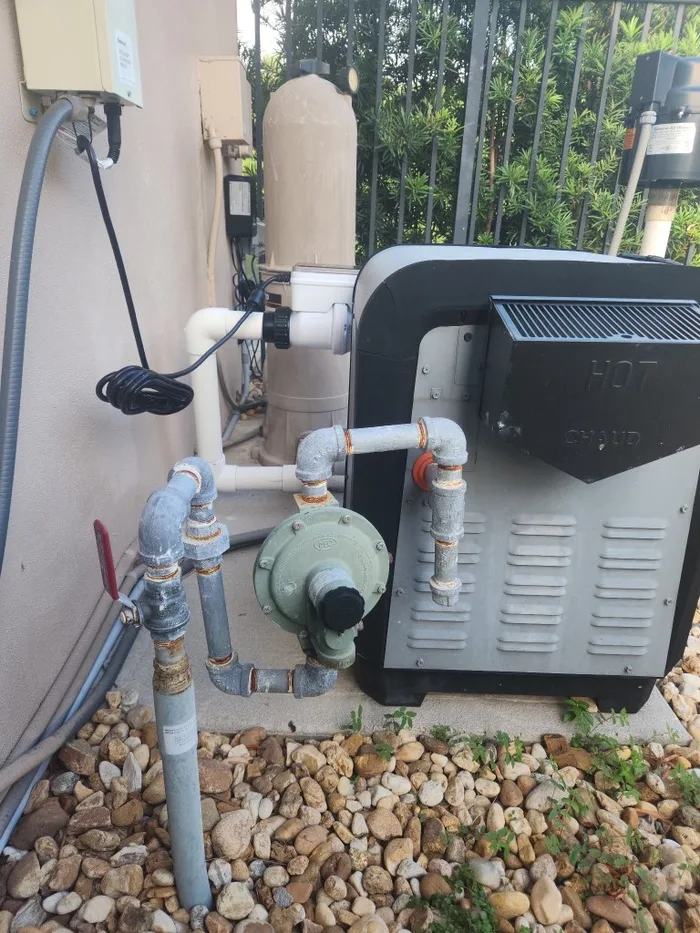
You can check, from outside the cabinet only: the gas valve is open and, on propane, the tank isn't low. Photograph the code and reset once. If it locks out again, stop. Call a techfor anything inside: clearing the venturi means gas off, power locked out, and a gas-pressure check, done by our techs or a licensed gas contractor. It's part of a $150–$350 annual cleaning; a damaged igniter or flame sensor is a $250–$1,800 repair.
Two stop signs.A heater that lights with a boom (delayed ignition) gets shut off and left off. If you smell gas, don't touch the heater or nearby switches: shut off the gas if you safely can, leave the area, and call your gas utility.
Call 3: “The heat pump runs all day and the pool won't warm up”
Around lunchtime the heat pump calls start, and these are where I most often get to say the unit is fine. A heat pump moves heat out of the air into your water; cooler air means less heat to move. Hayward's HeatPro spec sheet (80°F water) shows how much:
| HeatPro model | 80°F air, 80% humidity | 50°F air, 63% humidity | Output left |
|---|---|---|---|
| 90K | 90,000 BTU/hr | 59,000 BTU/hr | About 66% |
| 110K | 110,000 BTU/hr | 75,000 BTU/hr | About 68% |
| 140K | 140,000 BTU/hr | 85,000 BTU/hr | About 61% |
The standard HeatPro models list 50°F as the bottom of their heating range; the low-ambient versions go to 40°F. So on the first cool morning the unit has about two-thirds of its September output, the pool is losing heat to cool wind, and the owner wants a 10- or 12-degree climb. The quick tell that it's working: the air off the fan is noticeably colder than the air around it. The full symptom table is in our heat pump not heating guide (AquaCal owners: AquaCal troubleshooting).
You can check: run the pump around the clock, rinse the coil gently with the breaker off, clear space around the cabinet, and cover the pool at night. Call a tech if the air off the fan feels like the air going in. If the pool has lost ground every cold week for years, check sizing in our pool heater size calculator before paying for a repair; a right-sized replacement heater runs $5,000–$7,000 installed.
Call 4: ice on the heat pump at 7 a.m.
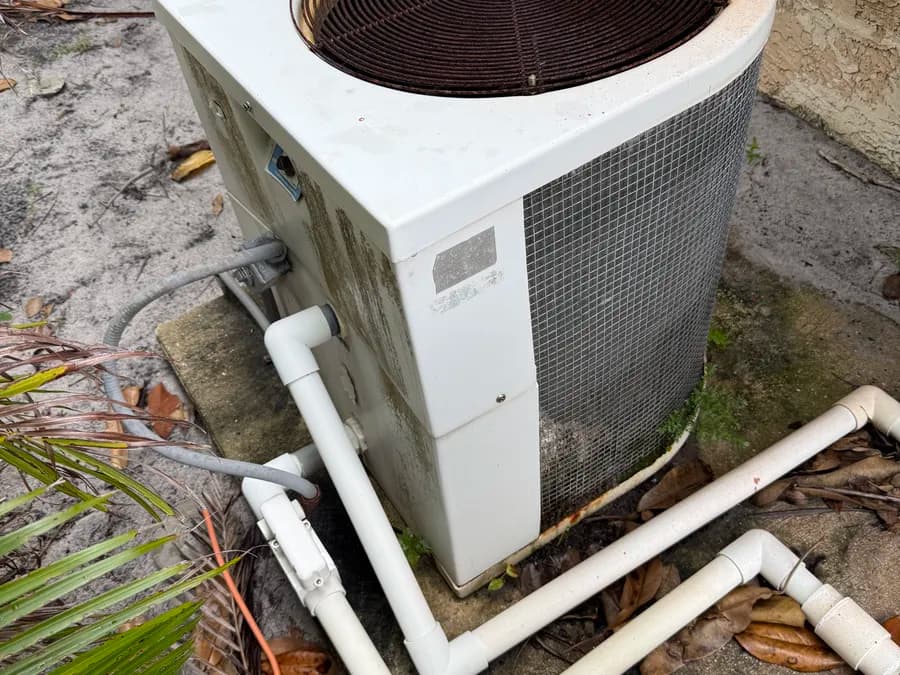
After the coldest night, someone always sends a photo of a frosted heat pump. Usually that's defrost doing its job: the coil runs colder than the air, frost forms on a humid morning, and the unit pauses heating for a cycle that typically runs 5 to 15 minutes. Steam and a whoosh when it switches back are normal. Re-aim any sprinkler hitting the coil. Call a tech for ice in mild weather, ice that never clears, or a unit flipping between defrost and heat every few minutes; turn it off and let it thaw. Blocked airflow, low refrigerant, or a failed defrost sensor are the usual causes; refrigerant work needs an EPA 608-certified technician. More in our heat pump defrost guide.
Calls 5 and 6: codes, dead displays, and tripped breakers
By day two the calls shift to “it's showing something.” Most first-start codes are flow codes under another name (LO on a Hayward gas heater, a low-flow message on a heat pump) and go back to Call 1. The rest are often summer's doing: South Florida's afternoon lightning is hard on heater control boards, and a board hit in July stays quiet until somebody asks for heat. Photograph the code, clean the filter, reset once. If it returns, stop resetting.
Breakers get the same one-reset rule. A second trip means a failing contactor or capacitor, a short, or a circuit problem: a tech or licensed electrician job. Don't open the cabinet; capacitors hold a charge after the power is off. These repairs usually land in the $250–$1,800 range, and our pool heater repair page covers what a diagnostic includes.
Call 7: the heater that was dying quietly all summer
Days later come the heaters that were hiding something. The usual finds:
- A slow drip at the exchanger or gaskets. Water under a heat pump is usually condensation; a chlorine strip tells you. Our guide to a heater leaking or making noise walks through it.
- A heat pump with a salt-crusted coil, a pinhole refrigerant leak, or a capacitor cooked by summer heat on the pad.
- A scaled gas exchanger from hard water and unbalanced chemistry, heating slowly and tripping its high limit.
This is where the money gets real: a heat exchanger or compressor runs $4,000–$5,000, a new heater $5,000–$7,000 installed. The repair-versus-replace math is in our pool heater repair cost guide.
Call 8: “I set it to 90 last night. Why is it 76?”
The last call isn't a failure; it's an expectation. One BTU raises one pound of water one degree Fahrenheit, and a gallon weighs about 8.34 pounds. Using the HeatPro 110K ratings above, a 10-degree climb with zero heat loss looks like this:
| Pool size | Heat for +10°F | Hours at 80°F air | Hours at 50°F air |
|---|---|---|---|
| 10,000 gallons | About 834,000 BTU | About 7.6 | About 11 |
| 15,000 gallons | About 1.25 million BTU | About 11.4 | About 16.7 |
| 20,000 gallons | About 1.67 million BTU | About 15.2 | About 22 |
Those are best cases. Real pools lose heat the whole time, mostly to evaporation, so heat-ups after a front often take days. A gas heater closes the gap far faster in any weather; a heat pump is built to hold a temperature, not raise one fast. Three things help: start before the front, while the air is warm and the heat pump has full output; run the pump around the clock until you reach temperature; and cover the pool at night, the cheapest heater upgrade there is.
Flying back from up north for the season? Our snowbird pool heater checklist covers when to start the heater so the pool is warm when you land.
Before the next front: what you can check, and where you stop
If you do one thing this fall, run the heater for an hour on a warm afternoon before the forecast turns.
| Yours to check | Tech only |
|---|---|
| Filter, baskets, valves, heater bypass | Venturi, burner tray, igniter, gas pressure (tech or licensed gas contractor) |
| Pump speed and run hours | Capacitor, contactor, board, wiring (tech or electrician) |
| Set point, pool/spa mode, automation | Refrigerant leaks and recharge (EPA 608-certified tech) |
| Gentle coil rinse, breaker off | Any repeat code or breaker trip |
| Photograph a code, reset once | Gas smell: leave the area and call your gas utility |
Every weekly visit includes an equipment-pad walk-around, heater included, and a heater diagnostic is free for route clients ($0–$125 otherwise). Our pool heater maintenance guide has the full checklist; a $150–$350 annual cleaning clears the venturi before the spiders get a vote.
The low-risk first step
Whatever your heater did after the front, the lowest-risk first step is a free on-site evaluation: we check flow and the filter, read the code, test your water, and tell you honestly what you're looking at, whether you hire us or not. Repairs are managed by us under our Florida Certified Pool/Spa Contractor license (CPC1461731): our techs do most of the work, a licensed gas contractor or EPA 608-certified technician comes in when needed, and every repair is quoted in writing first.
Florida's Best Pool Service is family-owned, CPO C-105377, fully insured, and runs weekly routes through Boca Raton, Delray Beach, Fort Lauderdale, Highland Beach, Boynton Beach, Pompano Beach, Coral Springs, Coconut Creek, Wellington, and the surrounding South Florida corridor. Your regular tech, same day every week; if they're out, weather moves the route, or the job needs a specialist, we send another member of our team or a specialist, and you still get your service report with photos at 6 p.m. on the day of every visit. Built around 40+ years of combined founder experience between Matt Balog, Joe Ford, Ronald Liddell, and Doug Santiago.
Heater acting up now? Book heater serviceand we'll diagnose it with a written quote before any part is ordered.
Request a free evaluation or call 954-347-1120.
Frequently Asked Questions
Most often because it can't get enough water. Every gas heater and heat pump has a pressure or flow switch that won't let it fire without circulation, and after a summer of storms the filter is loaded, the baskets are packed, or a valve got moved. A variable-speed pump turned down to a quiet summer speed can also fall below the heater's minimum flow. Clean the filter, empty the baskets, open the valves to the heater, close any bypass, give the pump enough speed and hours, and call for heat again. If it still shows a flow code with good flow, the switch itself may need a repair in the normal $250–$1,800 range.
On a heater that sat idle since spring, the classic Florida cause is spider webs in the venturi, the tube where gas and air mix, or a wasp nest in the burner tray or flue. The webs choke combustion, flame never proves, and the board shuts the gas off with an ignition code. Confirm the gas valve is open and, on propane, that the tank isn't low, then reset once. If it locks out again, the venturi and burner tray need a cleaning by a licensed tech or gas contractor, which is part of a $150–$350 annual heater cleaning. If it lights with a boom, shut it off; if you smell gas, leave the area and call your gas utility.
Usually not. A heat pump moves heat out of the air, and cool air holds less of it. Hayward's HeatPro spec sheet rates its units at roughly 60–68% of their 80-degree output when the air is 50 degrees, and the standard models list 50 degrees as the bottom of their heating range. Hold a hand over the fan outlet: if the air coming off it is noticeably colder than the air around it, the unit is working. Run the pump around the clock, keep the coil clear, and cover the pool at night. If the discharge air feels the same as the air going in, that's a tech call.
Longer than most people expect. One BTU raises one pound of water one degree, so a 15,000-gallon pool needs about 1.25 million BTU to climb 10 degrees. A heat pump rated 110,000 BTU per hour at 80-degree air delivers about 75,000 at 50-degree air, so that climb takes roughly 11 hours of run time on a warm day and about 17 hours on a cool one, before counting any heat lost to evaporation and wind. Real heat-ups after a front often take days. A gas heater closes the gap much faster and works in any weather.
Yes, if you want the pool warm through the front. A heat pump has its full output while the air is still warm, and holding a temperature is far easier than climbing back to it once the pool has cooled. Starting a day or two ahead also flushes out the first-start problems, like a flow fault from a dirty filter or a lockout from spider webs in a gas heater, before every pool company in town is booked. Run the pump around the clock during the heat-up and cover the pool at night.
Reset the breaker once and watch a full start. A single trip on the first start of the season can be a one-off. If it trips again, leave it off and call a tech or a licensed electrician, because a repeat trip usually means a failing contactor or capacitor, a shorted component, or a circuit problem. Don't open the cabinet: capacitors hold a charge even after the power is off. Board, contactor, and capacitor repairs usually land in the $250–$1,800 range.
A heater diagnostic runs $0–$125 and is free for our weekly-route clients. Many first-cold-front calls cost nothing beyond a filter rinse, and a replacement cartridge runs $50–$200. A gas heater with spider webs or nests in the venturi needs a cleaning, which is part of a $150–$350 annual heater cleaning or tune-up. Most heater repairs run $250–$1,800. A failed heat exchanger or compressor runs $4,000–$5,000, and a new heater runs $5,000–$7,000 installed. Every repair is quoted in writing before a part is ordered.
Don't touch the heater, its controls, or any light switch nearby, and don't try to relight it. Shut off the gas supply if you can do it safely, get away from the area, and call your gas utility. Once the utility has made it safe, gas-side repairs on a pool heater are work for a licensed gas contractor. A heater that lights with a loud boom or rumble is a related warning sign: shut it off and leave it off until a licensed tech has inspected the burners.
Need a pro to handle this?
Florida's Best Pool Service has serviced South Florida homes for 40+ years. CPO-licensed. Fully insured. 230+ five-star reviews.