Between Matt Balog (our founder), Ronald Liddell, Doug Santiago, and me, we've put 40+ years of combined founder experience into Florida's Best Pools, and one of the most honest questions we get from new South Florida homeowners is some version of: “Should I just clean my pool myself?”My answer is more nuanced than the marketing copy you'll find on either side. DIY can work in a narrow band of South Florida pools. Outside that band, the economics, time, and risk all collapse in favor of professional service — usually by a wider margin than the homeowner sees coming.
The 2026 head-to-head: pro service vs DIY done right
Here's the line-by-line comparison for a typical Boca Raton residential pool in 2026 — 14,000–18,000 gallons, salt system, screen enclosure, light landscape. The numbers are mid-band; smaller chlorine pools come down, larger luxury pools go up, but the ratio holds.
| Cost / time / risk line | Professional weekly service | DIY done right |
|---|---|---|
| Monthly chemistry | Included in flat rate | $90–$140 retail |
| Your time per month | 0 hours | 5–9 hours (~$175–$315 at $35/hr) |
| Equipment (vacuum, brush, test kit) | Tech's truck | $300–$600 one-time + $80–$120/yr replacement |
| Filter cleaning on schedule | Included | You — 30–90 min per occurrence |
| Salt cell maintenance | Quarterly inspection included | You + learning curve |
| Equipment-pad inspection | Every visit | If you remember |
| Photo-documented service report | Included on request | None |
| Algae bloom recovery | Included | $400–$1,500 per occurrence |
| Hurricane storm response | Included (flat-rate) | You, in the storm |
| Risk if you travel a week | None — service continues | Pool can turn green in 4–7 days in summer |
| Typical year-1 out-of-pocket | $1,500–$3,000 | $1,800–$3,200 + your time + risk premium |
Note what isn't in the DIY column: your time. Even at a modest $35/hour value, 5–9 hours/month is another $175–$315 you're paying yourself — bringing real DIY cost to $3,900–$6,800/year on a pool that a fair-priced pro service would run $1,800–$3,000. The “savings” only exist if you're willing to ignore the value of your time. Plenty of homeowners are. Most professionals aren't.
What DIY chemistry actually costs per month (retail vs wholesale)
The single biggest line item working against DIY in South Florida is what your pool store charges for chemicals. Retail markup at Pinch A Penny, Leslie's, and the box-store pool aisles runs 30–60% over what a licensed service company pays wholesale. Here's the breakdown for a 14,000–18,000-gallon Boca pool with salt:
| Chemistry line | Retail (DIY) / mo | Wholesale (pro) / mo |
|---|---|---|
| Chlorine (tabs / liquid / salt) | $35–$60 | $25–$40 |
| pH & alkalinity adjusters | $15–$25 | $8–$15 |
| Calcium hardness adjuster | $10–$20 | $6–$12 |
| Cyanuric acid (stabilizer) | $10–$25 | $6–$15 |
| Weekly shock | $15–$30 | $10–$20 |
| Phosphate remover (when needed) | $5–$15 | $3–$10 |
| Total monthly chemistry | $90–$140 | $60–$90 |
$30–$50/month of pure markup, every month, forever. That's before time, before equipment, before any of the consequence costs. A fair-priced pro service folds the wholesale chemistry into the monthly fee and still has labor margin. DIY pays full retail and provides the labor for free.
What DIY actually costs in time per week
The most-underestimated line in any DIY-vs-pro decision is the homeowner's time. Done properly — not corner-cut — here's what a weekly DIY routine looks like on a standard South Florida pool:
| Task | DIY time / occurrence | Frequency |
|---|---|---|
| Calibrated 7-point water test (Taylor K-2006, not strips) | 5–10 min | Every week |
| Skim & empty baskets | 15–25 min | Every week |
| Brush walls, steps, tile, sun shelves | 20–40 min | Every week |
| Vacuum (dedicated head, not system vac) | 30–45 min | Weekly or as needed |
| Dose chemistry from test results | 5–10 min | Every week |
| Filter clean (cartridge / sand backwash / DE) | 30–90 min | Every 4–12 weeks |
| Salt cell inspection & cleaning | 15–20 min | Quarterly |
| Equipment-pad walk-around | 5–10 min | Every week |
| Weekly total (averaged) | 80–130 min | — |
| Monthly total | 5–9 hours | — |
Five to nine hours of your time, every month, on the equipment pad and the pool deck — usually in Florida heat. If you genuinely enjoy it, that's a free workout and a project you control. If you tolerate it at best, you're paying yourself $0/hour to do work a pro would do for ~$30/hr of your money — and the pro is faster, more consistent, and insured against the things that go wrong.
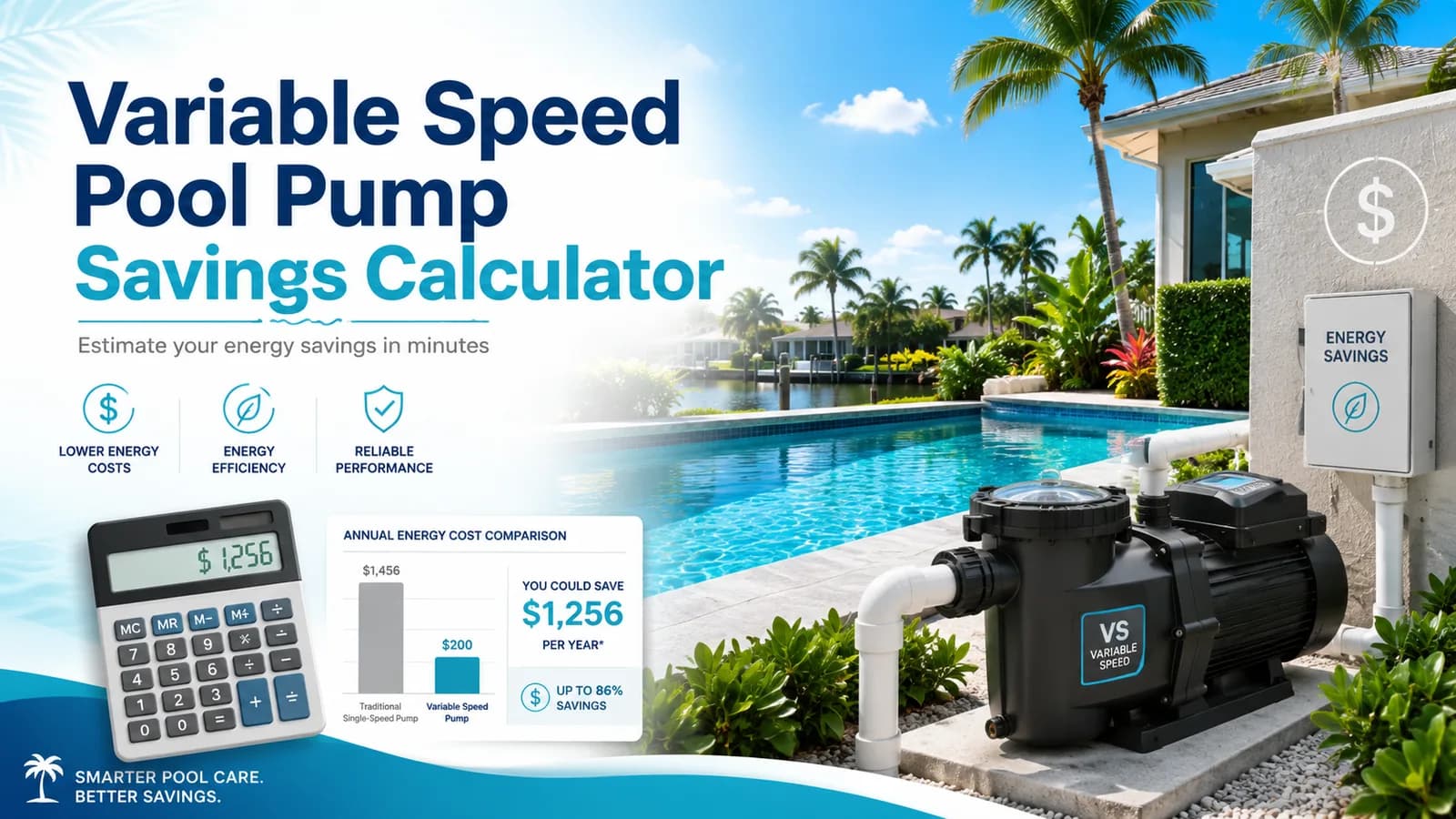
A common follow-up: “Can't I just buy a robot and an IoT chlorinator and split the difference?” Sometimes yes, often no. Our 2026 AI & Robotics Pool Automation industry reportcovers the current generation of robotic cleaners, smart chlorinators, and chemistry-monitoring systems — which tasks they meaningfully reduce, which they don't, and where the $1,500–$4,000 capex actually pays back on a DIY pool.
The Florida multipliers — why DIY here is harder than DIY elsewhere
This is the part most DIY-vs-pro guides written for Arizona, Texas, or California completely miss. South Florida is the most aggressive pool environment in North America, and every multiplier below makes the DIY path narrower than it looks on paper.
| Florida multiplier | What it does to your pool | DIY consequence |
|---|---|---|
| 85–95°F summer heat | Burns through unstabilized chlorine in 4–6 hours | Miss a Tuesday test = visible algae by Thursday |
| Daily 3pm thunderstorms | Dilutes salt, drops alkalinity, raises pH, dumps phosphates | Constant chemistry chase; nothing “sets” |
| Hard South Florida water (calcium 200–300+ ppm baseline) | Scale on tile, salt cells, and heaters | Calcium scaling visible in 6–12 months without active management |
| Pollen / palm seed / oak debris seasons | Basket fills mid-week | Higher skimming load Mar–May |
| Travel & snowbird absence | Unattended pool May–Oct | A neglected Florida pool can be unrecoverable in 14–21 days summer |
| Hurricane season (Jun–Nov) | Storm prep + post-storm debris | DIY storm response means you outside before, during, after |
| Salt-air corrosion (coastal homes < 1 mi from ocean) | Equipment lifespan 25–50% shorter | More repairs, more frequent — DIY can't catch early signs |
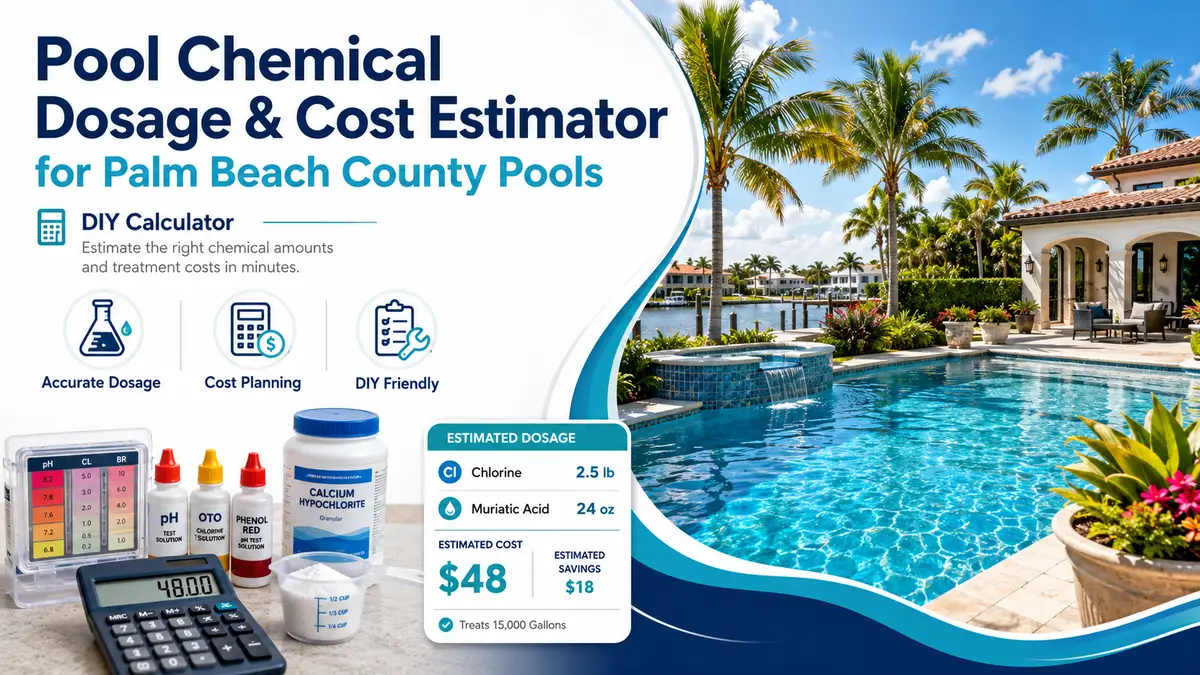
Want a number for your specific pool before deciding either way? Run yours through our pool service cost calculator— it asks the same questions I'd ask on a walk-through (size, salt vs chlorine, spa, screen, coastal proximity) and gives you the band a fair 2026 quote should land in. Compare that against your honest DIY cost from the tables above and the decision often makes itself.
The risk side — what can actually go wrong with DIY in year 1
Cost and time are visible. Risk is the line homeowners systematically under-estimate. Here's what we see come across our desk every month from homeowners switching to us after a year of DIY:
| Failure mode | Likelihood DIY year 1 | Cost to fix |
|---|---|---|
| Single algae bloom in Florida summer | 50–70% | $400–$1,500 recovery |
| Calcium scale on tile from neglected hardness | 30–50% | $400–$900 tile clean |
| Salt cell killed by neglected calcium scale | 20–30% (coastal) | $800–$2,100 replacement |
| Pump damage from cleaning through algae | 10–15% | $1,400–$2,400 replacement |
| Heater core damage from chronic low pH | 10–15% | $1,400–$3,200 repair |
| Plaster etching from chronic low LSI | 15–25% over 3 yrs | $7,500–$12,000 resurface |
| Chemical injury (acid splash, chlorine gas mix) | 1–3% | Medical + insurance hassle |
Wearing my other hat for a moment — I'm a Florida-licensed Public Adjuster and the owner of Dolphin Claims — homeowner insurance can be a wall when a DIY mistake causes a six-figure issue. Most homeowner policies cover sudden & accidental damage, not gradual deterioration from improper chemistry. A pool resurface from chronic low LSI is usually a denied claim. A pump that burned out from running through algae is sometimes denied as wear-and-tear. The risk premium of DIY isn't just the cost to fix; it's the cost to fix out-of-pocket.
When DIY actually makes sense
I'm not anti-DIY. There's a real homeowner profile where DIY works — and you should ignore anyone trying to talk you out of it if you fit:
- Smaller chlorine pool (under 12,000 gallons) with simple equipment — no salt, no heater, no automation
- Home every week, no extended travel, no snowbird half-year up north
- Genuinely interested in pool chemistry (not just tolerant of it) — this matters more than people admit
- Inland location (3+ miles from the ocean), lower salt-air exposure
- Backup plan for vacations — a neighbor, family member, or paid one-off visit
- Calibrated test kit (Taylor K-2006 or equivalent reagent kit) — not test strips
- Patience for the first 6 months of the learning curve — you will go green at least once, that's normal
When professional service is the obvious win
- You travel for work, are a snowbird, or have a vacation home (unattended Florida pool May–Oct = thousands in recovery)
- Salt pool, attached spa, screen enclosure, or country-club gated community
- Coastal property within 1 mile of the ocean — the salt-air protocol is its own job
- You're past 60 and don't want to be on a deck in 95°F humidity every Tuesday
- You hate dealing with chemistry — it shows up in the water within 2 weeks
- Your time is worth more than $35/hour to you
- You've tried DIY and the pool has gone green at least once
- You have an Airbnb / vacation rental with high bather load
The 30-second decision framework
Three questions to settle it yourself in 30 seconds:
- Will you be home every Tuesday for the next 12 months — including July and August?
- Do you genuinely find pool chemistry interesting (not just tolerable)?
- Is your time worth less than $35/hour to you?
Two or three yeses — DIY is worth trying for 6 months. Pick up a Taylor K-2006, read our water chemistry pillar, and commit to weekly. One or zero yeses — professional service is mathematically cheaper from week one, even before you factor in risk.
The low-risk first step (in either direction)
Whichever way you lean, the lowest-risk first step is a free on-site evaluation. We'll test your water on calibrated equipment, walk your equipment pad, and tell you honestly what your pool actually needs — whether you hire us or not. If you're a strong DIY fit, we'll tell you the three things to invest in first. If you're a pro-service fit, we'll send you a one-page flat-rate quote the same day, with what's included and what's separate spelled out in writing.
Florida's Best Pools is family-owned, CPO C-105377, fully insured, and runs weekly routes through Boca Raton, Delray Beach, Fort Lauderdale, Highland Beach, Boynton Beach, Pompano Beach, Coral Springs, Coconut Creek, Wellington, and the surrounding South Florida service corridor. Same tech every visit (once your route is established). Photo-documented service reports on request. Month-to-month — no long-term lock-in. Built around 40+ years of combined founder experience between Matt Balog, Joe Ford, Ronald Liddell, and Doug Santiago.
Request a free evaluation or call 954-347-1120. We'll give you the honest read either way.
Frequently Asked Questions
Professional weekly service runs $125–$240/month in 2026 and is usually cheaper than properly-done DIY all-in; Retail chemicals cost 30–60% more than wholesale — DIY chemistry alone is $90–$140/month; Add 5–9 hours/month of your time, plus equipment investment; A single Florida-summer algae bloom recovery costs $400–$1,500; DIY only pencils for a small, simple, low-bather-load chlorine pool with a homeowner who's home weekly and enjoys the routine.
For most South Florida homeowners, professional weekly pool service ($125–$240/month in 2026) is cheaper than properly-done DIY when you total chemicals, equipment, time, and risk. Retail chemicals run $90–$140/month vs $60–$90 wholesale for the pro. Your time at a modest $35/hour value adds another $175–$315/month for the 5–9 hours of weekly work. Add the risk premium of a single Florida-summer algae bloom ($400–$1,500 recovery) and DIY routinely costs more than pro service while delivering worse outcomes. DIY only wins for small, simple, low-bather-load chlorine pools owned by homeowners who are home every week and genuinely enjoy the routine.
Done properly on a standard South Florida pool, DIY takes 80–130 minutes per week — averaging out to 5–9 hours per month. Breakdown: water testing 5–10 min, skim and baskets 15–25 min, brushing 20–40 min, vacuuming 30–45 min, dosing chemistry 5–10 min, filter cleaning 30–90 min every 4–12 weeks, salt cell inspection 15–20 min quarterly, equipment-pad walk-around 5–10 min weekly. Usually performed in Florida heat. At $35/hour personal-time value that's another $175–$315/month on top of chemistry and equipment costs.
Retail chemicals at Pinch A Penny, Leslie's, and the box-store pool aisles run 30–60% more than wholesale. For a 14,000–18,000 gallon Boca Raton salt pool the monthly chemistry breakdown at retail is: chlorine $35–$60, pH/alkalinity adjusters $15–$25, calcium hardness $10–$20, cyanuric acid stabilizer $10–$25, weekly shock $15–$30, phosphate remover (when needed) $5–$15. Total monthly chemistry: $90–$140 retail vs $60–$90 wholesale. A pro service folds wholesale chemistry into the flat monthly fee.
Seven Florida-specific multipliers stack against DIY: (1) 85–95°F summer heat burns through unstabilized chlorine in 4–6 hours. (2) Daily 3pm thunderstorms dilute salt, drop alkalinity, raise pH, dump phosphates. (3) Hard South Florida water (calcium 200–300+ ppm baseline) scales tile, salt cells, and heaters. (4) Pollen, palm seed, and oak debris seasons fill baskets mid-week. (5) Snowbird and vacation absence — an unattended Florida pool can be unrecoverable in 14–21 days summer. (6) Hurricane season Jun–Nov means DIY storm response = you outside before, during, after. (7) Salt-air corrosion within 1 mile of the ocean shortens equipment lifespan 25–50%.
Tracked across hundreds of homeowners who switched to us after a DIY year: 50–70% experience at least one Florida-summer algae bloom ($400–$1,500 recovery). 30–50% develop calcium scale on tile ($400–$900 cleaning). 20–30% of coastal pools lose a salt cell to neglected calcium scale ($800–$2,100 replacement). 10–15% damage a pump cleaning through algae ($1,400–$2,400 replacement). 10–15% damage a heater core from chronic low pH ($1,400–$3,200 repair). Over 3 years, 15–25% develop plaster etching from chronic low LSI ($7,500–$12,000 resurface). And 1–3% have a chemical injury from acid splash or accidental chlorine-gas mixing.
DIY works for a narrow but real homeowner profile: a smaller chlorine pool (under 12,000 gallons) with simple equipment (no salt, no heater, no automation), an owner who is home every week (no snowbird or extended travel), genuinely interested in pool chemistry (not just tolerant), located inland (3+ miles from the ocean), with a backup plan for vacations, using a calibrated reagent test kit (Taylor K-2006, not strips), and patient enough to absorb a 6-month learning curve including at least one green-pool episode.
Professional service is the obvious win if any of these apply: you travel for work or are a snowbird (unattended Florida pool May–Oct = $$$), you have a salt pool with attached spa or screen enclosure, you live in a country-club gated community, your property is within 1 mile of the ocean, you're past 60 and don't want to be on a 95°F deck weekly, you hate dealing with chemistry, your time is worth more than $35/hour, you've already tried DIY and the pool went green at least once, or you have an Airbnb / vacation rental with high bather load.
Usually no — and this is the under-discussed risk premium of DIY. Most homeowner policies cover sudden & accidental damage, not gradual deterioration from improper chemistry. A pool resurface from chronic low LSI is typically a denied claim. A pump that burned out from running through algae is often denied as wear-and-tear. Chemical injury claims can run into homeowner-liability questions. Joe Ford, our co-owner, is a Florida-licensed Public Adjuster (3-20, W026874) and the owner of Dolphin Claims — this is his other professional area. The risk premium of DIY isn't just cost to fix; it's cost to fix out-of-pocket.
Need a pro to handle this?
Florida's Best Pools has serviced South Florida homes for 40+ years. CPO-licensed. Fully insured. 230+ five-star reviews.