
Between Matt Balog (our founder) and me, we've put 40+ years of combined founder experience into Florida's Best Pool Service, and the variable-speed pump conversation is the one where I most often watch a homeowner do the math for the first time and go quiet for a second.
Here's why:your pool pump is probably the second-biggest electrical load in your house, behind the air conditioning and ahead of everything else — and unlike the AC, it runs at full blast whether it needs to or not. A single-speed pump has exactly one setting: all of it.
In November 2025, Florida regulators approved FPL's four-year rate settlement, which raises base rates again in 2026 and 2027. So every year you keep a single-speed motor spinning at 3,450 RPM, the same pump costs a little more to run than it did the year before. That's the part that turns a nice-to-have upgrade into a math problem worth ten minutes of your time.
Run your pump through the calculator below, then read the rest — because the number the calculator gives you is only real if the pump gets programmed after it gets installed.
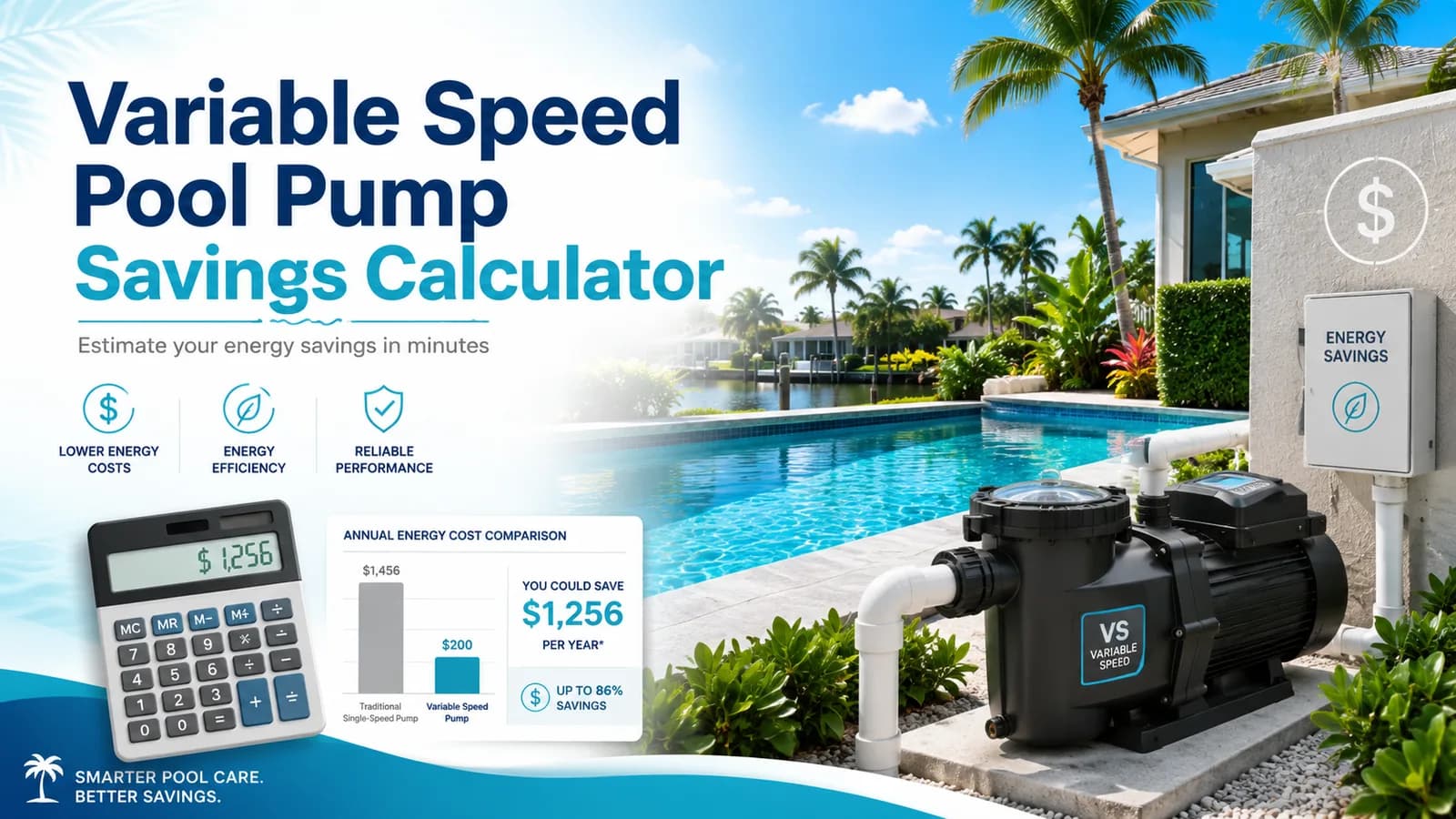
Variable-speed pump savings calculator
Enter your current single-speed pump size, how long it runs, and your electricity rate. We compare it against a properly programmed variable-speed schedule doing the same daily turnover.
On the motor label. Most Boca single-speeds are 1.5 or 2.0 HP.
Check your timer. 8 hours is the common Boca setting.
13.7¢ ≈ the 2026 FPL all-in residential average.
You'd save ≈ $450/year (75% off the pump's electricity)
Your single-speed today
$50/month · $600/year
Variable-speed, programmed right
$13/month · $150/year
10-year savings at today's rate
$4,500 (3,285 kWh/yr off your bill — and FPL rates are scheduled to keep rising)
Payback window
VS motor swap ($700–$1,200): ≈ 19–32 months · Full VS pump ($1,400–$2,400): ≈ 37–64 months
Model: your single-speed at nameplate draw for the hours you set, vs. a properly programmed variable-speed schedule (~275 W at 1,500–1,800 RPM, ~11 hrs/day ≈ 3.0 kWh) delivering the same daily turnover for a typical 12,000–18,000-gallon pool. Estimates only — equipment condition, plumbing, and programming move the real number.
Single-speed vs. two-speed vs. variable-speed: the honest head-to-head
Three technologies, one job. The differences that actually show up on your bill and in your water:
| Factor | Single-speed | Two-speed | Variable-speed |
|---|---|---|---|
| How it runs | One speed, 3,450 RPM, every second it's on | High or low, nothing in between | Any speed you program, typically 1,500–1,800 RPM for filtering |
| Motor type | Induction (capacitor-start) | Two-winding induction | Permanent-magnet with a variable-frequency drive |
| Typical draw (1.5–2 HP class) | 1,500–2,200 W | ~700–900 W on low | 250–350 W filtering, ramps up on demand |
| Annual electricity (Boca, typical schedule) | $600–$1,320 | $240–$340 | $90–$160 |
| 10-year electricity | $6,000–$13,200 | $2,400–$3,400 | $900–$1,600 |
| Noise | Loud — the neighbor-complaint pump | Loud on high, tolerable on low | Near-silent at filtering speed |
| Filtration quality | Water moves fast — less filter contact time | Better on low | Best — slow flow gives the filter time to catch fine particles |
| Typical lifespan (inland Boca) | 8–10 years | 8–10 years | 8–12 years; the drive runs cooler at low RPM |
| Legal to install on a Boca replacement (1 HP+) | No | Meets the multi-speed floor | Yes — and the only path the DOE rules leave open going forward |
| Installed cost, 2026 | $900–$1,400 (like-for-like, where still permitted) | $1,100–$1,700 | $1,400–$2,400 |
| 10-year total cost of ownership | $6,900–$14,600 | $3,500–$5,100 | $2,300–$4,000 |
Read the last row twice. The variable-speed pump is the most expensive box on the shelf and the cheapestpump to own — by a margin wide enough that on a high-consumption pool, the electricity you'd avoid over ten years exceeds the entire cost of the upgrade three or four times over.
The Boca Raton electricity math, by pump size
These are the numbers the calculator is running, at 13.7¢/kWh — roughly FPL's all-in residential average after the 2026 rate adjustment. Compare your own row against the variable-speed column, which assumes a properly programmed schedule (~275 W for about 11 hours, delivering the same daily turnover).
| Your single-speed pump | Runs | Its annual electricity | Variable-speed instead | You keep |
|---|---|---|---|---|
| 1.0 HP (~1,100 W) | 6 hrs/day | $330 | $150 | $180/yr (55%) |
| 1.0 HP (~1,100 W) | 8 hrs/day | $440 | $150 | $290/yr (66%) |
| 1.5 HP (~1,500 W) | 8 hrs/day | $600 | $150 | $450/yr (75%) |
| 1.5 HP (~1,500 W) | 10 hrs/day | $750 | $150 | $600/yr (80%) |
| 2.0 HP (~2,200 W) | 10 hrs/day | $1,100 | $150 | $950/yr (86%) |
| 2.0 HP (~2,200 W) | 12 hrs/day | $1,320 | $150 | $1,170/yr (89%) |
| 2.5 HP (~2,600 W) | 12 hrs/day | $1,560 | $150 | $1,410/yr (90%) |
The 1.5 HP at 8 hours row is the most common Boca setup we walk up to. The 2.0 HP rows are the ones that make people put their coffee down — and they're not rare, because a lot of Boca pools got oversized pumps installed on the theory that more horsepower is better. It isn't. An oversized single-speed pump is just a more expensive way to move the same water.
Why the savings are so large (the one bit of physics that matters)
A pump's power draw scales with roughly the cube of its speed. Halve the RPM and the energy drops to about an eighth. That's the whole trick: a variable-speed pump doesn't save money by running less — it usually runs longer — it saves money by moving the same water far more slowly. Your pool gets the same daily turnover, the filter gets more contact time to catch fine particles, and the meter barely notices. The full engineering treatment, including the sizing math and RPM curves, is on our variable-speed pump savings library page, and the programming specifics are in our VFD programming guide.
The laws that already decided part of this for you
Most homeowners don't realize the single-speed pump is being legislated out from under them in stages. Three separate rules are in play, and one of them has a date coming:
| Rule | Effective | What it actually requires |
|---|---|---|
| Florida Building Code / Energy Conservation (ANSI-APSP-15) | In force since the 2010 code cycle | Pool pump motors 1 HP and larger must be capable of two or more speeds — and it applies to replacement pumps on existing pools, not just new construction. Split-phase, shaded-pole, and capacitor-start-induction-run motors are out. |
| DOE dedicated-purpose pool pump standard | July 2021 | Ended the single-speed market for most self-priming pool pumps above 1 total HP. This is why your pool guy stopped quoting them. |
| DOE pool pump motor standard — first phase | September 29, 2025 | Motors under 0.5 THP, and motors from 1.15 to 5 THP, must meet the new efficiency standard. |
| DOE pool pump motor standard — small motors | September 28, 2027 | Motors from 0.5 to under 1.15 THP must comply — and above 0.5 THP, compliance effectively means variable-speed. This is the last common replacement motor still available as a fixed-speed part. |
| DOE enforcement relief | Through March 26, 2029 | DOE has said it won't pursue civil penalties on certain certification requirements for motors made in the interim window — a manufacturer-paperwork reprieve, not a reprieve on the standard itself. |
The practical translation for a Boca homeowner: if your pump is 1 HP or larger and it dies, a like-for-like single-speed swap is not a compliant replacement, and after September 2027 the small-motor loophole closes too. You are not choosing between single-speed and variable-speed for the long run. You're choosing whether to make the switch on your schedule — with the pump still running and quotes you had time to compare — or on the pump's schedule, on a Saturday in August, with a green pool and no leverage.
What the upgrade costs in Boca Raton — and when it pays back
Three real paths, with the payback math run at the two most common baselines:
| Path | Installed cost, 2026 | Payback (1.5 HP / 8 hrs) | Payback (2.0 HP / 10 hrs) | Best when |
|---|---|---|---|---|
| Like-for-like single-speed motor swap | $450–$780 | Never — saves nothing | Never | Almost never now. Not compliant at 1 HP+, and you re-buy the same power bill. |
| Variable-speed retrofit motor (new VS motor + drive on your existing wet end) | $700–$1,200 | 19–32 months | 9–15 months | Housing, volute, and plumbing are sound and under ~6 years old. The value play. |
| Full variable-speed pump (complete unit, installed) | $1,400–$2,400 | 37–64 months | 18–30 months | Pump is 8+ years old, corroded, or the wet end is cracked. Full warranty resets. |
| Add automation / timer controls | $300–$900 | Doesn't save on its own — it protects the savings by keeping the schedule honest | Worth it on pools with heaters, spas, or salt cells that need flow coordination | |
Notice how much the baseline moves the answer. On a 2 HP pump running 10 hours, a retrofit motor pays for itself in under a year and a full pump lands in that 18–30 month window we quote most often. On a modest 1 HP running 6 hours, honest payback is three to four years — still positive, but I'm not going to pretend it's urgent. Anyone who quotes you the same payback period regardless of your pump size and run time is quoting a brochure, not your pool.
What eats the savings (this is where most upgrades leak)
Here's the uncomfortable part of this industry: a large share of the variable-speed pumps we walk up to on new client pools are running at 2,800–3,450 RPM around the clock, because that's the default the installer left them on. The homeowner paid for a variable-speed pump and is getting single-speed bills. The hardware saves you money; the configuration saves you more.
| What goes wrong | What it costs you | The fix |
|---|---|---|
| Installer leaves it on high 24/7 | Wipes out 60–80% of the savings — the single most common failure | Program a low-RPM filtration schedule with short high-speed bursts for cleaning |
| Salt cell stops producing | Chlorine drops, algae follows — a $400–$1,500 green-pool recovery erases years of savings | Most cells need minimum flow to trigger the flow switch. Schedule hours above that threshold. |
| Undersized or dirty filter | Slow flow channels instead of filtering; water goes cloudy | Match filter surface area to the reduced flow; keep cartridges on a real cleaning cycle |
| Pressure-side or suction-side cleaner won't run | Debris load shifts to you or your tech | Raise the minimum RPM during cleaner hours, or move to a robotic cleaner |
| Heater won't fire | No heat, and repeated flow faults that look like a broken heater | Heaters need flow to ignite. Coordinate the schedule — see our heater repair guide. |
| Pump oversized for the plumbing | You paid for horsepower the pipe can't use | Size to the pool's turnover and pipe diameter, not to the old pump's label |
The Boca Raton multipliers
Three local realities change this math in ways a national article won't tell you about.
Coastal corrosion sets the clock.Salt-laden air degrades motor windings, bearings, and shaft seals. East of Federal Highway — and especially near-oceanfront — pumps reach end of life years sooner than identical pumps out west past Boca's golf communities. Oceanfront pumps run 5–7 years; 1–3 miles inland it's 8–10; and 3+ miles inland you can see 8–12. If your pump is coastal and past six years, you're not deciding whether to upgrade — you're deciding whether to do it before or after it fails.
HOA noise rules make the quiet a feature, not a bonus. A lot of Boca communities have equipment-noise provisions, and a single-speed pump is genuinely loud. At filtering speed a variable-speed is close to silent, which quietly solves a category of neighbor problem that has nothing to do with your power bill.
Snowbird schedules are where the savings compound.If you're north from May to November, a variable-speed pump lets you run a long, slow, low-wattage summer schedule that keeps the water turning over through storm season for a couple of dollars a week. A single-speed forces the same bad choice every year: burn real money running it, or cut hours and come home to a green pool and a recovery bill. That's not a savings story — it's an avoided-disaster story, and it's worth more.
Don't build the decision around a rebate
I get asked about this constantly, so: Florida has no statewide pool-pump rebate, and FPL — which covers most of South Florida — absorbed the legacy residential pool-pump rebate and then discontinued it under its consolidated efficiency plan. As of 2026, FPL treats the variable-speed pump as an energy-savings tip, not a cash rebate; its active residential rebates cover air conditioning and insulation. A few municipal utilities still run small one-time incentives, so it costs you one phone call to your own provider to check. But don't wait on a rebate that isn't coming. The savings pay this back on their own, which is the entire point.
Upgrade now, or wait? The 30-second version
Upgrade now if any two of these are true:
- Your pump is 1.5 HP or larger and runs 8+ hours a day — the savings are $450–$1,170/year, so waiting a year costs you real money.
- The pump is 8+ years old anywhere in Boca, or 6+ years old east of Federal Highway.
- It's already showing symptoms — grinding, humming, dripping at the seal plate, or tripping a breaker.
- Your motor is in the 0.5–1.15 THP band that has to comply by September 2027, and you'd rather buy on your timeline than on a failure's.
- You're a snowbird and your summer plan currently involves hoping.
- Your pool is on a salt system, a heater, or automation you'd like to actually coordinate.
Waiting is defensible if all of these are true:
- The pump is under 1 HP and runs 6 hours or less — payback is 3–4 years, not 18 months.
- It's under 5 years old, quiet, and west of I-95 with no corrosion showing.
- You already have a two-speed running on low for most of its schedule — you've captured a good chunk of the win.
- A bigger project is coming — resurfacing or a full pad rebuild — and bundling the pump into it saves a trip charge and a second permit.
Why us for this particular job
Anyone can bolt a variable-speed pump to a pad. Two things separate an upgrade that hits the calculator's number from one that doesn't, and both of them happen after the box is open.
First, we size it to your pool and program it before we leave.We set the filtration schedule at the RPM your plumbing and turnover actually call for, verify the salt cell's flow switch triggers, confirm the heater fires, and make sure your cleaner still runs. Then we write the schedule down and leave it with you. That's the step that turns a $2,000 purchase into a $950-a-year asset instead of an expensive pump running on factory defaults.
Second, we're the ones who see it every week afterward.Because we run weekly routes through Boca, the tech who programmed your pump is the tech who watches the filter pressure, the cell output, and the water clarity for the next several years — and who notices at month four if the schedule needs a seasonal adjustment. If anything needs repair or replacement, we manage it under our CPC license after you approve the cost in writing, so you always see the number before the work happens. We don't sell equipment we wouldn't put on our own pools, and if your pump has five good years left, we'll tell you that instead — run the calculator and you'll see exactly why some pools shouldn't do this yet.
If you also want a number for ongoing weekly service while you're pricing this out, our pool service cost calculator gives you the band a fair 2026 quote should land in, and our equipment upgrades page covers what a pad modernization involves end to end. If the pump is already failing rather than merely expensive, our pump repair vs. replacement guide walks the diagnostic side of the decision.
The low-risk first step
Whichever way your numbers land, the lowest-risk first step is a free on-site evaluation. We'll read your pump's nameplate, clock its actual run time, check the wet end and seal plate for corrosion, test your water on site, and give you the real savings figure for yourpool in writing — along with both quotes, retrofit motor and full pump. Whether you hire us or not.
Florida's Best Pool Service is family-owned, CPO C-105377, fully insured, and runs weekly routes through Boca Raton, Delray Beach, Fort Lauderdale, Highland Beach, Boynton Beach, Pompano Beach, Coral Springs, Coconut Creek, Wellington, and the surrounding South Florida service corridor. Your regular tech, same day every week, once your route is established. Photo-documented service report after every visit. Month-to-month — no long-term lock-in. Built around 40+ years of combined founder experience between Matt Balog, Joe Ford, Ronald Liddell, and Doug Santiago.
Request a free evaluation or call 954-347-1120.
Watch: Your pump is not the problem. Your plumbing is.
Why an eight thousand gallon pool needs twelve hours of run time, and how opening the restriction in the plumbing halves a turnover without anyone replacing the pump.
Frequently Asked Questions
A typical Boca single-speed pump costs $600–$1,320 a year to run; a properly programmed variable-speed doing the same daily turnover costs about $150. That's $450–$1,170 saved annually, or a 75–90% cut. The exact figure depends on your pump's horsepower and how many hours it runs — a 1.5 HP at 8 hours/day saves about $450/year, while a 2.0 HP at 12 hours/day saves about $1,170/year.
Not illegal to own or keep running, but effectively unavailable as a compliant replacement at 1 HP and larger. Florida's energy code has required pool pump motors of 1 HP or more to be capable of two or more speeds since the 2010 code cycle, and it applies to replacement pumps on existing pools — not just new construction. The DOE's 2021 dedicated-purpose pool pump standard then ended the single-speed market for most self-priming pumps above 1 total horsepower. Small fixed-speed motors are the last category still sold, and their compliance date is September 28, 2027.
It's the second phase of the DOE's dedicated-purpose pool pump motor efficiency standard. Motors under 0.5 THP and motors from 1.15 to 5 THP had to comply by September 29, 2025; motors from 0.5 to under 1.15 THP must comply by September 28, 2027. Above 0.5 THP, meeting the standard effectively requires variable-speed — so that date closes the last common fixed-speed replacement-motor category. DOE has said it won't pursue civil penalties on certain certification requirements for motors manufactured in the interim window through March 26, 2029, but that's manufacturer paperwork relief, not a delay of the standard.
It depends almost entirely on what you're replacing. A full variable-speed pump at $1,400–$2,400 installed pays back in 18–30 months against a 2 HP pump running 10 hours a day — the most common replacement scenario — but 3–4 years against a small 1 HP pump running 6 hours. A variable-speed retrofit motor at $700–$1,200 pays back in 9–15 months on that same 2 HP baseline. Be suspicious of any company quoting one payback number without asking your pump's horsepower and run time.
Often yes, and it's the value play when it works. A variable-speed retrofit motor with its drive mounts to your existing wet end for $700–$1,200 installed, versus $1,400–$2,400 for a complete pump. It makes sense when the housing, volute, seal plate, and plumbing are sound and generally under about six years old. It stops making sense when the wet end is cracked or the pump is a coastal unit already showing corrosion — at that point you're putting a new motor on a housing that will fail next, and a full pump resets the entire warranty.
No. Florida has no statewide pool-pump rebate, and FPL absorbed the legacy residential pool-pump rebate and then discontinued it under its consolidated efficiency plan. As of 2026, FPL lists the variable-speed pump as an energy-savings tip rather than a cash rebate, and its active residential rebates cover air conditioning and insulation instead. A few municipal utilities still run small one-time incentives, so it's worth one call to your own provider — but the savings pay the upgrade back without a rebate, so don't delay the decision waiting for one.
Longer than your single-speed did, at a much lower speed — typically 10–12 hours at 1,500–1,800 RPM for filtration, with short high-speed bursts for vacuuming, cleaner operation, or spa jets. That combination delivers a full daily turnover with more filter contact time and still draws only about 275 watts. Running fewer hours at high RPM is the expensive mistake: it costs more and filters worse.
Cleaner, in our experience, as long as it's programmed correctly. Slower flow gives the filter time to capture finer particles instead of pushing water through fast. The failure mode isn't cleanliness — it's coordination: salt cells need minimum flow to trigger their flow switch, heaters need flow to ignite, and pressure- or suction-side cleaners need specific flow to run. Get those thresholds built into the schedule and the water is better than it was. Skip that step and you get a cloudy pool, a dead salt cell, and a mystery heater fault.
Need a pro to handle this?
Florida's Best Pool Service has serviced South Florida homes for 40+ years. CPO-licensed. Fully insured. 230+ five-star reviews.