
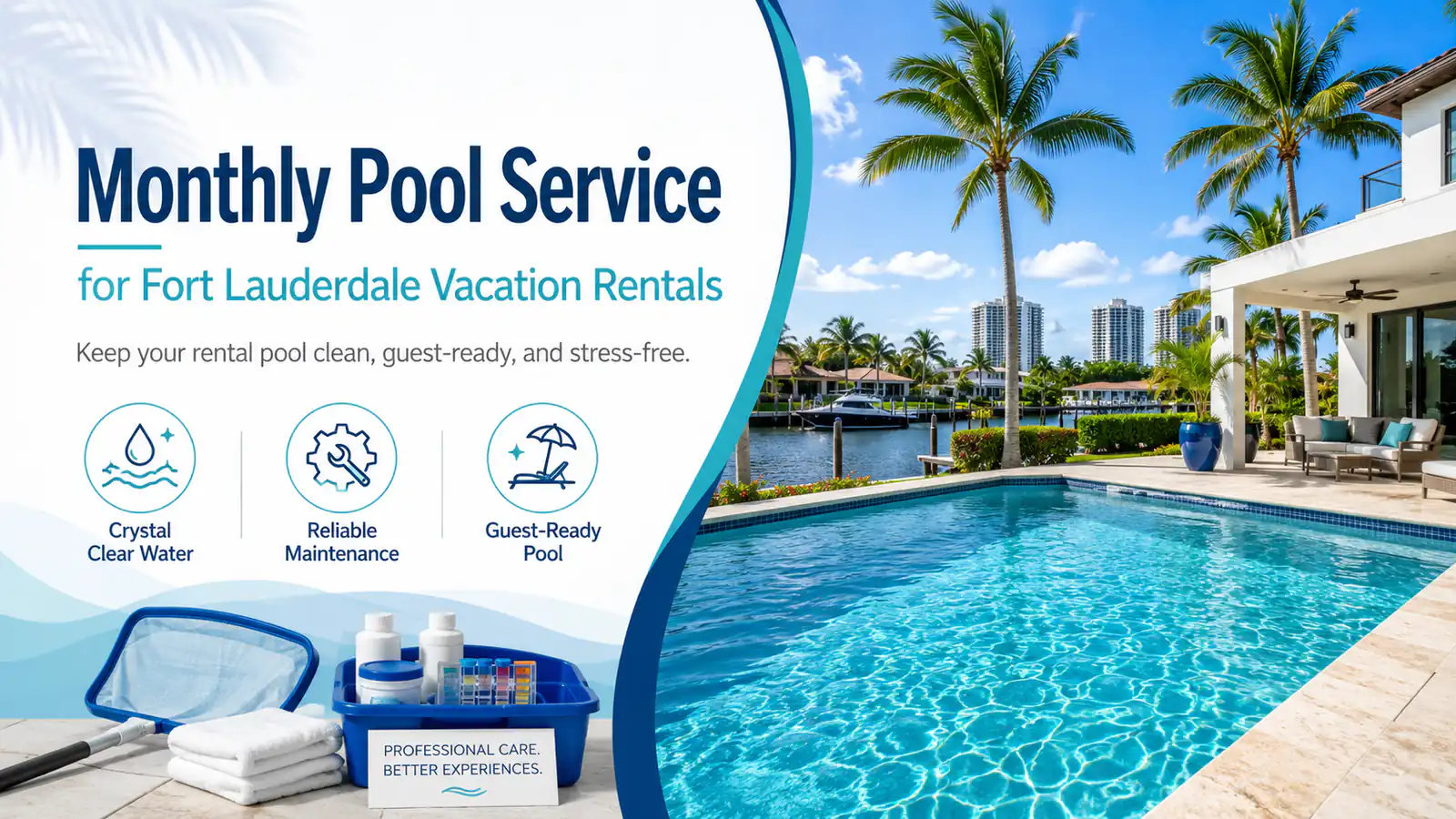
A vacation rental pool is not a residential pool with more people in it. It is a small commercial pool that happens to sit in a backyard— and the most expensive mistake I see Fort Lauderdale hosts make is buying residential weekly service for one. Between Matt Balog (our founder) and me, we've put 40+ years of combined founder experience into Florida's Best Pool Service, and rental properties have become a part of our Fort Lauderdale route we deliberately built the company around. Here's what the service actually includes, what it costs in 2026, and how to tell which frequency your property needs.
The bather-load math that changes everything
Every chemistry decision on a rental pool traces back to one number: bather-hours. People multiplied by hours in the water — the load your chlorine, your filter, and your service schedule have to absorb.
| Usage profile | Typical swimmers | Time in water | Bather-hours / week |
|---|---|---|---|
| Owner-occupied home pool | 2–4 people | 2–5 hours/week | ~10 |
| Family vacation rental | 6–10 guests | 4–8 hours/day | 100–200 |
| Party / event rental, peak week | 8–14+ guests | 10+ hours/day | 200+ |
| Load vs. a home pool | Chemistry demand scales | roughly linearly with exposure | 10–30× |
Each swimmer introduces 50–200 mL of sweat per hour in the water, plus body oils, sunscreen, cosmetics, urea, skin cells, and hair. In practice free chlorine gets consumed 5–10× faster than on a home pool, chloramines build up (the “pool smell” and stinging eyes guests complain about), and filters take 2–3× the residential loading. The full technical breakdown lives in our library: high bather load in rental pools.
This is why a weekly visit fails. A tech balances the water Monday morning, twelve guests check in Friday afternoon, and by Sunday free chlorine is at zero with four days left before anyone looks at it again. Nothing was done wrong. The schedule was built for a different pool.
Party rental or family rental? The question that sets your frequency
When we quote a Fort Lauderdale rental this is the first thing we work out, because it moves the price more than pool size does. The two profiles behave completely differently in the water.
| Factor | Family rental | Party / event rental |
|---|---|---|
| Typical group | 6–10, one or two households | 10–20+, often multiple groups |
| Water use pattern | Spread across the day, kids-heavy | Concentrated bursts, evening-heavy |
| Dominant contaminant | Sunscreen, urea, body oils | Oils, cosmetics, drinks and food in the water |
| Chlorine demand | High and steady | Spiky — can crash a pool in one night |
| Recovery window between guests | Usually a full turnover day | Often same-day back-to-back |
| Right frequency | 2×/week | 3×/week, daily in peak |
Booking density matters as much as party size. A property booked 80%+ of the year needs twice-weekly as a floor regardless of group size, and a spa pushes any property up a tier — hot water at high bather load is the fastest chemistry failure in this business. The tier logic is covered in depth in our rental pool service frequency guide.
What's actually included at each frequency
“Pool service” means different things at different price points, so here is the line-by-line of what a Fort Lauderdale rental plan should include.
| Included | Weekly | Twice-weekly | 3×/week |
|---|---|---|---|
| Water test with test strips (LaMotte WaterLink Spin Touch photometer when the pool needs a closer look) | Every visit | Every visit | Every visit |
| Elevated free-chlorine target (3–5 ppm, not 1–3) | Yes | Yes | Yes |
| Skim, brush, vacuum, baskets emptied | 1× | 2× | 3× |
| Non-chlorine shock to knock down chloramines | Weekly | Weekly | Weekly + as needed |
| Filter cleaning cadence | Standard | Accelerated (2–3× residential loading) | Accelerated |
| Pre-check-in boost timed to arrivals | Not reliable | Included | Included |
| Photo-documented service report | Every visit | Every visit | Every visit |
| Chemistry log for compliance / insurer | On request | Standing | Standing |
| Equipment pad inspection | Weekly | Weekly | Weekly |
| Guest-issue response window | Next visit | Same day | Same day |
The pre-check-in boost is the line hosts underrate. Chemistry set 24–48 hours before arrival is what makes the water look like the listing photos guests are comparing it to — our pre-check-in chemistry boost protocol walks through the sequence. Standard chemicals belong in the monthly fee, not as a surcharge. If a quote surcharges chlorine and acid on a rental pool, your bill goes up every time you get a good booking.
What it costs in Fort Lauderdale in 2026
| Plan | Visits | Monthly | Right for |
|---|---|---|---|
| Weekly | 1×/week | $180–$250 | Booked under 3 weeks/month, small groups, good automation |
| Twice-weekly | 2×/week | $280–$400 | Most Fort Lauderdale rentals — families, 6–10 guests |
| Three times weekly | 3×/week | $500–$800 | Party and event homes, 10+ guests, peak-season blocks |
| Spa add-on | — | +$30–$55 | Any property with a heated spa |
| Reference: owner-occupied home pool | 1×/week | $125–$240 | Not a rental plan — shown for comparison |
Fort Lauderdale sits in the upper half of every one of those bands. Coastal and Intracoastal properties carry higher equipment wear, tighter access, and heavier seasonal booking than inland Broward. Measured against a nightly rate, twice-weekly service costs roughly one booked night a month — which is the comparison worth making, because a single green pool costs considerably more than that.
The Fort Lauderdale multipliers
- Canal-front and Intracoastal salt air. Las Olas Isles, Harbor Beach, Rio Vista, and Bay Colony pools sit in constant salt-laden air. Salt cells run 3–4 years oceanfront against 5–7 inland, and replacement is $800–$1,100 installed. On a rental, that cell failing between guests isn't a maintenance item — it's a refund.
- There is no off-season. Pools here run 365 days a year. Unstabilized chlorine burns off in 4–6 hours of summer sun, so stabilizer management and dose timing decide whether Monday's chemistry survives to Wednesday.
- The 3pm storm. June through September a single afternoon storm can dump an inch of rain and rewrite the chemistry mid-week. On a weekly schedule nobody sees it until the following Monday — with guests in the house the whole time.
- Peak occupancy and peak chemistry stress are out of phase. Fort Lauderdale books hardest December through April, peaking around spring break, with another spike at boat-show week in late fall. But the hardest months on the water are the quiet summer ones. Hosts who dial service back in July are cutting exactly when the pool needs the most.
- Guest expectations are set by hotels. Your guest walked past a resort pool on Las Olas on the way in. That's the standard your water gets judged against, fairly or not.
What goes wrong on a residential plan
| Failure | What it costs | What it really costs |
|---|---|---|
| Green pool mid-stay | $400–$1,500 recovery | Partial refund, plus the review |
| Cloudy water on check-in day | Emergency visit | A 5-star listing becomes a 4-star listing |
| Chloramine smell, stinging eyes | Shock + filtration correction | “The pool smelled like chemicals” in writing, permanently |
| Filter overloaded and bypassing | Cartridge replacement $50–$200 | Cloudy water no amount of chlorine fixes |
| Salt cell dies early on a canal-front pad | $800–$1,100 installed | Sanitizer gone between guests with no backup |
| No chemistry log when an insurer or inspector asks | — | Exposure you can't reconstruct after the fact |
Read that right column again. The recovery invoice is rarely the real number. A single pool-related review sits on your listing for years and discounts every future booking, which is why rental service gets priced against revenue protection rather than against a home pool.
Why we specialize in this — and how we actually run it
Most residential pool companies can't serve this market well, and it's worth being specific about why rather than just claiming we're different.
- The credential. Rental pools are generally treated as public pools under Florida DOH rules, which require a CPO or FPPS holder as the operator of record. A pool contractor's construction license doesn't satisfy that. We hold both credentials — CPO C-105377 at the company and FPPS #600551 (Matt Balog, valid through March 3, 2031). If an inspector asks, the property is covered.
- The route economics. Two or three visits a week only works if the property sits on a route already running that corridor. Ronald Liddell, one of our four partners, came out of route logistics and dispatch, and that discipline is what keeps multi-visit scheduling from drifting into “whenever we're nearby.”
- The commercial training. Doug Santiago, our partner over commercial operations, has 10+ years working and teaching commercial pool cleaning and FDOH compliance, and runs our in-house technician training. Rental pools get serviced by techs trained on commercial chemistry, not residential habits.
- The documentation. Every rental visit is photo-documented and logged. Hosts and property managers get proof the pool was guest-ready, which settles disputes before they turn into refunds — and gives you the record if a permit process or an insurer ever asks for it.
- The schedule discipline. A meaningful share of our Fort Lauderdale route is rental property, run on a standing two-visit week with the second visit positioned deliberately against the property's turnover day. When a host's calendar shifts into a heavy block, we move that property up a tier for the block instead of making them carry peak pricing all year.
- The terms. Fully insured, general liability plus workers' comp, certificate of insurance and additional-insured endorsement on request, and month-to-month. Nobody should be locked into a rental service contract through their slow season.
If you want the local service page rather than the reasoning behind it, it's here: vacation rental pool service in Fort Lauderdale.
The 30-second decision framework
Count how many of these are true of your property: booked more than three weeks a month; sleeps eight or more; has a spa; markets itself for events or large groups; sits on a canal or within a half mile of the ocean; has had even one guest mention the pool in a review. Zero to one — weekly service is probably honest for your property. Two to three — you're a twice-weekly property, and a weekly plan is quietly costing you bookings. Four or more— you're running a small commercial pool, and three visits a week is the number that protects both the asset and the reviews.
Want a starting number for your specific property? Run it through our pool service cost calculator— it asks the same questions we'd ask on a walk-through (size, salt vs chlorine, spa, screen, coastal proximity) and returns the band a fair 2026 quote should land in. Add a tier on top of that for rental use.
The low-risk first step
Whichever tier you land on, the lowest-risk first step is a free on-site evaluation. We'll test your water on site, walk your equipment pad, look at your actual booking calendar, and tell you honestly what frequency your property needs — including when the answer is that weekly is genuinely enough. Overselling a host into a tier they don't need is a good way to lose the account in four months.
Florida's Best Pool Service is family-owned, CPO C-105377, FPPS #600551, fully insured, and runs weekly routes through Fort Lauderdale, Boca Raton, Delray Beach, Highland Beach, Boynton Beach, Pompano Beach, Coral Springs, Coconut Creek, Wellington, and the surrounding South Florida service corridor. Your regular tech, same day every week, once your route is established. Photo-documented service reports. Month-to-month — no long-term lock-in. Built around 40+ years of combined founder experience between Matt Balog, Joe Ford, Ronald Liddell, and Doug Santiago.
Request a free evaluation or call 954-347-1120.
Frequently Asked Questions
Three tiers in 2026. Weekly service runs $180–$250/month and only works for light-use properties booked fewer than three weeks a month with small groups and good automation. Twice-weekly runs $280–$400/month and is the right plan for most Fort Lauderdale rentals — families of 6–10 guests. Three-times-weekly runs $500–$800/month and fits party and event homes, groups of 10+, and peak-season blocks. A spa adds $30–$55/month. For comparison, an owner-occupied home pool on weekly service runs $125–$240/month. Fort Lauderdale sits in the upper half of every band because coastal and Intracoastal properties carry higher equipment wear, tighter access, and heavier seasonal booking than inland Broward.
Two to three times a week for most properties. A family rental sleeping 6–10 needs twice-weekly. A party or event rental hosting 10–20+ guests needs three times a week, and daily during peak blocks. Weekly service is only honest for a property booked fewer than three weeks a month with small groups. Booking density matters as much as party size — a property booked 80%+ of the year needs twice-weekly as a floor regardless of group size, and any property with a heated spa should go up a tier, because hot water at high bather load is the fastest chemistry failure in the business.
Bather load. A rental pool carries 10–30× the load of a home pool — roughly 100–200 bather-hours a week against about 10 — and chemistry demand scales roughly linearly with that exposure. Free chlorine gets consumed 5–10× faster, chloramines build up, and filters take 2–3× the residential loading. The practical failure looks like this: a tech balances the water Monday morning, twelve guests check in Friday afternoon, and by Sunday free chlorine is at zero with four days left before anyone returns. Nothing was done wrong on the visit — the schedule was simply built for a different pool.
Family rentals host 6–10 guests from one or two households, use the water spread across the day, and produce high but steady chlorine demand dominated by sunscreen, urea, and body oils. There's usually a full turnover day between guests. Twice-weekly service handles it. Party and event rentals host 10–20+ guests, often multiple groups, in concentrated evening-heavy bursts, with oils, cosmetics, and drinks and food entering the water. Chlorine demand is spiky and can crash a pool in a single night, and turnovers are frequently same-day back-to-back. Those properties need three visits a week, and daily service during peak blocks.
At every tier: a water test with test strips every visit, stepping up to a LaMotte WaterLink Spin Touch photometer when the pool needs a closer look, an elevated free-chlorine target of 3–5 ppm rather than the residential 1–3, weekly non-chlorine shock to knock down chloramines, and a weekly equipment pad inspection. Skimming, brushing, vacuuming, and basket emptying scale with visit count. Filter cleaning runs accelerated above the weekly tier because filters take 2–3× residential loading. Twice-weekly and above should also include a pre-check-in boost timed to guest arrivals, photo-documented service reports every visit, a standing chemistry log, and same-day response to guest-reported issues. Standard chemicals belong in the monthly fee — a plan that surcharges chlorine and acid means your bill rises every time you get a good booking.
Generally yes. Rental pools are typically treated as public pools under Florida Department of Health rules, which require a CPO (Certified Pool Operator) or FPPS (Florida Public Pool Specialist) holder as the operator of record, along with kept chemistry logs and required signage. A pool contractor's construction license — a CPC or Class C servicing license — does not satisfy the operator requirement, and if an inspector finds no credentialed operator on file, the property gets written up rather than the vendor. Exact classification depends on how your property is licensed and how many units or parties it serves, so it's worth confirming for your specific property. Florida's Best Pool Service holds both credentials: CPO C-105377 at the company and FPPS #600551 (Matt Balog, valid through March 3, 2031).
The recovery invoice runs $400–$1,500 depending on severity, but that's rarely the real number. Add the partial refund or comped night for guests who couldn't use the pool, then add the review — a single pool-related complaint sits on your listing for years and discounts every future booking. Cloudy water on a check-in day turns a 5-star listing into a 4-star one. "The pool smelled like chemicals" — usually chloramines from unmanaged bather load — stays in writing permanently. That asymmetry is why rental pool service gets priced against revenue protection rather than against what a home pool costs.
Be careful, because in Fort Lauderdale peak occupancy and peak chemistry stress are out of phase. The city books hardest December through April, peaking around spring break, with another spike at boat-show week in late fall, but the hardest months on the water are the quiet summer ones — 85–95°F heat, unstabilized chlorine burning off in 4–6 hours of sun, and afternoon storms that can dump an inch of rain and rewrite chemistry mid-week. Hosts who dial service back in July are cutting exactly when the pool needs the most. The better approach is to hold a steady baseline tier year-round and move up a tier for heavy booking blocks, rather than cutting during the months that do the most damage.
Count how many of these are true: booked more than three weeks a month; sleeps eight or more; has a spa; markets itself for events or large groups; sits on a canal or within a half mile of the ocean; has had even one guest mention the pool in a review. Zero to one and weekly service is probably honest for your property. Two to three and you're a twice-weekly property — a weekly plan is quietly costing you bookings. Four or more and you're running a small commercial pool, where three visits a week is the number that protects both the asset and the reviews.
Salt air. Las Olas Isles, Harbor Beach, Rio Vista, and Bay Colony pools sit in constant salt-laden air off the Intracoastal and the ocean, which corrodes pump bearings, stainless hardware, light niches, and heater coils faster than inland equipment. Salt cells run 3–4 years oceanfront against 5–7 inland, and replacement is $800–$1,100 installed. On an owner-occupied pool that's a budgeting item. On a rental it's a revenue event — a cell failing mid-week leaves the pool with no sanitizer while guests are in the house, which is how a maintenance issue becomes a refund and a review. That's why coastal rental properties sit in the upper half of every pricing band, and why weekly equipment-pad inspection matters more here than inland.
Need a pro to handle this?
Florida's Best Pool Service has serviced South Florida homes for 40+ years. CPO-licensed. Fully insured. 230+ five-star reviews.