If you own a condo, HOA, hotel, country club, apartment complex, or any other commercial property with a swimming pool in Florida, the company servicing your pool is required by state law to hold a specific certification. Most pool owners — and a surprising number of pool service companies — don't know this. Hiring an uncertified technician to service a public pool isn't just risky; it's a violation of Florida Department of Health rules and can put your property's operating permit at risk.
This guide explains what the Florida Public Pool Specialist (FPPS) certification is, who's required to have it, what the training covers, and how to verify any pool company's credentials before you hire them.
What Is the FPPS Certification?
The Florida Public Pool Specialist (FPPS) is a 16-hour professional certification course developed by the Florida Swimming Pool Association (FSPA) and approved by the Florida Department of Health as a Public Pool Service Technician Certification under Chapter 514, Florida Statutes, and Chapter 64E-9, Florida Administrative Code.
The FSPA was founded in 1959 and is Florida's largest trade association for the pool and spa industry. It serves as the regulatory liaison between Florida's pool professionals and the Construction Industry Licensing Board (CILB), the Florida Department of Health (DOH), and the Florida Department of Business and Professional Regulation (DBPR).
The FPPS certification is valid for five years and confirms that the holder has demonstrated technical competency in the legal, chemical, and operational requirements of servicing public swimming pools and spas in the state of Florida.
Who Is Legally Required to Hold the FPPS?
Under Florida Administrative Code Rule 64E-9.018, any individual who services a public swimming pool by maintaining its cleanliness, water quality, or chemical balance must hold a Florida DOH-approved certification. The FPPS is one of the courses that satisfies this requirement.
Florida law defines a “public pool” broadly. It includes:
- Hotel and motel pools
- Condominium pools
- Homeowners association (HOA) pools
- Apartment complex pools (any building with 5 or more units)
- Country club and golf community pools
- Fitness center, gym, and spa pools
- School and university pools
- Municipal and community pools
- Water park and splash pad facilities
- Vacation rental pools used commercially
If your pool falls into any of these categories, the technician servicing it is required by law to be certified. A residential pool used solely by the homeowner is not subject to this rule, but many residential customers still prefer working with FPPS-certified technicians because the training is significantly more rigorous than the typical residential pool service experience.
What Does the FPPS Cover?
The certification course is structured around twelve technical modules, each tied to a specific operational competency:
- Operation principles — how pumps, filters, and circulation systems work together
- Basic calculations — pool volume, turnover rate, chemical dosing math
- Safety — chemical handling, electrical safety, suction entrapment prevention
- Water illnesses — recreational water illnesses, cryptosporidium, legionella, E. coli
- Water chemistry — pH, alkalinity, calcium hardness, cyanuric acid, Langelier Saturation Index
- Sanitation — chlorine and bromine disinfection, breakpoint chlorination, combined chlorine
- Specialty chemicals — algaecides, clarifiers, enzymes, phosphate removers, metal sequestrants
- Special problems — algae, scaling, staining, cloudy water, equipment failures
- Water testing — DPD testing, titration, photometric testing, sample handling
- Circulation and filtration systems — sand, cartridge, and DE filter maintenance
- Spa pools — hot water chemistry differences, bromine systems, sanitizer demand
- Hot water chemistry — operating temperature impacts on disinfection and balance
Students must complete all 16 hours of instruction and pass a Florida DOH-approved examination to receive the certification.
How to Verify a Pool Company's FPPS Certification
Florida pool owners — especially HOA boards, property managers, and condo associations — should always verify the credentials of any pool service company before hiring. Here's how:
1. Ask for the certificate number. Every FPPS holder is issued a unique certificate number. A legitimate certified technician will provide it without hesitation.
2. Check the FSPA “Find a Pool Pro” directory. Visit FloridaPoolPro.com and search by zip code or company name. FSPA membership is restricted to companies that maintain proof of insurance, workers' compensation coverage, and active certifications.
3. Verify the contractor license separately. The FPPS is a service technician certification — it is not a contractor's license. For repair, equipment installation, or structural work, the company also needs an active license through the Florida Department of Business and Professional Regulation (DBPR). You can verify any contractor license at MyFloridaLicense.com.
4. Confirm the five-year expiration. FPPS certifications expire five years after issuance. Ask when the certification was awarded and when it expires.
5. For commercial pools, request the certificate before service begins. Property managers and HOA boards should keep a copy on file. If your pool is inspected by the county health department and the servicing technician cannot produce certification, your operating permit can be suspended.
Why This Matters for Boca Raton, Delray Beach, and South Florida Property Owners
South Florida has one of the densest concentrations of public pools in the country. Boca Raton, Delray Beach, Highland Beach, Boynton Beach, Deerfield Beach, and the surrounding communities are home to hundreds of condominium associations, country clubs, gated communities, and luxury hotels — every one of which requires FPPS or equivalent DOH-approved certification for routine pool service.
Despite this, a significant number of pool service companies operating in the area are either unlicensed, uncertified, or both. Hiring one of these companies to service a public pool is a direct regulatory violation. The risks include:
- Suspension or revocation of the property's DOH operating permit
- Liability exposure in the event of a recreational water illness outbreak
- Insurance complications if a swimmer is injured
- Failed county health inspections
- Code enforcement citations
For HOA boards, condo associations, and property managers, certification verification should be a non-negotiable step in vendor selection. The cost difference between a certified and uncertified pool service company is usually minimal — but the legal and liability exposure of using an uncertified company is substantial.
About Florida's Best Pools
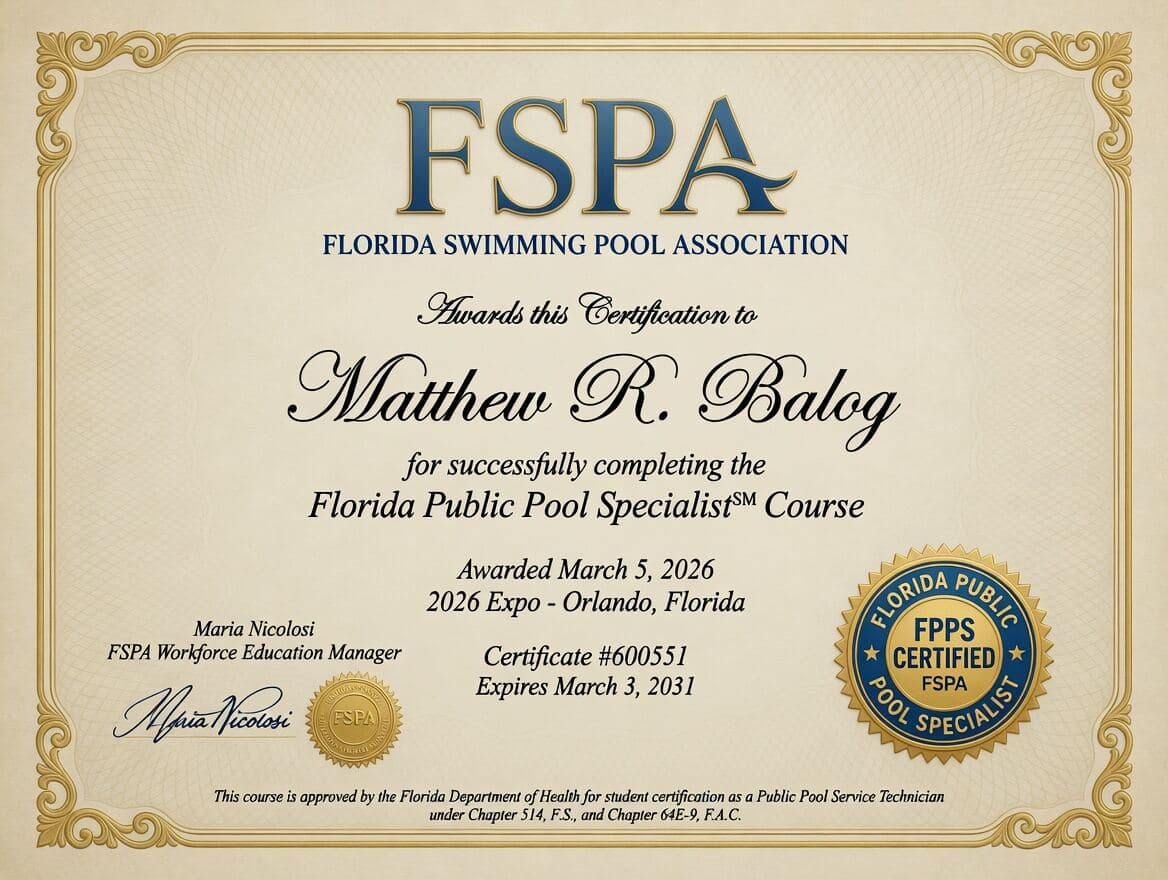
Florida's Best Pools serves residential and commercial properties throughout Boca Raton, Delray Beach, Highland Beach, and surrounding South Florida communities. Co-founder Matthew Balog holds Florida Public Pool Specialist Certification #600551, awarded March 5, 2026 by the Florida Swimming Pool Association under FSPA Providership #0000917 and approved by the Florida Department of Health.
Our team also holds Certified Pool Operator (CPO) certification, maintains active Florida pool servicing contractor licensing, and carries comprehensive general liability and workers' compensation insurance. We are accredited by the Better Business Bureau and maintain a 5.0-star average across more than 222+ Google reviews.
For commercial pool service, HOA and condominium pool maintenance, hotel pool service, or residential weekly pool care in Boca Raton or Delray Beach, contact us at 954-347-1120 or visit our contact page.
Frequently Asked Questions
No, but they are related. The Certified Pool Operator (CPO) is a national certification issued by the Pool & Hot Tub Alliance (PHTA). The FPPS is a Florida-specific certification developed by the FSPA and tailored to Florida's specific public pool codes (Chapter 514 and FAC 64E-9). Both are recognized by the Florida Department of Health. Many Florida pool professionals hold both.
No. Florida law only requires this certification for technicians servicing public pools as defined under FAC 64E-9. However, hiring a certified technician for residential service indicates a higher level of training and professionalism.
Five years from the date of issuance. After expiration, the certification must be renewed by completing the course again.
Your property is in violation of Florida Department of Health rules. The county health department conducts unannounced inspections of public pools, and an uncertified servicing technician can result in operating permit suspension, fines, and required corrective action.
Ask the company for the certificate number and the date of issuance. You can also confirm FSPA membership through the "Find a Pool Pro" directory at FloridaPoolPro.com.
Yes — and you should. HOA boards, property managers, and condo associations have both the right and the responsibility to verify vendor credentials. A reputable pool service company will provide certification documentation upon request.