I've been on Florida pool routes since the late 1990s — my father has been a licensed Florida pool contractor since 1989, and he's the one who taught me.
After 25 years running routes from Seagate and Tropic Isle on the barrier island out to Addison Reserve and Mizner Country Club in west Delray, the same seven problems land in my service-report notes over and over. If you own a pool in Delray Beach, you'll meet most of these eventually.
The good news: every one of them is preventable on a competent weekly route, and every one of them has a known fix when it does show up.
Delray is unusual because it's narrow east-to-west with very different pool environments inside the same ZIP-code clusters. Seagate and the beachside Tropic Isle pools fight salt-air corrosion all year. The dense oak-and-ficus canopy from Lake Ida down through downtown drops debris constantly.
The west-of-I-95 country-club pools — Addison Reserve, Mizner CC, Hamlet, Seven Bridges — sit on phosphate-rich well-water aquifer and run heavy bather load. Every route I've trained a tech to handle in Delray has to cover all of that on the same day. Here's the field-tested list.
Master problem table — what shows up, where, and why
The seven problems I diagnose most often on Delray Beach pools, ranked by how frequently they appear on our service reports across a calendar year.
| # | Problem | Where it hits hardest | Trigger season | 2026 fix cost |
|---|---|---|---|---|
| 1 | Salt-air equipment corrosion | Seagate, Tropic Isle, Delray Beach Club (east of A1A) | Year-round; accelerates summer | $800–$2,100 salt cell · $1,400–$2,400 pump |
| 2 | Pollen + organic debris overload | Lake Ida, downtown Delray, Hamlet (canopy zones) | Feb–May (peak), Sept–Oct (secondary) | $0 if caught weekly · $350–$1,200 if it bloomed |
| 3 | Phosphate spike | West Delray (well-water and irrigation tie-ins) | Aug–Oct after storms | $30–$70 per treatment · 2–4×/year |
| 4 | Cyanuric acid (CYA) creep | Any pool on stabilized tablets, especially salt + tab combo | Builds over 12–24 months | Partial drain-and-refill $150–$400 DIY |
| 5 | Calcium scale at the waterline | Mizner CC, Addison Reserve, Seven Bridges (hard well water) | Year-round; visible in 3–6 months | $350–$900 tile cleaning · $400–$900 acid wash |
| 6 | Iguana droppings + screen damage | Lake Ida, Tropic Isle, Pelican Harbor (mature trees) | Year-round; spikes post-hurricane | $0 same-day net + shock · $200–$2,500 screen repair |
| 7 | Algae bloom after summer storm | Every neighborhood in late Aug–Oct | Aug–Oct rainy season | $350–$1,200 green-to-clean recovery |
| Almost all of these compound. Three problems left unaddressed for 4–6 weeks usually equals a fourth problem (a green pool). | ||||
1. Salt-air corrosion (the east-Delray problem)
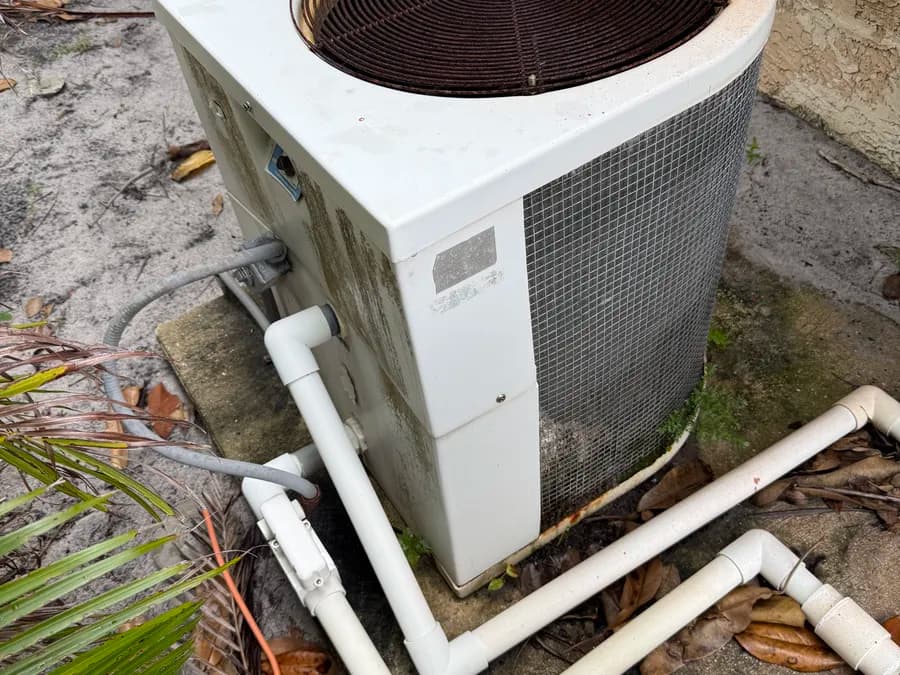
If your pool is east of Federal Highway — and especially anywhere from Linton east to A1A in Seagate or down through Tropic Isle and the Delray Beach Club — the ocean is rusting your equipment from the inside out. Salt-laden air condenses on stainless ladder hardware, light niche screws, salt cell housings, pump shaft seals, and heater coils every night. Inland a salt cell lasts 5–7 years. Oceanfront in Delray, I've replaced cells at 3–4 years.
The fix is not a different vendor or a different product — it's a discipline. Every weekly visit, our techs visually inspect the equipment pad and flag corrosion before the part fails. A salt cell that drops below a 70% efficiency reading gets ordered before the algae bloom that would have proven it's dead. The full coastal lifespan table and the salt-vs-chlorine technical reference live on our salt-vs-chlorine library page, and you can read the storm-damage version on our salt-air equipment damage post.
2. Pollen, oak tassels, and organic debris (Feb–May is hell)
Lake Ida, Pelican Harbor, the historic downtown, and the Hamlet are all canopy neighborhoods — oak, ficus, royal palm, and bottlebrush dropping pollen, tassels, blossoms, and leaves into the pool all spring. From mid-February to early May the organic load is the highest of any season except a hurricane. Skimmer baskets fill in days, not weeks. Pollen on the surface stays even after skimming and feeds bacteria.
| Symptom | What's actually happening | Fix |
|---|---|---|
| Yellow film on the water surface in March | Oak pollen, not algae | Skim, brush, run filter on high speed, then vacuum up dense pollen without sending it through the filter |
| Skimmer basket full of red-brown stringy debris | Bottlebrush or palm flower fall | Empty basket every 2–3 days during peak |
| Cloudy water 24 hours after a heavy pollen day | Chlorine demand spike from organic load | Shock to 5–8 ppm FC, run pump 12 hours |
| Pump pressure 4–6 PSI above clean baseline | Filter loading from organic fines | Backwash (sand/DE) or hose-rinse cartridge |
3. Phosphate spikes (the west-Delray problem)
Country-club Delray — Addison Reserve, Mizner CC, Hamlet, Seven Bridges — sits on well-water aquifer and gets heavy irrigation overspray. Both sources are phosphate-rich. After the August storms wash lawn fertilizer into the pool, I've logged phosphate readings of 1,200–2,800 ppb on west-Delray pools — which means algae has unlimited food the moment chlorine slips for 24 hours.
This is also a seasonal problem. Jan–March it's a non-issue. Mid-August through October is the treatment window where a $40 phosphate treatment prevents a $400 green-pool recovery. The full field test on 12 Delray and Boca pools, the seasonal pattern, and the treatment protocol are in my phosphates after summer rain post.
4. Cyanuric acid (CYA) creep
If your previous pool guy has been dropping stabilized chlorine tablets in the skimmer for two years, your CYA is almost certainly over 80 ppm. Every trichlor or dichlor tablet adds CYA. There's no chemical that removes it — only draining and refilling. Once CYA passes about 70 ppm, your existing free chlorine stops killing algae effectively even though the test reads “in range.”
I see this on at least one in three new-client takeovers in Delray. The fix is a partial drain-and-refill (33–50% of pool volume) plus moving to liquid chlorine or a salt system for daily sanitation. Full mechanism and dosing table on our cyanuric acid library page and the seasonal pattern in my CYA creep post.
5. Calcium scale at the waterline (Mizner / Addison territory)
West Delray well water runs calcium hardness in the 350–550 ppm range. Add 85–95°F summer heat and aggressive evaporation, and calcium concentrates at the tile waterline as the water level drops. Within 3–6 months of skipped weekly brushing you get a chalky white ring that costs $350–$900 to professionally clean — or $400–$900 plus an acid wash if it's been ignored for a year.
Prevention is brushing the tile every weekly visit, holding pH at 7.4–7.6 (not 7.8+), and managing total alkalinity to 80–100 ppm. Technical reference: calcium hardness library page.
East vs. west Delray — which problems hit where
If you take nothing else from this post, take this. Knowing your geography tells you which three or four problems to prioritize on a weekly route.
| Problem | East of Federal Hwy (Seagate, Tropic Isle, Pelican Harbor) | Central Delray (downtown, Lake Ida, Hamlet) | West of I-95 (Addison Reserve, Mizner CC, Seven Bridges) |
|---|---|---|---|
| Salt-air equipment corrosion | High | Moderate | Low |
| Pollen / tree-canopy debris | Moderate | High | Low–Moderate |
| Phosphate spikes | Low | Moderate | High |
| CYA creep | Moderate | Moderate | Moderate |
| Calcium waterline scale | Low–Moderate | Moderate | High |
| Iguana droppings | High | High | Low |
| Storm-week algae bloom | High (equipment risk) | Moderate | High (phosphate risk) |
6. Iguana droppings and screen damage
The green iguana population east of Federal Highway exploded over the last decade. Lake Ida, Pelican Harbor, Tropic Isle, and Seagate are the neighborhoods I see it most. The droppings carry Salmonella, and a single hurricane that shakes 20 iguanas out of the trees and through a torn screen panel turns a clean pool into a public-health concern by Wednesday.
The protocol: physically remove (never brush or vacuum through the filter), shock to 10+ ppm free chlorine if the load was heavy, brush the affected surface, run filtration on high speed for 4–6 hours, retest at 24 hours. Full Florida-specific protocol in my iguana droppings post. Flag screen tears the same week they happen — a 2-inch tear is a 4-foot iguana's door.
7. Algae bloom after a summer storm
This is the problem that costs Delray homeowners the most money each year. The mechanism: a heavy August thunderstorm dumps 2–4 inches of rain in an afternoon, dilutes free chlorine, washes phosphate-rich runoff into the pool, drops organic debris in, and 48–72 hours later the pool is green. If chlorine stays at zero for 36 hours and phosphates are above 500 ppb, algae wins every time.
The pre-storm protocol — shock to 10 ppm, balance pH and alkalinity, add maintenance algaecide, backwash filter — is in my hurricane pool prep post. The algae types and recovery protocol is on the green algae library page. And the deep dive on why Delray specifically blooms after rain is in the companion post I'm publishing alongside this one.
The 30-second Delray field decision tree
- Pool east of Federal Highway? Inspect the equipment pad weekly. Budget for salt cells at 3–4 years, pumps at 7–9 years (vs. 8–12 inland).
- Pool under heavy tree canopy? Weekly skimmer-basket discipline Feb–May is non-negotiable. Bi-weekly will fail.
- Pool west of I-95? Test phosphates quarterly, treat 2–4 times per year (concentrated Aug–Oct), and watch CYA.
- Screen enclosure? Walk it monthly. Flag any tear bigger than a quarter immediately.
- Pool over 5 years old on stabilized tablets? Test CYA — if it's above 70 ppm, plan a partial drain before next summer.
What a fair 2026 weekly route looks like for a Delray pool
If your current service is “in and out in 15 minutes,” something is being skipped — and one of these seven problems is quietly compounding. A real weekly visit on a Delray pool runs 30–50 minutes and includes a test-strip water check (with our LaMotte WaterLink Spin Touch photometer on tougher pools), brushing tile and walls, basket service, equipment pad visual, and a photo report.
Run your specific pool through our pool service cost calculator for a 2026 quote range — it asks the same questions I'd ask on a walk-through (size, salt vs chlorine, spa, screen, distance from the coast). For Delray specifically, the comparison guide is on our Boca + Delray pool service comparison post.
The low-risk first step
If three or more of the seven problems above sound like your pool right now, the lowest-risk first step is a free on-site evaluation. We'll test your water on site, walk the equipment pad, check the screen enclosure if you have one, and tell you honestly which of the seven you're dealing with and what it'll cost to fix — whether you hire us or not.
Florida's Best Pool Service is family-owned, CPO C-105377, fully insured, and runs weekly routes through Delray Beach, Boca Raton, Highland Beach, Boynton Beach, Fort Lauderdale, Pompano Beach, Coral Springs, Coconut Creek, Wellington, and the surrounding South Florida service corridor. Your regular tech, same day every week, once your route is established. Photo-documented service report after every visit. Month-to-month — no long-term lock-in. Built around 40+ years of combined founder experience between Matt Balog, Joe Ford, Ronald Liddell, and Doug Santiago.
Request a free evaluation or call 954-347-1120.
Frequently Asked Questions
The seven recurring problems I see on every Delray route: (1) salt-air equipment corrosion (Seagate, Tropic Isle, Delray Beach Club — pumps and salt cells fail 25–40% sooner than inland); (2) pollen and organic debris overload (Feb–May tree canopy in Lake Ida, Pelican Harbor, downtown, Hamlet); (3) phosphate spikes from west-Delray well-water irrigation and lawn-fertilizer runoff after summer storms (Addison Reserve, Mizner CC, Hamlet, Seven Bridges); (4) cyanuric acid creep from stabilized tablets — over 70 ppm CYA neuters chlorine even when tests read in range; (5) calcium scale at the waterline tile from hard well water; (6) iguana droppings and screen-enclosure damage; (7) algae blooms 48–72 hours after summer storms (Aug–Oct rainy season). Most are preventable on a competent weekly route.
Geography splits the city. East of Federal Highway — Seagate, Tropic Isle, Pelican Harbor, Delray Beach Club, Lake Ida — fights salt-air equipment corrosion (pumps last 7–9 years vs. 8–12 inland, salt cells 3–5 years vs. 5–7 inland), heavy tree-canopy debris, and higher iguana pressure. West of I-95 — Addison Reserve, Mizner Country Club, Hamlet, Seven Bridges, Lakeside Estates — sits on phosphate-rich well-water aquifer and gets heavy irrigation overspray, so phosphate spikes (1,200–2,800 ppb after August storms) and calcium scale at the tile waterline are the dominant issues. CYA creep and algae blooms hit both sides. A real Delray service company runs different inspection protocols east vs. west.
Real 2026 Delray cost reference: green-pool recovery $350–$1,200 depending on severity; salt cell replacement $800–$2,100 installed; pool tile waterline calcium cleaning $350–$900; acid wash + drain (severe scale or algae-penetrated plaster) $400–$900; phosphate treatment $30–$70 in chemicals or $120–$240 by a pro; partial drain-and-refill for CYA creep $150–$400 DIY plus a fresh-water bill; screen-enclosure repair $200–$2,500 depending on panel count; weekly route prevention $125–$240/month. The math almost always favors prevention — a $40 phosphate treatment prevents a $400 algae recovery, a $20/visit equipment-pad inspection catches a $1,200 pump failure 6 months ahead.
Two reasons. (1) Heat and UV — Florida sun degrades unstabilized chlorine in 4–6 hours unstabilized in summer, so prior service companies often default to stabilized chlorine tablets (trichlor, dichlor) that include CYA in the molecule. Every tablet adds CYA. Over 12–24 months of weekly tablet feeding, CYA creeps from 30 ppm to 80–120 ppm. (2) No South Florida groundwater dilutes it — once CYA is in the pool, the only removal mechanism is draining and refilling. Pools in Northern climates get partial dilution from snowmelt or off-season refills; Delray pools don't. The fix is a partial drain-and-refill (33–50% of pool volume) plus moving daily sanitation to liquid chlorine or a salt system going forward.
Every weekly visit — that's the discipline. West-Delray well water runs calcium hardness in the 350–550 ppm range, which is high. Combined with 85–95°F summer heat and aggressive evaporation, calcium concentrates at the tile waterline as the water level drops. Brushing the tile every week (especially the waterline, the steps, and sun shelves) along with holding pH at 7.4–7.6 (not 7.8+) and total alkalinity at 80–100 ppm prevents the chalky white ring. Skip brushing for 3–6 months and you'll have a $350–$900 professional cleaning bill. Skip it for a year and you'll need an acid wash on top.
Yes — the green iguana population east of Federal Highway has exploded over the last decade, and the droppings carry Salmonella. Lake Ida, Pelican Harbor, Tropic Isle, and Seagate are the neighborhoods I see it most. A single hurricane that shakes 20 iguanas out of the trees and through a torn screen panel turns a clean pool into a public-health concern by Wednesday. Protocol if you find droppings: physically remove them (never brush or vacuum through the filter — you don't want fecal matter recycling through the cartridge); shock to 10+ ppm free chlorine if the load was heavy; brush the affected surface; run filtration on high speed for 4–6 hours; retest at 24 hours. Prevention: trim overhanging branches, repair screen tears (a 2-inch tear is a 4-foot iguana's door), don't leave fruit on the ground, and consider a licensed iguana removal service for repeat issues.
Cumulatively over a pool's life, it's salt-air equipment corrosion on east-Delray pools — replacement pumps every 7–9 years instead of every 8–12, salt cells every 3–5 years instead of every 5–7, plus accelerated corrosion on ladders, light niches, and stainless hardware. That can total $8,000–$15,000 in additional equipment spend over 20 years for a Seagate or Tropic Isle pool vs. an inland Mizner CC pool. Single-event-wise, the most expensive problem is a severe algae bloom that penetrates plaster pores and requires an acid wash + drain ($400–$900) on top of green-pool recovery ($600–$1,200) — total $1,000–$2,100, and the next bloom comes faster because the plaster is now compromised. Both are prevented by weekly discipline.
Five common reasons. (1) Higher CYA — over 70 ppm, your existing free chlorine is locked up and not killing algae or bacteria effectively. (2) Higher phosphate (especially west Delray after summer storms) — gives algae unlimited food, so chlorine has more work to do. (3) Heavier bather load — vacation rentals, family visits, or simply more swimmers daily. (4) Higher organic debris load — tree canopy, screen enclosure trapping leaves, irrigation runoff carrying lawn organics. (5) Failing equipment — pump or salt cell at reduced efficiency means less sanitation per hour of runtime. The diagnostic order is: test CYA first, then phosphate, then walk the equipment pad for failing components, then compare bather load and debris. Almost every 'mystery high chlorine demand' resolves to one of those five.
Run the 7-step pre-storm protocol 24–48 hours before a forecast 1.5+ inch rain (or any named storm in the cone): (1) shock free chlorine to 10 ppm with liquid chlorine or calcium hypochlorite — not trichlor; (2) balance pH to 7.4 and total alkalinity to 80–100 ppm; (3) add a maintenance dose of polyquat 60 algaecide; (4) backwash filter or rinse cartridges; (5) run pump 24 hours; (6) check phosphate in the Aug–Oct window and treat if over 500 ppb; (7) walk the screen enclosure and flag tears. Pools that follow this protocol bloom less than 10% of the time even during the worst Delray storm weeks. Pools that skip it bloom over 60% of the time in the Aug–Oct window. Full mechanism in our companion algae-blooms-summer-rain-delray post.
Call a pro if three or more of these are true: you've had two or more algae blooms in 12 months; your equipment is over 6 years old and showing visible corrosion (east Delray); your CYA has been above 70 ppm for 6+ months; you don't have a calibrated reagent test kit (Taylor K-2006 or LaMotte ColorQ) and are relying on test strips; your chlorine demand has measurably increased in the last 3 months without explanation; you're heading into the Aug–Oct storm window without a pre-storm protocol. DIY is fine for routine weekly chemistry and brushing on a stable pool with good equipment. The cost crossover usually happens when prevention discipline slips — at that point, a $150/month weekly service is cheaper than the recovery costs you're accumulating.
Need a pro to handle this?
Florida's Best Pool Service has serviced South Florida homes for 40+ years. CPO-licensed. Fully insured. 230+ five-star reviews.