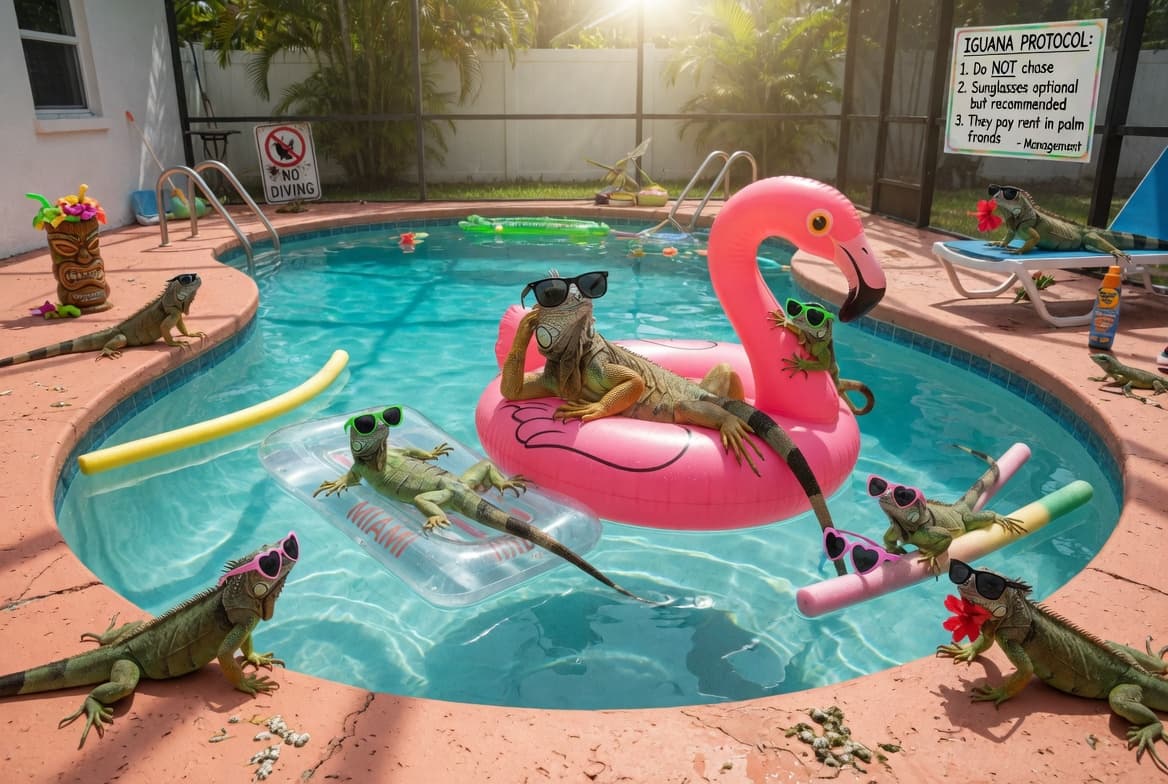
I'll tell you what nobody warned me about when I started servicing pools in Boca Raton in the mid-1990s: green iguanas weren't a problem then. They are now. After 30 years on routes from Las Olas Isles to Highland Beach, I've watched the iguana population explode, and the one consistent question homeowners ask me — usually after a hurricane shakes them out of the trees — is: are these droppings actually a health risk in my pool?
Short answer: yes. Long answer: yes, and here's the protocol we follow on every weekly visit, plus what we recommend homeowners do between visits to stay ahead of it.
Why iguana droppings in your pool are a real problem
Iguana feces carry Salmonella. The CDC has documented multiple Salmonella outbreaks linked to reptile contact, and the FDA classifies green iguanas as a known reservoir host. When iguana droppings hit pool water, the chlorine in a properly maintained pool will kill Salmonella — but two things have to be true: (1) free chlorine has to actually be at the right level, and (2) the contact time has to be long enough.
Here's where the problem starts. Most pools I inspect for new clients in coastal Broward and Palm Beach County run free chlorine below 1.5 ppm because the previous service company was “saving on chemicals.” At those levels, you don't have the headroom to neutralize a heavy organic load fast. Add a hurricane that knocks 30 iguanas into a screen-enclosed pool, and a pool that looked fine on Monday is a public-health concern by Wednesday.
What we do on every weekly visit
The protocol Florida's Best Pool Service has refined over 40+ years of combined founder experience still holds — with one update made post-2017 hurricane season as the iguana population grew. Every weekly visit on a Florida's Best Pool Service route includes:
- Visual inspection of the deck and waterline before any chemistry work. If there are droppings on the deck, in the skimmer, on the steps, or on the waterline tile, that's noted in the service report before anything else.
- Physical removal first. Droppings get netted out — never broken up with a brush, never vacuumed up through the filter (you don't want fecal matter recycling through cartridge media).
- Targeted shock treatment if warranted. If the load was heavy or recent, we shock the pool to a free chlorine of 10+ ppm to drive the chlorine-to-CYA ratio above the disinfection threshold. We do this with calcium hypochlorite or liquid chlorine — never trichlor, which adds cyanuric acid you don't need.
- Brushing of the affected area. Anywhere droppings sat on a surface gets brushed after shock to break up any residue.
- Filter run-time bump. Variable-speed pumps get bumped to high speed for 4–6 hours to fully turn over the water. Single-speed pumps run an extra cycle.
- Re-test 24 hours later. If the load was significant, we come back the next day to verify free chlorine has held and combined chlorine is below 0.5 ppm.
- Photo documentation. Every step gets photographed and emailed to the homeowner. No surprises, no “trust me.”
This is what I mean when I say systems beat talent. A great pool tech who skips step 4 because they're running late is worse than an average tech who follows the checklist every time. Routine is the whole game.
What homeowners should do between weekly visits
You're going to spot droppings between visits — especially during hurricane season, after heavy rain, or if you have mature trees overhanging the pool. Here's the homeowner protocol:
- Net them out within hours, not days. The longer organic matter sits in pool water, the more chlorine demand it creates and the higher the bacterial load gets.
- Wear gloves. Salmonella transmits through hand-to-mouth contact. Gloves, then wash hands.
- Don't swim for 24 hours after a heavy load. Even with shock treatment, give the system time to work. Free chlorine should be back in the 1–4 ppm range and combined chlorine below 0.5 ppm before swimmers go in.
- Bag and trash — don't flush. Iguana waste in the septic or municipal system isn't the right disposal path.
- Text or call your pool service if it's a heavy load. A quality service will respond quickly — that's what we do for our clients in Boca, Delray, Fort Lauderdale, and the surrounding routes.
Prevention — the part most companies skip
I'm honest with clients: you can't fully prevent iguanas from getting near a South Florida pool. What you can do is reduce the frequency. Things we recommend that actually work:
- Don't leave fruit on the ground. Mango, avocado, and fig trees over a pool deck are iguana magnets.
- Trim back overhanging branches. Iguanas drop from trees during storms and cold snaps — if there's no canopy, there's no platform.
- Repair screen enclosures aggressively. A 2-inch tear is a 4-foot iguana's entry point. We flag screen damage on every weekly visit on the report.
- Remove brush piles and dense ground cover within 20 feet of the pool deck. Iguanas use these as hiding spots.
- Don't feed any wildlife. Sounds obvious, still happens.
- Consider a licensed iguana removal service for repeat issues. Florida's green iguana is an invasive species and removal is legal year-round on private property.
What to ask your pool service company
If you're evaluating pool service companies in South Florida, ask three questions about how they handle iguana droppings:
- “What's your protocol when you find droppings on a visit?” If they shrug or say “net it out,” that's the answer of someone who doesn't take it seriously.
- “Do you photograph and document the issue in the service report?” If no, you'll never know it happened — or how often.
- “What do you charge for an emergency visit after a heavy load?” Some companies charge $150+. We don't — a prompt response after a documented issue is included in the flat-rate monthly service for our clients.
That last point matters. The whole reason a flat-rate, no-surcharge service exists is so that homeowners aren't penalized for South Florida being South Florida. Iguanas are part of the deal here. The work just has to get done right when it happens.
If you're in Boca Raton, Delray Beach, Fort Lauderdale, Highland Beach, or anywhere in the surrounding routes and you want a service company that documents, photographs, and follows the protocol every time — request a free on-site evaluation. Prompt written quote, no long-term contract, your regular tech every week (once your route is established).
Frequently Asked Questions
Yes. Green iguanas are documented Salmonella carriers per the CDC and FDA. Properly maintained pool chlorine will neutralize Salmonella, but only if free chlorine is at the correct level (1–4 ppm), the chlorine-to-cyanuric-acid ratio is healthy, and contact time is sufficient. After a heavy load of droppings, the standard protocol is to net out solids first (never brush or vacuum), shock to 10+ ppm free chlorine, brush the affected surface, run filtration on high speed for 4–6 hours, and re-test 24 hours later. Don't swim until free chlorine is back in the 1–4 ppm range and combined chlorine is below 0.5 ppm.
Net them out within hours, not days — the longer organic matter sits, the higher the bacterial load and chlorine demand. Wear gloves (Salmonella transmits through hand-to-mouth contact). Don't swim for 24 hours. Bag and trash the waste — don't flush. If the load is heavy, text or call your pool service company; a quality service will respond promptly at no surcharge.
You can't fully prevent it in South Florida, but you can reduce frequency: trim overhanging branches (iguanas drop from trees during storms and cold snaps), repair any tears in the screen enclosure (a 2-inch tear is an entry point for a 4-foot iguana), don't leave fruit on the ground (mango, avocado, fig trees over a deck are iguana magnets), remove brush piles and dense ground cover within 20 feet of the pool deck, and consider a licensed iguana removal service for repeat issues — Florida's green iguana is invasive and removal is legal year-round on private property.
Not for a single dropping that's been removed quickly. For multiple droppings, a heavy load after a hurricane, or any visible contamination of the water itself, yes — shock to 10+ ppm free chlorine, brush the affected area, and run high-speed filtration for 4–6 hours. The Florida's Best Pool Service weekly visit checklist documents the load size, the shock level applied, and the post-treatment chemistry — every step photographed and emailed to the homeowner.
If you're in coastal Boca, Delray, Fort Lauderdale, or anywhere in South Florida, yes — and you should ask three questions when evaluating any company: (1) What's your protocol when you find droppings on a visit? (2) Do you photograph and document it in the service report? (3) What do you charge for emergency response after a heavy load? A flat-rate company that includes prompt response in the monthly fee is the right structure for South Florida.
Need a pro to handle this?
Florida's Best Pool Service has serviced South Florida homes for 40+ years. CPO-licensed. Fully insured. 230+ five-star reviews.