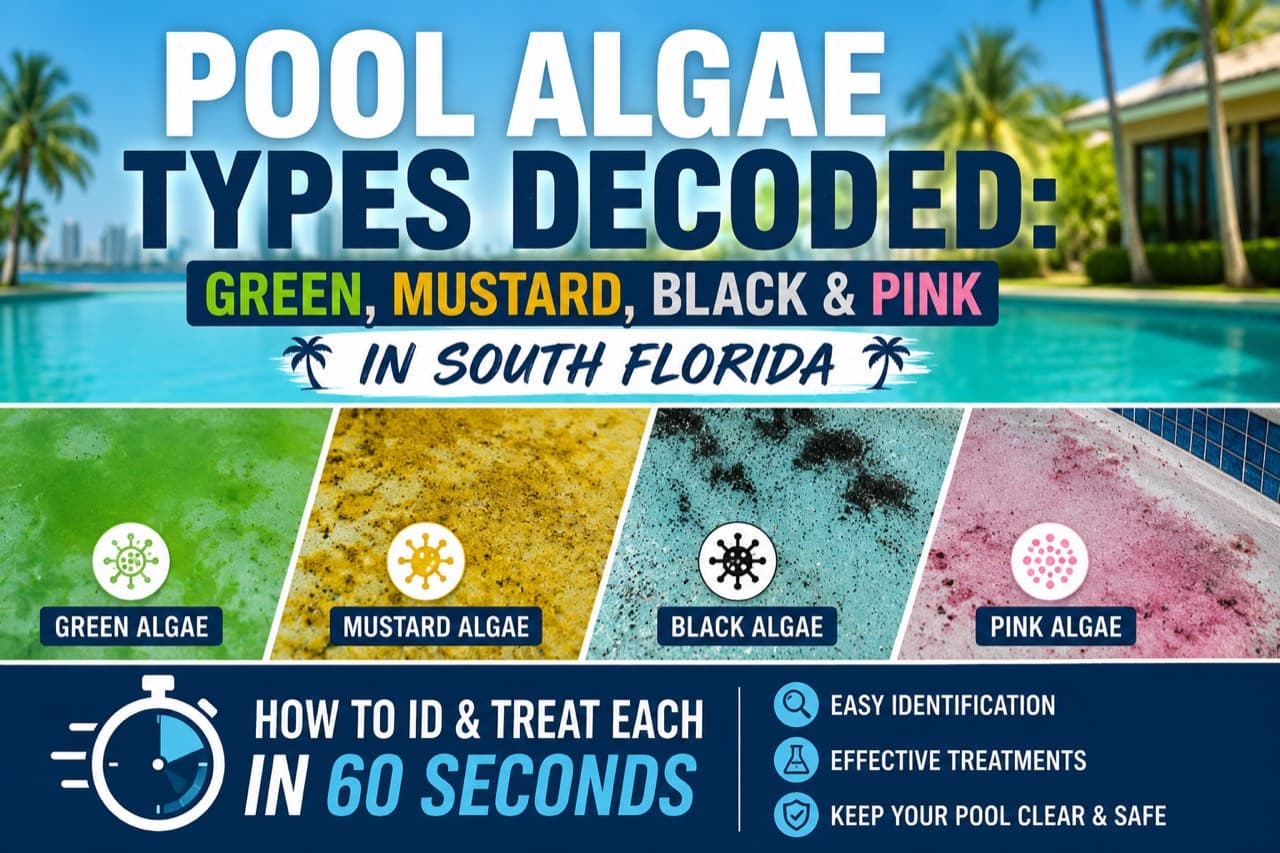
I've been on Florida pool routes since the late 1990s — my father has been a licensed Florida pool contractor since 1989, and he's the one who taught me — and after 25 years of brushing, shocking, scrubbing, and triple-shocking pools across Boca Raton, Delray Beach, Fort Lauderdale, and the rest of the South Florida service corridor, I can tell you that 90% of homeowners who call us “with algae” have one of four types. The fix for one is not the fix for the others. Get the ID wrong and you can dump $200 in shock at a pool that needs $40 of yellow-algae treatment plus an equipment-pad scrub-down — and watch it come back in 72 hours.
The 60-second visual ID
| What you see | Where | How it brushes | Type |
|---|---|---|---|
| Free-floating green tint, water cloudy to swamp | Whole pool, worst in dead zones | Easy — suspends in water | Green algae |
| Yellow / mustard powdery film, looks like pollen settled on walls | Shaded walls, steps, behind ladders — rarely sunny areas | Comes off with brushing but settles back | Mustard / yellow algae |
| Black or blue-black spots, dime-to-quarter sized, embedded in plaster | Plaster pits, rough surfaces, grout lines | Hard — spots persist even with stainless brush | Black algae |
| Pink / salmon slime, slick texture, smells slightly off | Behind light niches, return jets, skimmer baskets, PVC fittings | Slimy, smears rather than brushes off | Pink algae (technically bacteria) |
| Cloudy white/gray after shocking a green pool | Whole pool | Doesn't brush — suspended particulates | Dead algae (not active — filter problem) |
Misidentification is the #1 reason homeowner algae treatments fail. The mustard-algae owner shocks to 10 ppm, the pool clears for 48 hours, then it comes back — because mustard tolerates normal shock and lives in the filter, the pool brush, the pole, and the steps. You have to treat the equipment too.
Type 1 — green algae (75% of South Florida algae calls)
The default. Green algae is free-floating, doubles every 3–8 hours in summer water above 80°F, and goes from “dull/hazy” to “clearly green” to “swamp green you can't see the steps” in 24–72 hours. Florida sun, daily 3pm rain, and any chlorine drop below 1 ppm sets the stage. We see this most often after vacations, hot weekends, or a tab feeder that ran out.
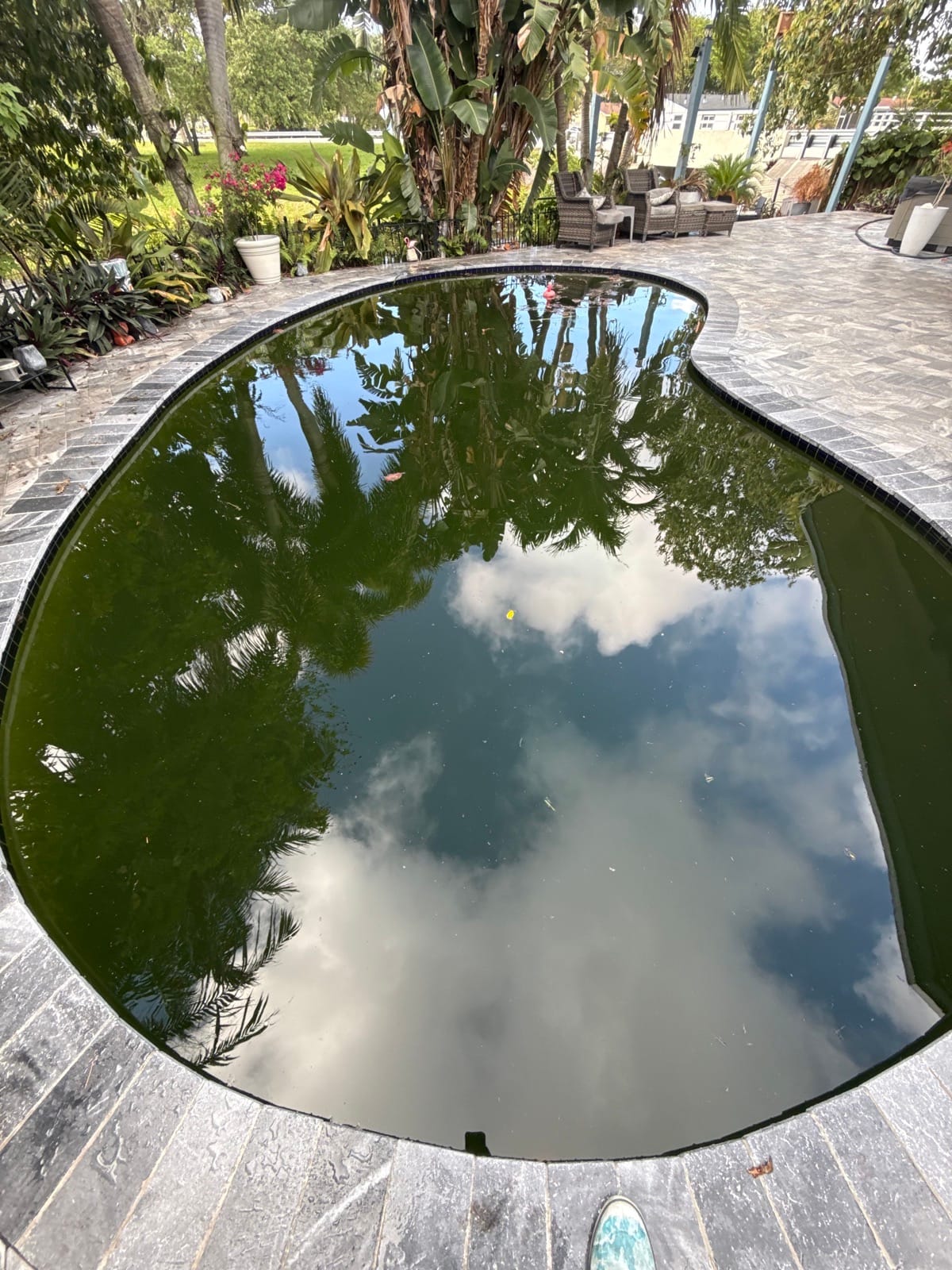
The fix: shock to 10–20 ppm FC with calcium hypochlorite or liquid chlorine (dose by pool volume and CYA per the FC:CYA ratio — high CYA pools need much more shock). Brush every wall, step, sun shelf, dead zone. Run pump 24–48 hours continuous. Clean filter at hour 12 and hour 36. Pool clears in 48–96 hours. Full diagnostic and recovery protocol lives in our library article on how to clear a green pool.
2026 cost:$40–$120 in chemicals if caught early; $400–$1,500 for a full pro green-pool recovery if the bottom is no longer visible. Prevention costs roughly $0 — FC 3–5 ppm, run pump 8–12 hours summer.
Type 2 — mustard / yellow algae (15% of calls, and the trickiest)
Mustard algae looks like someone dusted the shaded walls and steps with pollen or fine yellow powder. It tolerates normal chlorine levels (FC 3–5 ppm) and lives in places shock can't easily reach — pool brushes, telescoping poles, filter cartridges, the underside of solar covers, the pool toys you left in the deep end. Treat the water but not the equipment and it returns in 4–10 days. Homeowners describe it as “the algae that keeps coming back.”
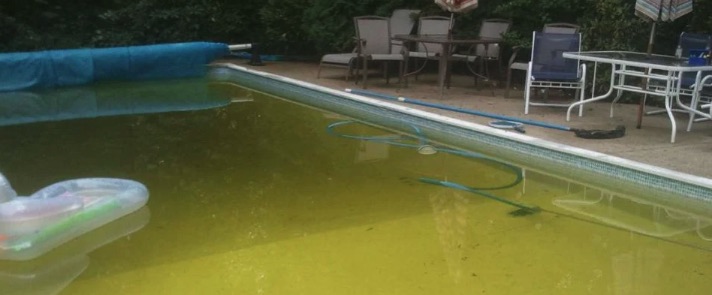
The fix: triple-shock to roughly 3× normal shock dose (30+ ppm FC with appropriate CYA correction), brush the affected surfaces aggressively, and — this is the critical part — soak every piece of pool equipment in the deep end of the shocked pool: brushes, poles, vacuum heads, pool toys, ladder steps if removable, even the bathing suit you wore yesterday. Filter cartridges go through a 24-hour soak in cal-hypo solution or get replaced. Without the equipment scrub-down, the pool re-infects. Full protocol in our library article on mustard yellow algae.
2026 cost:$80–$250 chemicals + 1–2 weeks of vigilance. Pro service call $250–$500 one-time, included in weekly-route service.
Type 3 — black algae (3% of calls, the long game)
Black algae isn't really “black” — it's blue-black, embedded in plaster pits or rough surfaces like grout lines and pebbletec interiors. Each colony has a protective outer layer that shrugs off normal chlorine. The roots go into the substrate. It does not happen in vinyl or fiberglass pools (no porous surface), and it's mostly a concern on older plaster pools or pools with mineral staining and rough patches.
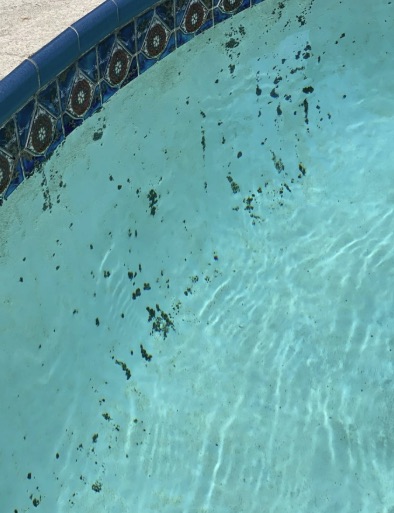
The fix: nothing fast. Brush each spot with a stainless-steel brush to break the protective outer layer, drop a chlorine tab directly onto the brushed spot (some techs hold one in place by hand for 10 minutes — gloves on), apply a copper-based algaecide labeled for black algae, run filter, and repeat weekly for 4–8 weeks. Even then, black algae is managed, not eliminated — the only true cure is a plaster resurface ($7,500–$12,000) which is not warranted unless the pool is due for one anyway. Full technical reference: how to kill black algae.
2026 cost:$150–$400 for chemicals + brushing time over 4–8 weeks. Pro service $400–$900 for the treatment cycle (included for weekly clients as part of route protocol).
Type 4 — pink algae / pink slime (5% of calls, fast and easy)
Pink algae is actually a bacterial colony — Methylobacterium— not algae at all. It grows in low-flow, sheltered spots: behind light niches, inside skimmer baskets, around return jet eyeballs, inside the pump basket, on the inside walls of PVC fittings. Pink, salmon, sometimes orange-tinted, slick to the touch.
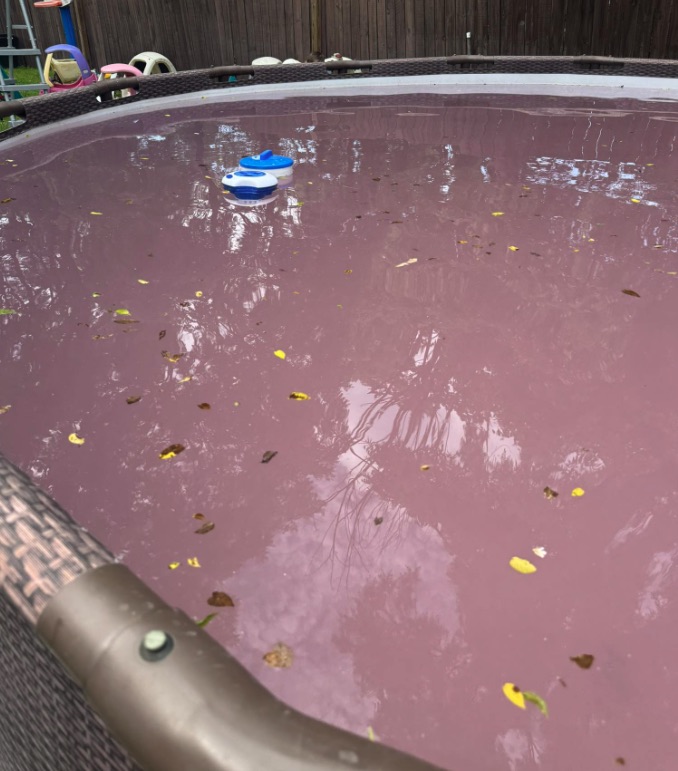
The fix:shock to 10–15 ppm FC, scrub every fitting and basket with a brush, and pour a dedicated pink-algae cleaner or polyquat 60 algaecide into the system per label. Run pump 24 hours. Returns rarely if the underlying issue (low flow, sheltered fittings) gets addressed.
2026 cost:$30–$80 chemicals; almost never escalates to a service call unless ignored for weeks.
The Florida multiplier — why we see more of all four than northern climates
South Florida is the most aggressive algae environment in continental North America. Water temperatures stay above 80°F from May through October. UV burns through unstabilized chlorine in 4–6 hours. Daily 3pm thunderstorms cycle pH, alkalinity, and bather load through wide ranges. Hurricane season blows organic debris (leaves, palm fronds, grass clippings, lovebug bodies) into pools in volumes that overwhelm normal sanitization. Snowbird homes sit unattended May through October with tabs that ran out in August.
We tracked species prevalence and treatment outcomes across our service corridor — full data, including which automation strategies actually reduce green-pool incidence vs. which mostly add hardware cost (smart chlorinators, UV secondaries, phosphate dosing pumps), is in the corridor-level analysis we published.
The prevention math is straightforward: FC 3–5 ppm at all times, FC:CYA ratio above 7.5%, pump 8–12 hours/day in summer, weekly brushing of shaded walls and dead zones, quarterly CYA test, phosphate management if >500 ppb. Five habits, no exceptions. Full Florida-specific prevention protocol: prevent algae in hot humid Florida.
2026 South Florida algae cost reference
| Type | DIY chemicals | Pro recovery (non-client) | Weekly-client cost |
|---|---|---|---|
| Green — caught early (dull/hazy stage) | $10–$40 | $100–$175 | Included in flat monthly |
| Green — clearly green | $40–$120 | $300–$600 | Included |
| Green — swamp (bottom not visible) | $120–$400 | $400–$1,500 | Included (we'd catch it before this) |
| Mustard / yellow | $80–$250 | $250–$500 | Included |
| Black | $150–$400 + 4–8 wk cycle | $400–$900 | Included as managed cycle |
| Pink slime | $30–$80 | $150–$300 | Included |
What NOT to do when you see algae
- Don't shock without testing CYA first. If CYA is over 80 ppm, normal shock won't kill algae. You'll burn through 4 lbs of cal-hypo and the pool stays green.
- Don't shock a mustard pool at normal dose. Triple-shock or the pool re-infects in 4 days.
- Don't pour copper-based algaecide into a salt pool casually. Some copper algaecides interact with salt cell electrodes. Read the label.
- Don't use floc with a cartridge filter. Floc requires vacuum-to-waste; cartridges don't backwash. Clarifier instead for dead algae cleanup.
- Don't skip the equipment scrub on mustard. The single most common re-infection vector is the brush, pole, and filter.
- Don't swim until clear and chemistry-balanced. Visible algae = drowning hazard plus elevated bacterial load.
Run yours through the calculator
If you're paying for weekly service and still got algae, that's a signal. Run your quote through our pool service cost calculator— the band tells you whether you're overpaying, underpaying, or about right for what you should be getting in algae prevention.
The low-risk first step
If you've got visible algae and you're not sure which type, the lowest-risk first step is a free on-site evaluation. We'll ID the type by its visual signature, test your water on site, walk your equipment pad, and tell you honestly what it'll cost to clear — and what prevention should cost going forward. Whether you hire us or not.
Florida's Best Pools is family-owned, CPO C-105377, fully insured, and runs weekly routes through Boca Raton, Delray Beach, Fort Lauderdale, Highland Beach, Boynton Beach, Pompano Beach, Coral Springs, Coconut Creek, Wellington, and the surrounding South Florida service corridor. Same tech every visit (once your route is established). Photo-documented service reports on request. Month-to-month — no long-term lock-in. Built around 40+ years of combined founder experience between Matt Balog, Joe Ford, Ronald Liddell, and Doug Santiago.
Request a free algae evaluation or call 954-347-1120.
Frequently Asked Questions
Green algae — free-floating, fastest growing; shock + brush + filter run; $40–$120 chemicals or $400–$1,500 full recovery; Mustard / yellow algae — clings to shaded walls, chlorine-resistant; triple-shock + equipment scrub-down + re-infection prevention; Black algae — rare, embedded in plaster pits; scrub + algaecide + months of patience; never fully eliminated, only managed; Pink algae / pink slime — actually Methylobacterium bacteria; fast fix with shock + dedicated cleaner; 60-second visual ID below; wrong ID = wasted chemicals and algae back in 72 hours.
Use the 60-second visual ID. Free-floating green tint with the whole pool cloudy and worst in dead zones is green algae (75% of calls). Yellow or mustard powdery film that looks like pollen settled on shaded walls, steps, and behind ladders, that brushes off but settles back, is mustard or yellow algae (15% of calls). Black or blue-black spots dime-to-quarter sized embedded in plaster pits or grout lines is black algae (3% of calls, mostly older plaster pools). Pink or salmon slime behind light niches, return jets, or in skimmer baskets is pink algae — technically Methylobacterium bacteria, not algae (5% of calls). Cloudy white or gray water after you shocked a green pool is dead algae from the shock working — that's a filter problem, not active algae.
Because mustard algae tolerates normal chlorine and lives in places your shock can't reach — pool brushes, telescoping poles, filter cartridges, the underside of solar covers, pool toys, ladder steps. You shock the water and the visible algae dies, but the colonies on your equipment survive and re-infect the pool within 4–10 days. The fix is the equipment scrub-down: while the pool is at triple-shock chlorine level (about 30+ ppm FC with appropriate CYA correction), soak every piece of pool equipment in the deep end — brushes, poles, vacuum heads, pool toys, removable ladder steps, even the bathing suit you wore yesterday. Filter cartridges either get a 24-hour soak in cal-hypo solution or get replaced. Skip this step and the algae returns guaranteed.
You can manage it, not eliminate it, without a plaster resurface. Black algae embeds in plaster pits or rough surfaces and has a protective outer layer that shrugs off normal chlorine — its roots go into the substrate. The DIY protocol: brush each spot with a stainless-steel brush to break the protective layer, drop a chlorine tab directly onto the brushed spot (some techs hold one in place for 10 minutes with gloves), apply a copper-based algaecide specifically labeled for black algae, run the filter, and repeat weekly for 4–8 weeks. Spots will fade but rarely disappear entirely. The only true cure is a plaster resurface ($7,500–$12,000), which is not worth doing for black algae alone unless your pool is due for resurfacing anyway. Black algae does not occur in vinyl or fiberglass pools — no porous surface to embed in.
No — pink algae is a bacterial colony, specifically Methylobacterium, that grows in low-flow sheltered spots like behind light niches, inside skimmer baskets, around return jet eyeballs, and on the inside walls of PVC fittings. It's pink, salmon, or sometimes orange-tinted, and feels slick or slimy rather than powdery like real algae. It responds to chlorine differently than algae does — shock to 10–15 ppm FC plus a polyquat 60 algaecide or a dedicated pink-algae cleaner clears it quickly. The trick is scrubbing every fitting, basket, and PVC inner surface you can reach, because the bacteria nests in places water flow alone doesn't sanitize. Total fix typically $30–$80 in chemicals.
Three common reasons. First, your CYA is too high — above about 80 ppm, chlorine is chemically locked and the actual sanitizing chlorine (HOCl) is too low to kill algae regardless of FC reading. Test CYA with a reagent kit; if it's over 80, drain and refill before shocking again. Second, you're dosing at maintenance shock for a problem that requires triple-shock — mustard algae specifically tolerates normal shock and needs 3× the dose. Third, you shocked the water but didn't address the algae's hiding spots — for mustard, the equipment scrub-down is essential; for black, the protective outer layer needs to be brushed open first; for green algae in shaded dead zones, the corners and sun shelves need direct brushing during the shock window.
Depends on type and how far it's progressed. Green algae caught early at the dull/hazy stage runs $10–$40 DIY in shock. Clearly green is $40–$120 DIY chemicals or $300–$600 pro recovery. Swamp green (bottom not visible) is $120–$400 DIY or $400–$1,500 full pro recovery. Mustard runs $80–$250 DIY chemicals or $250–$500 pro service call. Black algae is $150–$400 in chemicals over a 4–8 week treatment cycle, or $400–$900 pro management cycle. Pink slime is $30–$80 DIY or $150–$300 pro. All algae types are included in the flat monthly rate for our weekly-route clients — no surprise recovery bill if we catch it during a normal service visit.
Five habits with no exceptions in our climate. (1) Maintain free chlorine 3–5 ppm at all times, with FC:CYA ratio above 7.5% (so if your CYA is 50 ppm, your FC should be 4+ ppm). (2) Run your pump 8–12 hours per day in summer, 6–8 in winter, to keep flow through every dead zone. (3) Brush shaded walls, sun shelves, steps, and behind ladders weekly — these are the dead zones where mustard and green get a foothold. (4) Test CYA quarterly with a reagent kit; partial-drain when CYA exceeds 70 ppm. (5) Manage phosphates seasonally — treat with a lanthanum-chloride remover when phosphates exceed 500 ppb, especially in the August–October Florida spike window. Five habits, every week. Skip any one of them in Florida summer and you're rolling dice.
No — for two reasons. First, visible algae means the bottom of the pool is not fully visible, which is a documented drowning hazard. CDC and Florida pool safety guidelines say you should be able to see the main drain clearly from the deck before allowing swimmers. Second, algae blooms typically coincide with elevated bacterial load — when chlorine is too low or locked to control algae, it's usually too low to control bacteria either. Wait until the algae is cleared, the water is fully clear, and chemistry tests are in range (FC 3–5 ppm, pH 7.4–7.6, combined chlorine under 0.5 ppm) before swimming. For black algae specifically, you can usually swim once water clarity and chemistry are normal — black algae is mostly a cosmetic and structural problem, not a safety one in a balanced pool.
It depends on the product and the concentration. Most modern copper-based algaecides are safe in salt pools at label dose, but some interact with the salt cell electrodes over time, causing premature cell wear or staining. Read the product label specifically for salt-pool compatibility. The safer general-purpose algaecide for salt pools is polyquat 60 (polymer-based) — works for green and pink algae, no copper interaction. For mustard or black algae in a salt pool, use a salt-compatible copper algaecide and don't exceed label dose. And as a general principle: copper algaecide is a backup, not a primary sanitizer. The primary tool is always free chlorine at correct FC:CYA ratio. If chlorine alone isn't holding algae back, the underlying problem (CYA creep, low pump run-time, dead zones) is what needs the fix.
Call us if any of these apply: (1) the pool is so green you can't see the bottom of the shallow end — recovery requires equipment and chemistry expertise that's hard to manage solo; (2) you've shocked and brushed and the algae returned within a week — that's CYA creep, mustard re-infection, or a filter problem we'll diagnose on a calibrated test; (3) black algae spots are spreading, especially on pebbletec or rough plaster — managing without making it worse takes a specific protocol; (4) you have a salt pool with cell display reading 'normal' but the pool can't hold chlorine — cell output is degraded and shock alone won't fix it; (5) you've spent over $150 on chemicals and you're still not winning. Free on-site evaluation included for weekly-route clients; one-time recovery quotes provided to non-clients.
Need a pro to handle this?
Florida's Best Pools has serviced South Florida homes for 40+ years. CPO-licensed. Fully insured. 230+ five-star reviews.