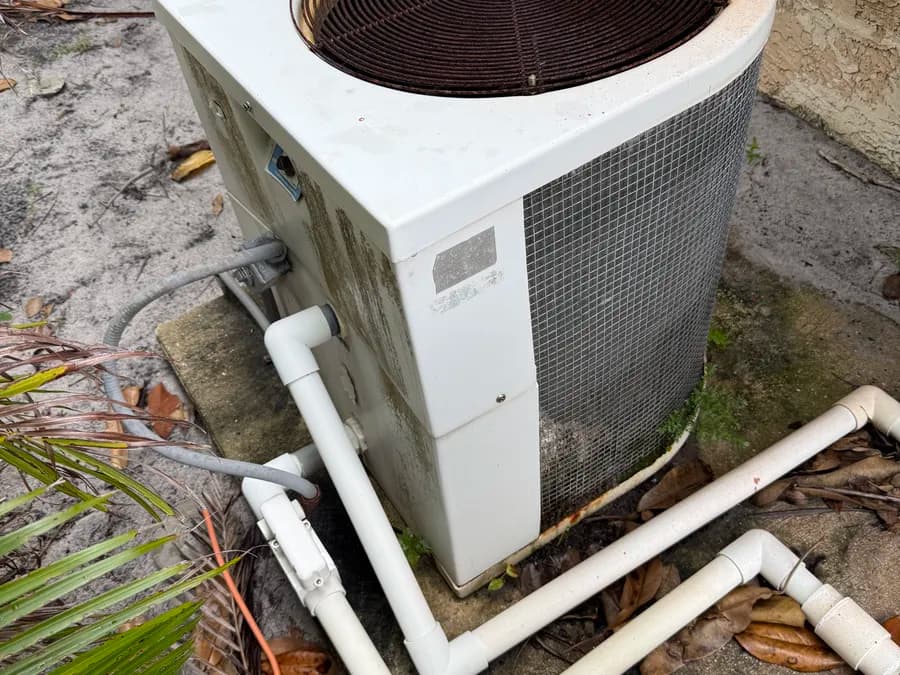

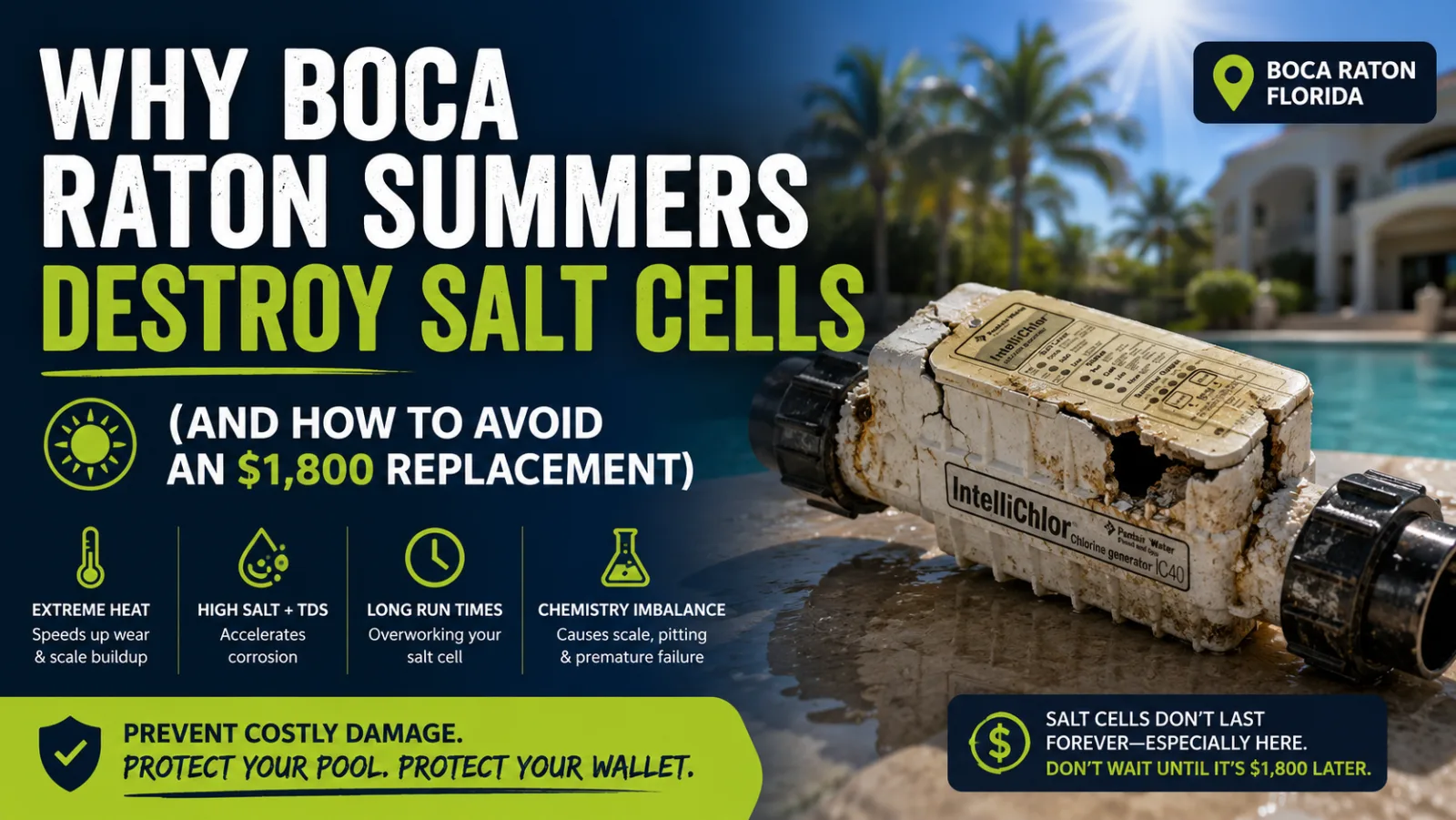
I pulled a two-year-old Hayward T-Cell-15 off a pad in east Boca last August. The plates were scaled gray-white, the cell body had a hairline crack from heat stress, and the homeowner had no idea anything was wrong — the control panel just read “check salt” and they'd been adding bags for months, chasing a number that was never going to come back. That cell was done. It didn't die in one day. Four things killed it, slowly, over two summers.
The $1,200 problem hiding in plain sight
Salt cells are rated for 10,000 hours of operation under normal conditions. “Normal” means water temps under 85°F, balanced chemistry, and seasonal off-time for northern pools. Boca Raton is not normal. Here, “normal” is sustained 92°F water temps from June through October, UV index 10–11 all summer, and a cell that runs 8–10 hours a day without a break, in chemistry that's increasingly fighting itself.
The math compounds fast. A cell burning through its lifespan at twice the rated rate doesn't give you 10,000 hours — it gives you 5,000. At 8 hours a day, that's under two years. Most Boca homeowners don't see the connection until the “no flow” or “check cell” light won't clear and they're calling for a replacement.
If you want a ballpark on what your service and any needed repairs would actually cost, the instant pricing tool returns a real number in 60 seconds without a phone call.
Stressor 1: Water temps above 90°F accelerate plate corrosion
Titanium plates coated in ruthenium or iridium oxide — the heart of every salt cell — are rated for water temperature ranges that assume a pool in, say, North Carolina. Once sustained water temps cross 85–88°F, the electrolytic process that generates chlorine becomes more aggressive toward the coating itself.
Above 90°F, which Boca pools hit by late June and hold through early October, the oxidation rate of the cell coating increases. You're not just making chlorine — you're also eating the surface that makes the chlorine. Manufacturers know this; it's why most warranties quietly specify temperature ranges. In South Florida, we're operating at the edge of that range for nearly half the year.
The fix isn't turning the cell off in heat — it's monitoring output percentage and reducing runtime hours rather than jacking output to 100% and leaving it.
Stressor 2: Florida's continuous runtime — your cell never rests
A pool in Ohio runs April to October, gets winterized, and the cell sits dormant for five months. That rest matters to hardware longevity. In Boca Raton, the pool runs twelve months a year. There is no dormant period. At 8–10 hours per day, 365 days, a Boca cell accumulates roughly 3,000 hours per year — versus 1,200–1,500 hours for a seasonal market.
The continuous runtime doesn't just accelerate plate wear. It keeps the cell in a constant thermal cycle: heating up when the pump runs, cooling when it stops, heating again. Every cycle flexes the internal seals and the cell body. Over two to three summers, those cycles add up to microcracks — which is exactly what I found on that Boca T-Cell-15.
Variable-speed pumps help here. Longer low-RPM runs beat short high-RPM runs for cell longevity — lower flow velocity reduces the turbulence stress on plates. If your pump is still single-speed, that's a separate conversation worth having.
Stressor 3: CYA creep forces your cell to work harder all summer
This one is the least obvious and the most damaging. Cyanuric acid (CYA) is a chlorine stabilizer — it protects chlorine from UV destruction. In Florida, you need some CYA. The problem is summer trichlor tablet users: every tab adds both chlorine and CYA. By August, pools running on tabs can be sitting at 100–130 ppm CYA — well past the 80 ppm threshold where the chemistry effectively locks.
At 100+ ppm CYA, your free chlorine is bound and largely unavailable. The water tests fine on a basic strip — chlorine present, check — but the actual sanitizing chlorine fraction is negligible. The pool knows. The salt system control board knows. It cranks the output percentage up to compensate. Now your cell is running at 80–100% output for hours at a time, trying to push enough active chlorine through chemistry that's actively suppressing it.
That sustained high-output run is the fastest way to eat through a cell's rated lifespan. CYA above 80 ppm is as damaging to a salt cell as running it dry. We see this on route every summer — a cell that was replaced 18 months ago is already showing degraded output because the CYA has been creeping since spring.
The fix: stop adding tabs to a salt pool. Salt cells generate chlorine from salt. Tabs in a salt pool add unnecessary CYA, push chemistry toward lock, and force the cell to overwork. If CYA is already above 100 ppm, the only real solution is a partial drain-and-refill. It's not fun to tell a homeowner that, but it's the honest answer.
Stressor 4: Calcium scale from hard water doubles in summer heat
South Florida water is hard. Boca Raton municipal water comes in with calcium hardness in the 250–400 ppm range depending on the source blend. Add summer heat, add evaporation losses of a quarter-inch or more per day in July, and the calcium concentration in your pool climbs fast as water evaporates and minerals concentrate.
Calcium carbonate deposits on salt cell plates at a rate that doubles for every 18°F increase in water temperature — that's basic chemistry, and it means your summer Boca pool is scaling that cell roughly twice as fast as a pool sitting at 75°F. The deposits start as a thin film, then build to the gray-white crust I showed you above.
Scale is insulating. It reduces electrical efficiency, forces the cell to draw more power to achieve the same output, and physically abrades the plate coating when it flakes and redeposits during pump cycles. A cell running 30% scaled is working maybe 60% of rated output. A cell running 60% scaled often reads as failed — because functionally, it is.
Quarterly acid-bath cleaning — a controlled muriatic acid soak at proper dilution — removes scale without damaging the plates. It's a 15-minute job if you do it on schedule. Skip two seasons and the scale is bonded hard enough that cleaning won't recover the efficiency you've lost.
How the four stressors compound (the math most owners never see)
Here's what makes Boca salt cell damage different from a generic “heat shortens cell life” explanation: each stressor multiplies the others.
High water temps increase calcium scaling rate (thermal effect on carbonate precipitation). High CYA forces higher cell output (chemistry forcing hardware to overwork). Continuous runtime means more total hours in that scaled, high-output, high-temp condition. And the combination thermal-cycles the control board hundreds more times per year than a seasonal pool.
No individual stressor looks catastrophic. Together they can cut a rated 5–7 year cell lifespan to 2–3 years — which is exactly what we see on Boca and Delray Beach routes. A cell I can expect to see replaced every 6 years on a well-maintained inland pool comes off a neglected Boca equipment pad in 18 months.
The 30–50% lifespan reduction is real, and it's preventable. Not with any one fix — with a protocol that addresses all four stressors every month.
The 3-step monthly protocol that stops early replacement
This is what we run on every salt-pool account we service. It's not complicated. It's just consistent.
Step 1 — Inspect the cell, every visit. Pull the cell and visual-check the plates. Early scaling looks like a light gray dusting. You want to catch it at that stage, not when it's a quarter-inch of white crust. Note the output percentage the control board is running at — a cell that was running at 60% last month and is now at 85% to maintain the same chlorine level is telling you something.
Step 2 — Quarterly acid-bath. Every three months — June, September, December, March is a reasonable Boca calendar — run a controlled acid-wash on the plates. Dilute muriatic acid in a plastic bucket (manufacturer ratios vary, typically 10:1 water-to-acid), soak the cell for 5–10 minutes until bubbling stops, rinse thoroughly. This removes calcium scale before it bonds. Do not let acid contact the cell body threads or any O-rings — rinse everything.
Step 3 — CYA check and summer tab audit. Every monthly visit, test CYA. If you're on a salt pool, your CYA should stay in the 30–50 ppm range — enough UV protection, not enough to lock the chemistry. If it's climbing past 70 ppm, cut the tabs. If it's already above 100 ppm, plan a partial water exchange before the chemistry forces your cell into overdrive all summer.
Quarterly acid-bath cleaning alone can extend cell life 30–50% per route data. The chemistry management piece is harder to sell — nobody wants to drain water — but it's the stressor that hides most successfully and does the most sustained damage.
Signs your salt cell is already losing the fight
You don't need a salt test kit to catch early failure. These are the field signs I look for on every visit:
- “Check cell” or “inspect cell” light that won't clear after you've confirmed salt level is correct. The cell is reading its own output as insufficient — usually scale or plate wear.
- Control board running at 80–100% output to maintain the same chlorine reading you used to get at 60%. Compensating for a cell that's losing efficiency.
- Green tint in the shallow end despite the salt system reporting operation. Algae pressure in summer plus degraded cell output equals a pool that can't hold sanitization.
- Visible scale or discoloration on the cell body at the port connections. Mineral buildup there means the plates have been scaling significantly longer.
- “No flow” fault codes that appear after new O-ring replacement and confirmed flow rate — sometimes a cell that's reading “no flow” internally has a failed flow sensor triggered by a scaled sensor housing, not actual flow loss.
If you're seeing two or more of these together, the cell is in active failure mode. Cleaning can help if you're early; if the plates are visibly pitted or the coating is flaking, the cell is past recovery.
What a cell replacement actually costs in 2026 (Boca Raton range)
Cell-only (parts) runs $600–$1,400 depending on brand and cell size — a Hayward T-Cell-9 for a smaller pool at the lower end, a Pentair IntelliChlor IC60 for a larger pool near the top of that range. That's the part cost; add installation labor and you're looking at more.
The honest answer is that installed cost varies enough by pool size, brand compatibility, and whether the control board also needs replacement that a single number is misleading. The cost calculator won't quote a cell replacement directly, but it'll give you a clear picture of what your full weekly service runs — which matters because the primary way to avoid a $1,200+ replacement is consistent monthly service that catches the problem early.
For a Boca homeowner on a route that gets monthly cell inspection and quarterly acid-bath, we're averaging 4+ years on cell lifespan. Off-route, with no inspection protocol, we're seeing 2 years or less. That's a replacement every other summer versus one every four-plus years — the math on professional service pays out on cell longevity alone, before you factor in chemistry savings and equipment protection.
When professional inspection catches it before the bill arrives
I'm not going to claim every cell failure is preventable — some cells fail early from manufacturing defects, some from power surge events, some from a single dramatic chemistry crash. But most of what I see on Boca and Delray Beach routes is slow, compounding, predictable damage that a monthly inspection would have flagged six months before the cell failed.
The tell: a tech who just checks the salt level and moves on won't see early scaling on the plates. You have to pull the cell. We pull it every visit. It adds five minutes to the route. It catches the problem before the homeowner is buying a new cell.
Florida's Best Pool Service is CPO-certified (C-105377) and fully licensed and insured — which matters for salt cell work specifically because incorrectly handled acid cleaning can void manufacturer warranties and damage cells. With 40+ years of combined founder experience and 10,000+ pools serviced across Palm Beach and Broward counties, we've replaced enough failed cells to have a strong opinion on what prevention looks like.
If your pool is in Boca Raton or anywhere in the Boca Raton service area and you're not sure your salt cell is getting monthly inspection, that's the first thing to sort out.
Common questions
How long does a salt cell last in Boca Raton?
On a consistently maintained pool with monthly inspection and quarterly acid-bath cleaning, 4–5 years. On an unmonitored pool with CYA creep and no scale management, sometimes 18–24 months. The wide range reflects how much protocol matters in this climate — Boca pools face all four stressors simultaneously in a way most other markets don't.
What water temperature damages a pool salt cell?
Sustained temps above 85–88°F begin accelerating plate corrosion and calcium scaling. Most Boca pools hit and hold 90–93°F water temps from late June through September. Above 104–105°F, most chlorine generator control boards trigger an automatic shutoff — protective, but repeated thermal cycling at those temperatures degrades the board itself over time.
How often should I clean my salt cell in Florida?
Quarterly — every three months — using a dilute muriatic acid bath. June, September, December, and March maps well to Boca's seasonal chemistry pressure. Between cleanings, monthly visual inspection catches early scaling before it becomes bonded crust that acid can't fully remove.
Does high cyanuric acid shorten salt cell life?
Yes, indirectly but significantly. CYA above 80 ppm puts the chemistry in partial lock — free chlorine is present but bound, with the active sanitizing fraction severely reduced. The salt cell control board compensates by increasing output percentage. Running at 80–100% output for extended periods to fight chemistry that's suppressing your chlorine is the fastest way to burn through a cell's rated lifespan.
Can I tell if my salt cell is failing before it stops working completely?
Yes. The clearest early sign is the control board running at a higher output percentage than usual to maintain the same chlorine reading. If the board used to run at 60% and now runs at 85% to hold the same level, the cell is losing efficiency. “Check cell” lights that won't clear after confirmed correct salt level, and visible plate discoloration when you pull the cell, are the next tier of signals.
Check where your pool stands before summer peaks
If your salt pool is heading into June without a recent cell inspection, this is the month to address it. The damage stack — heat, runtime, CYA, calcium — starts compounding as soon as water temps climb past 85°F, which in Boca means we're already in the window.
See what your pool's weekly service would cost: get your instant pricing band in 60 seconds.
Have a question the calculator doesn't cover about your Boca Raton pool salt cell? Text us at 954-347-1120 — we usually reply within a few hours.
Frequently Asked Questions
On a consistently maintained pool with monthly inspection and quarterly acid-bath cleaning, 4–5 years. On an unmonitored pool with CYA creep and no scale management, sometimes 18–24 months. The wide range reflects how much protocol matters in this climate — Boca pools face all four summer stressors simultaneously.
Sustained temps above 85–88°F begin accelerating plate corrosion and calcium scaling. Most Boca pools hit and hold 90–93°F from late June through September. Above 104–105°F most chlorine generator control boards trigger an automatic shutoff — protective, but repeated thermal cycling at those temperatures degrades the board over time.
Quarterly — every three months — using a dilute muriatic acid bath. June, September, December, and March maps well to Boca's seasonal chemistry pressure. Between cleanings, monthly visual inspection catches early scaling before it becomes bonded crust that acid can't fully remove.
Yes, indirectly but significantly. CYA above 80 ppm puts the chemistry in partial lock — free chlorine is present but bound, with the active sanitizing fraction severely reduced. The control board compensates by increasing output percentage. Running at 80–100% output to fight chemistry that's suppressing your chlorine is the fastest way to burn through a cell's rated lifespan.
Yes. The clearest early sign is the control board running at a higher output percentage than usual to maintain the same chlorine reading — if it used to run at 60% and now runs at 85% for the same level, the cell is losing efficiency. 'Check cell' lights that won't clear after confirmed salt level, and visible plate discoloration when you pull the cell, are the next tier of signals.
Need a pro to handle this?
Florida's Best Pool Service has serviced South Florida homes for 40+ years. CPO-licensed. Fully insured. 230+ five-star reviews.