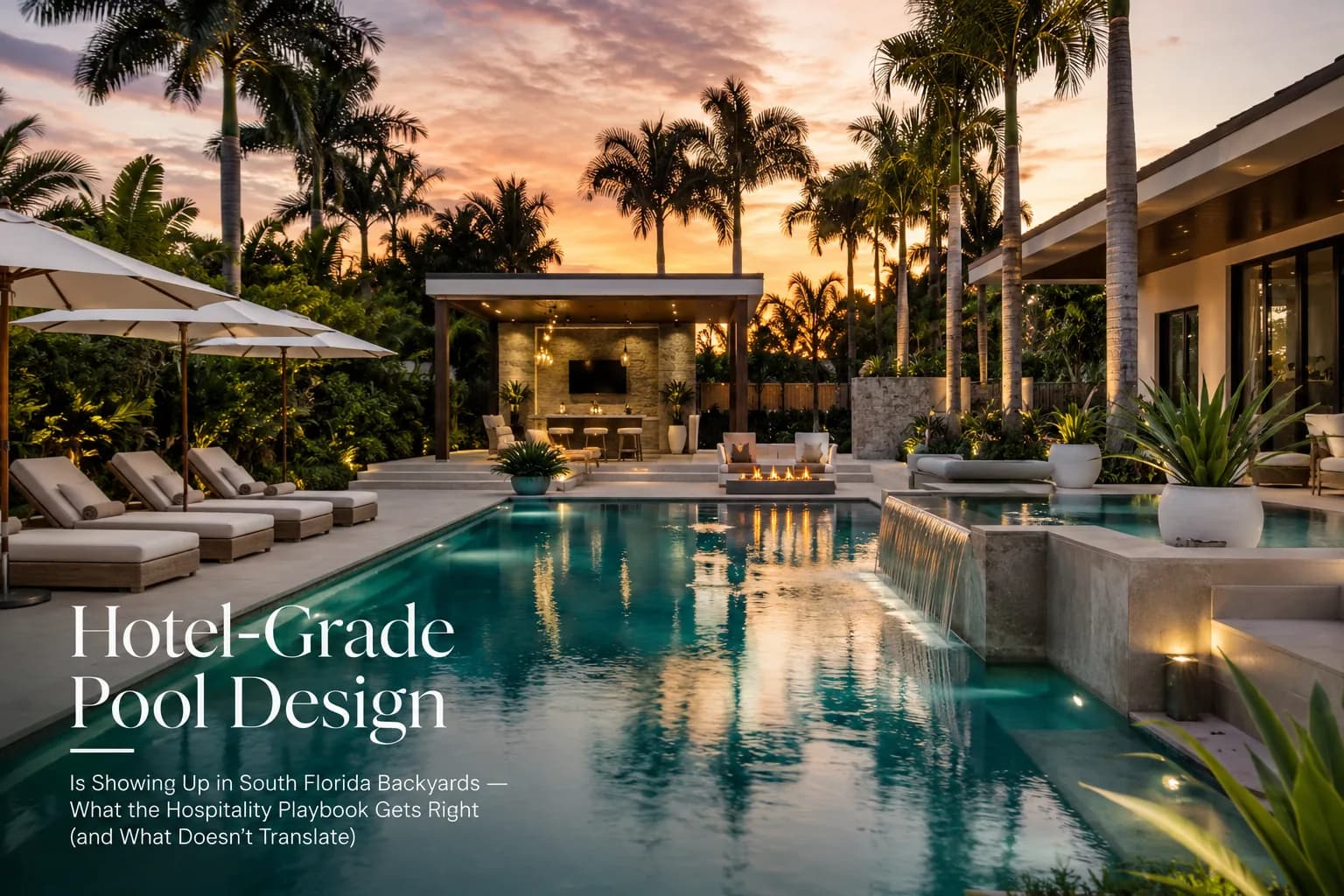
Spend a Sunday at the Boca Raton Resort & Club, and Monday morning the call comes in. Same call, different homeowner — five years running now. I'll spend the first half of the walk-through saying yes, the second half saying no, and the homeowner usually leaves understanding which is which. The yes-list and the no-list, with 2026 numbers, below.
The amenity-stack borrow — what South Florida homeowners are actually copying
The hospitality-design influence on residential builds is well documented — we covered it in the Backyard Wellness & Architecture industry report, where the dominant 2024–2026 trend lines are tri-temp hydrotherapy adoption, rectangular fiberglass dominance, in-water tanning ledges, and the move from organic-shaped “1990s pool” design language to clean rectangular hospitality-spec geometry. On the ground in Boca and Delray, the specific properties being referenced in remodel conversations:
- 1 Hotel South Beach — perimeter-overflow rooftop pool, natural-stone deck, integrated cabana lounger ledge. The single most-referenced design language in our walk-throughs since 2022.
- Four Seasons Surf Club & Acqualina — tri-temp lap + spa + cold plunge config in oceanfront pool decks. The hydrotherapy stack is the next-wave amenity request.
- Ritz-Carlton Key Biscayne / Auberge Beach Residences — glass-tile-clad lap pools with chaise-deep tanning ledges and integrated water features.
- Boca Raton Resort & Club (post-renovation) — the local reference point. Homeowners visit on a Sunday brunch and the next call comes Monday morning.
What translates well from hotel to backyard
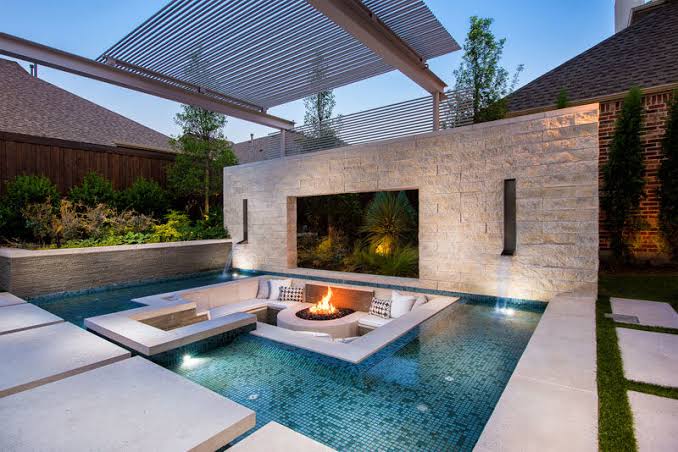
Four design elements lift cleanly from hospitality spec to high-end residential and deliver real long-term value. These are the borrows worth making.
| Hospitality element | Why it works residentially | 2026 South Florida cost premium |
|---|---|---|
| Rectangular fiberglass or PebbleTec shell | Fiberglass shells have 30–50 year service life vs. 10–15 for plaster, lower lifetime chemistry demand, smoother surface that algae cannot pit. PebbleTec splits the difference at higher upfront cost. | +$12,000–$28,000 over standard plaster on new build |
| Tri-temp config (lap + spa + cold plunge) | Hot/cold contrast hydrotherapy is the genuine wellness driver behind the trend. A 38–45°F cold plunge requires a dedicated chiller circuit, but operates on the same pad as the existing pool / spa equipment. | +$18,000–$45,000 for chiller, plumbing, separate shell |
| Tanning-ledge with in-water loungers | Shallow 6–12″ ledge with two to four loungers extends usable pool footprint without adding gallons. Translates straight from hospitality with zero engineering compromise. | +$6,000–$14,000 on new build, retrofit ~$18,000–$32,000 |
| Perimeter overflow / vanishing-edge | Architecturally striking, eliminates traditional skimmer line, surface debris carried to perimeter trough. Works on coastal lots with view corridors. Requires careful surge / equalization design. | +$22,000–$60,000 over standard skimmer pool |
| Glass tile waterline + interior accents | Hospitality-grade glass tile holds color, resists Florida UV, and never grouts-out the way ceramic does. Worth the premium on any luxury build. | +$8–$22/sq ft over ceramic; $4,000–$12,000 total upcharge |
These are the elements I tell estate-build homeowners to specify confidently. None of them create downstream operating-cost surprises, and all five carry resale value in the South Florida luxury market.
What does NOT translate from hotel to backyard
Here's the half of the conversation most pool builders won't have with homeowners — because it's a $40,000–$120,000 conversation that costs the builder margin. Hospitality pools are engineered for a fundamentally different bather-load profile. The Commercial Hospitality & Multifamily report we published goes deep on this; the short version sits in our analysis of why 3% of pools drive 40%+ of treated water: hotel and resort pools are servicing 50–300+ bathers per day with constant turnover. Your backyard pool, even at peak family-and-friends entertaining, sees 4–20 bathers per week.
| Hospitality element | What it's engineered for | Why it doesn't translate residentially | Operating-cost penalty if installed anyway |
|---|---|---|---|
| Commercial-grade filtration (oversized DE or high-rate sand) | 30,000–200,000 gal/hr throughput for 50+ swimmer bather load | Residential pool turnover is 1–2×/day at most; oversized filtration burns electricity without delivering measurable water-clarity gain | +$45–$120/month electricity + $400–$900/yr extra filter media |
| Surge tank / equalization tank | Buffers water displacement when 30+ bathers enter simultaneously | Residential entry rate never approaches the engineering threshold; tank just sits as standing water needing its own sanitation | +$8,000–$22,000 capex + dedicated sanitation cost |
| ANSI/APSP-11 compliant dual sanitizer + UV + ORP-controlled chemistry | Health-department-mandated redundancy for public-pool safety at high bather load | Residential sanitation does not require redundant systems; one well-managed sanitizer (salt or liquid chlorine) handles a 4–6 bather/week pool | +$3,500–$12,000 capex + $80–$180/month chemistry + sensor calibration |
| Continuous-flow chemistry monitoring (sample loop + lab-grade probes) | Real-time public-health compliance at hotel scale | Residential chemistry shifts on a 24–48 hour timeline that weekly testing catches; continuous monitoring catches nothing actionable | +$5,000–$15,000 capex + $60–$120/month sensor maintenance |
| Commercial heater BTU sizing | Bringing a 100,000+ gal hotel pool from 65°F to 88°F overnight | Residential pools are 10,000–25,000 gal and don't need 1.4M BTU input; oversized heater short-cycles, shortens its own life, and burns gas | +$1,800–$4,500 capex + 25–40% higher gas consumption from short-cycling |
The trap homeowners fall into: a luxury builder who treats the project as a small commercial install and spec's the whole pad accordingly. The pool looks identical to the 1 Hotel rooftop deck. The operating cost looks identical to a 30-room hotel. Don't make that trade.
Where the line should actually fall — 4 hospitality specs worth lifting for high-use residential
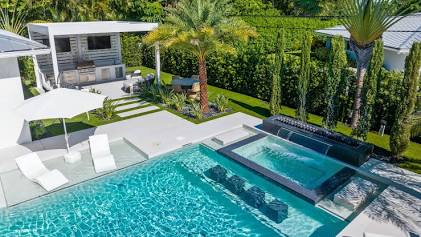
For most South Florida estate pools the residential / hospitality spec line is clear. But there's a middle tier — vacation-rental properties, family compounds with frequent multi-household entertaining, 8,000+ sqft estates with weekly events — where four specific hospitality borrows pay back. These are the upgrades to ask your builder about specifically:
- Dual-sanitizer redundancy (not full ANSI compliance). Primary salt cell + secondary liquid chlorine peristaltic pump tied to an ORP setpoint. If one fails, the other holds the pool clear for the week it takes to service. About $1,800–$3,800 installed. Real value on a vacation-rental pool where a sanitizer failure between guests = a green pool + a refund.
- Commercial-grade automation (Pentair IntelliCenter Pro, Jandy AquaLink RS, Hayward OmniLogic). Residential automation is fine for most homes; the commercial tier earns its premium on multi-feature pools (water features, integrated spa, lighting, cold plunge chiller, heater, automation logic). Pay the $2,400–$6,000 upcharge over base residential automation.
- Proper skimmer count + flow math. Hospitality engineering correctly requires one skimmer per ~500 sq ft of water surface. Residential builders routinely undercount on large pools. Adding the third or fourth skimmer at build time is $400–$900 each; retrofitting is $3,500–$8,000 each. Get this right at build.
- Deck drainage to commercial spec. Standard residential deck drainage cannot keep up with Florida summer rainfall on a 1,500–3,000 sq ft pool deck. Hospitality decks are engineered with trench drains, area drains, and proper slope. Lift the spec — $4,000–$12,000 at build, prevents standing water, slip hazards, and deck damage long-term.
The vacation-rental wrinkle — when residential pools start operating like mini-hotels
Florida's short-term rental boom has put a category of pool into a regulatory grey zone. A Boca Raton 8-bedroom estate listed on Airbnb at $4,500/night and hosting 12–18 guests every week is, by bather-load math, operating closer to a small hotel pool than a residential pool. Florida statute is gradually catching up — some municipalities now require commercial-style chemistry compliance and inspections for licensed STR pools with regular bather loads above thresholds. If you're building or remodeling a pool for vacation-rental income:
- Check local STR ordinance — Boca Raton, Delray Beach, Fort Lauderdale, and Miami-Dade all have evolving compliance rules. What was residential in 2023 may be commercial in 2026.
- Lift the sanitizer redundancy spec — one failed sanitizer between guests is a refund event plus a recovery cost. Dual sanitizer is cheap insurance.
- Photo-document chemistry weekly with the actual readings logged. The photo report is your liability defense if a guest claims water-quality issues.
- Run automation logic for heater, lighting, cleaner, and chemistry to a single homeowner-app-controlled interface — remote management of an STR pool is the entire reason commercial-tier automation pays back.
For owners running 20+ rental nights per month, the operating cost difference between “residential pool with hospitality borrows” and “over-engineered commercial install” is roughly $300–$700/month. Lift the right specs, not the wrong ones.
2026 South Florida hotel-grade backyard cost reference
| Tier | Build cost (new pool, 18–25k gal) | Monthly operating cost | Who it fits |
|---|---|---|---|
| Standard residential (plaster, single skimmer, basic automation) | $65,000–$95,000 | $140–$200 | Primary residence, 2–4 person household, weekly use |
| Hospitality-influenced residential (PebbleTec or fiberglass, tanning ledge, glass tile, residential automation) | $110,000–$180,000 | $180–$240 | Luxury primary residence, frequent entertaining, design-conscious |
| Estate tier with tri-temp (lap + spa + cold plunge, perimeter overflow, commercial automation, dual sanitizer) | $220,000–$450,000 | $240–$380 | $8,000+ sqft estate, multi-household compound, family wellness focus |
| Vacation-rental optimized (estate-tier features + redundancy + remote automation) | $240,000–$500,000 | $300–$500 | 20+ rental nights/month, multi-guest entertainment |
| Don't-do tier (residential pool spec'd to ANSI commercial standards) | $320,000–$600,000+ | $600–$1,100 | Nobody — this is where the trap lives |
What to ask your pool builder before you spec the build
- “Show me the bather-load math.” A builder who can articulate why your pool gets one skimmer or three, why the filter is sized to X gpm, and why the sanitizer redundancy is or isn't needed — that's the builder you want. A builder who quotes “we always do it this way” is spec'ing from habit, not engineering.
- “What's the lifetime operating cost projection?” Capex is the visible number. Opex is the invisible $400–$900/month penalty for over-engineering. Demand a written 10-year operating estimate.
- “Which of these features actually translate from hospitality, and which don't?” Any builder who tells you everything from a hotel translates to a backyard is selling, not engineering.
- “What does the service company say about maintaining this pad?” Have your weekly service company review the equipment-pad spec before you sign. We've red-flagged $35,000 of over-engineering on three estate builds in the last 18 months by being asked this question early.
Want a number for your specific build?
Run your projected pool through our pool service cost calculator— or, for estate-tier builds, request a pre-build pad review. We'll review the builder's spec, flag over-engineering, and confirm the residential-vs-hospitality line is drawn where it belongs. No charge for prospective service clients.
The low-risk first step
If you're in design conversations with a builder right now and the words “hotel-grade” or “commercial-spec” have come up, the lowest-risk first step is a free spec review. Bring the builder's equipment list and a photo of any hospitality reference pool, and we'll walk you through what translates and what doesn't — before construction starts and before you're locked in.
Florida's Best Pool Service is family-owned, CPO C-105377, fully insured, and runs weekly routes through Boca Raton, Delray Beach, Fort Lauderdale, Highland Beach, Boynton Beach, Pompano Beach, Coral Springs, Coconut Creek, Wellington, and the surrounding South Florida service corridor. Your regular tech, same day every week (once your route is established). Photo-documented service report after every visit. Month-to-month — no long-term lock-in. Built around 40+ years of combined founder experience between Matt Balog, Joe Ford, Ronald Liddell, and Doug Santiago.
Request a free design spec review or call 954-347-1120.
Frequently Asked Questions
Lift cleanly: rectangular fiberglass or PebbleTec shells, tri-temp config (lap + spa + cold plunge), tanning ledge with in-water loungers, perimeter overflow, glass tile; Don't lift: commercial-grade filtration, surge / equalization tanks, full ANSI/APSP-11 dual-sanitizer-plus-UV-plus-ORP chemistry, continuous lab-grade monitoring, oversized commercial heater BTU; Wrong-tier spec burns $40,000–$120,000 capex + $400–$900/month operating cost for zero benefit on a 4–6 bather/week pool; Middle-tier hospitality borrows worth lifting on estates & vacation rentals: dual-sanitizer redundancy, commercial automation, proper skimmer count, commercial deck drainage; 2026 cost tiers in our corridor: $65k–$95k standard residential · $110k–$180k hospitality-influenced · $220k–$450k estate tri-temp · $240k–$500k vacation-rental optimized; The don't-do tier (residential spec'd to ANSI commercial): $320k–$600k+ build, $600–$1,100/month operating — that's where the trap lives.
Four hospitality design elements lift cleanly from hotel pools to high-end residential builds: (1) rectangular fiberglass or PebbleTec shells (30–50 year service life vs. 10–15 for plaster), (2) tri-temp hydrotherapy config — lap pool + heated spa + 38–45°F cold plunge — for genuine wellness benefit, (3) tanning-ledge with in-water loungers (extends usable footprint with zero engineering compromise), (4) perimeter-overflow or vanishing-edge designs (works on coastal lots with view corridors), plus glass tile waterline and interior accents. All five carry resale value in the South Florida luxury market and don't create downstream operating-cost surprises.
Five hospitality engineering elements don't translate to residential and add $40,000–$120,000 of capex plus $400–$900/month of unnecessary operating cost: commercial-grade oversized filtration (engineered for 50+ bathers/hour, not 4–6 bathers/week), surge / equalization tanks (buffers 30+ simultaneous bathers — residential never reaches that threshold), full ANSI/APSP-11 dual-sanitizer-plus-UV-plus-ORP chemistry redundancy (health-department mandate for public pools, overkill for residential), continuous-flow chemistry monitoring with lab-grade probes (catches nothing actionable on residential timelines), and commercial-heater BTU sizing (oversized heaters short-cycle and burn gas without benefit).
2026 cost tiers in our South Florida service corridor: standard residential builds run $65,000–$95,000 ($140–$200/month operating); hospitality-influenced residential (PebbleTec or fiberglass shell, tanning ledge, glass tile, residential automation) runs $110,000–$180,000 build, $180–$240/month operating; estate tier with full tri-temp config (lap + spa + cold plunge, perimeter overflow, commercial automation, dual sanitizer) runs $220,000–$450,000 build, $240–$380/month operating; vacation-rental-optimized builds run $240,000–$500,000, $300–$500/month operating. A residential pool over-spec'd to commercial ANSI standards can hit $320,000–$600,000+ build and $600–$1,100/month operating — that's the trap to avoid.
For wellness-focused homeowners or families building an estate pool, yes — the contrast hydrotherapy benefit is real and the trend is durable enough that resale value carries. Adding a dedicated 38–45°F cold plunge requires a chiller circuit ($18,000–$45,000 installed including plumbing and separate shell), but operates on the same equipment pad as the existing pool and spa. The cold plunge itself is small (typically 300–600 gallons), so chemistry and operating cost increases are modest. It's one of the cleanest hospitality borrows for a high-end residential build. For a standard family pool with weekly use, the spend is harder to justify.
It depends on local ordinance and bather load, but the practical answer is: lift some hospitality specs, leave others. Florida municipalities (Boca Raton, Delray Beach, Fort Lauderdale, Miami-Dade) are evolving compliance rules for licensed short-term rentals — what was residential in 2023 may be commercial in 2026 if your bather load is high enough. Lift these four specs: dual-sanitizer redundancy (one failed sanitizer between guests is a refund event), commercial-grade automation for remote management, proper skimmer count, and commercial deck drainage. Skip full ANSI/APSP-11 dual-sanitizer-UV-ORP redundancy, surge tanks, oversized commercial filtration, and continuous chemistry monitoring — these are engineered for 50–300 bather days, not 12–18 guests per week.
Two reasons. First, some luxury pool builders treat estate residential projects as small commercial installs and spec the whole equipment pad accordingly — same playbook, same vendors, same margin structure. Second, homeowners ask for 'the same thing as the 1 Hotel' and the builder accommodates without flagging which specs translate and which don't. To avoid the trap: ask your builder to show the bather-load math (one skimmer per ~500 sq ft of water surface, filter sized for residential turnover not commercial throughput), demand a 10-year written operating cost projection, ask which features specifically translate from hospitality, and have your weekly service company review the equipment-pad spec before you sign. We've red-flagged $35,000+ of over-engineering on three estate builds in the last 18 months by being asked early.
Residential automation (Pentair IntelliCenter, Jandy AquaLink RS, Hayward OmniLogic in residential tier) handles pump scheduling, heater control, basic lighting, and single sanitizer logic — runs $1,200–$2,800 installed and is perfect for most South Florida homes. Commercial-grade automation (same brands, commercial tier) adds multi-feature integration (water features, integrated spa logic, cold plunge chiller, dual sanitizer with ORP control, advanced lighting scenes, remote-management API, multi-user app access). Runs $2,400–$6,000 over the residential tier. Worth the upcharge on estate-tier pools with five or more controllable features, multi-household compounds, and any vacation-rental property where remote management is the whole point. Not worth it on a standard single-family residential pool.
Yes — and preferably before construction starts. A weekly service company that operates a route through the same service corridor your build is in will spot equipment-pad over-engineering, skimmer undercount, deck-drainage shortcuts, and access-logistics problems that the builder won't flag because they're not on the maintenance side. We offer free spec reviews for prospective service clients — bring the builder's equipment list and any reference photos from hospitality properties, and we'll walk through which specs translate and which add operating cost without benefit. The 30-minute review has saved homeowners $20,000–$50,000 of unnecessary spec on multiple estate builds in our service corridor.
Need a pro to handle this?
Florida's Best Pool Service has serviced South Florida homes for 40+ years. CPO-licensed. Fully insured. 230+ five-star reviews.