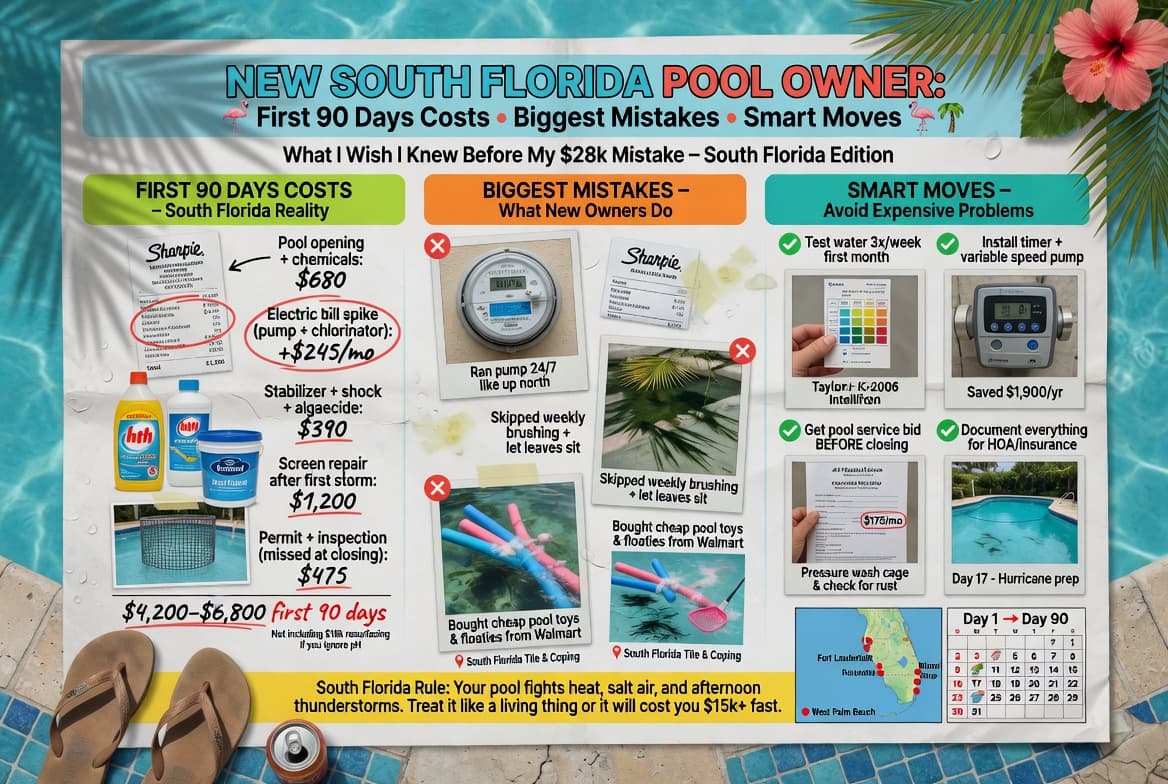
Between Matt Balog (our founder), Ronald Liddell, Doug Santiago, and me, we've put 40+ years of combined founder experience into Florida's Best Pools, and one of the most consequential questions we get every single week comes from new homeowners who just closed on a South Florida house with a pool: “What do I do first, what does it actually cost, and what mistakes should I avoid in year one?”The honest 90-day answer is more nuanced than the “dump some chlorine in and you're fine” advice you'll get at the pool-supply counter — because the first 90 days of pool ownership in Boca Raton, Delray Beach, Fort Lauderdale, or anywhere in our service corridor is when the most expensive mistakes get made, and almost all of them are preventable.
The real 2026 first-year budget for a South Florida pool
The pool-supply-store number is $1,800/year. The reality on a standard 14,000–18,000 gallon Boca Raton pool with average equipment age and use is $2,400–$3,500/year. Larger pools, attached spas, coastal corrosion exposure, vacation-rental bather load, or aging equipment push it higher. Here's the honest breakdown most listing brochures don't show:
| Line item | Annual cost — pro service | Annual cost — DIY done right |
|---|---|---|
| Weekly service or DIY-equivalent chemistry | $1,500–$2,880 (flat $125–$240/mo) | $1,080–$1,680 wholesale chems |
| Quarterly filter cleans + media replacement amortized | Included | $120–$280 |
| Annual drain & refill 25–33% | Included or $80–$150 | $30–$60 in water + your time |
| Salt cell amortized (3–7 yr life depending on coast distance) | $160–$420/yr (only for salt pools) | $160–$420/yr |
| Phosphate / specialty treatment (quarterly) | $120–$240 | $120–$240 |
| Minor repairs / fittings / o-rings / gaskets | $100–$300 | $100–$300 |
| One post-storm or vacation-related correction | $0–$200 (often included) | $100–$400 |
| Your time (DIY only, ~5–9 hr/month at $35/hr value) | — | $2,100–$3,780 |
| Realistic 2026 annual total | $2,400–$3,500 hard-dollar | $1,800–$3,400 hard-dollar + 60–110 hrs of your time |
Two things to notice. First, the “DIY saves money” pitch only works on hard dollars — when you value your time at a conservative $35/hour, properly-done DIY routinely costs more than fair-priced pro service. Second, the $2,400–$3,500 band is what a well-maintained pool costs. Mismanage year one and you can easily add a $400–$1,500 green-pool recovery, a $350–$900 tile cleaning, or a $1,400–$3,200 surprise pump or heater repair — and that's before equipment that's already at end-of-life gets discovered in month two. For the deep cost breakdown by city and pool profile, our 2026 South Florida pricing reference has the full table. For a wider-angle view of the Florida residential pool stock you just joined — build-year cohort, equipment-mix trends, and county-level construction velocity — see our 2026 Florida Pool Construction Market Index.
The first-90-days budget — what to expect month by month
Year-one costs aren't spread evenly. The first 90 days typically front-load $700–$1,600 on top of the recurring service or chemistry baseline, because you're inheriting whatever the previous owner's pool company let drift in the final weeks before closing.
| Month | What typically happens | Typical spend (above baseline) |
|---|---|---|
| Month 1 | Equipment documentation, calibrated chemistry baseline, deferred maintenance discovery, first weekly service or DIY supply purchase | $300–$700 |
| Month 2 | CYA correction if drifted (drain & refill 25%), filter teardown if needed, salt cell acid bath, first phosphate treatment | $250–$500 |
| Month 3 | First filter clean on schedule, equipment-pad walk-around, first warning-sign correction (small leak, valve actuator, gauge replacement) | $150–$400 |
| 90-day total above baseline | Three months of inherited-drift cleanup | $700–$1,600 |
That front-loaded cost is normal. It's the cost of resetting whatever the prior owner's service was tolerating to keep the pool “passable” for showings. Skip it and you'll pay the same money plus a 30–60% premium 6–12 months later when it surfaces as a failure rather than a correction.
The 5 most expensive mistakes new pool owners make (in order of cost)
| # | Mistake | What it costs | How to avoid |
|---|---|---|---|
| 1 | Skipping the pool inspection during purchase | $1,400–$12,000 in inherited end-of-life equipment or plaster issues you now own | Always include a dedicated pool inspection (pump, heater, salt cell, plaster, plumbing, automation, screen) in the closing inspection. $150–$300, saves five figures. |
| 2 | Dosing chemistry in the wrong order (or using strips) | $400–$1,500 green-pool recovery; over time, plaster etching $7,500–$12,000 resurface | Order: alkalinity → pH → calcium → CYA → chlorine → shock. Calibrated reagent kit (Taylor K-2006), not strips. |
| 3 | Ignoring cyanuric acid (CYA) in Florida sun | Pool tips green at “normal” FC; eventual forced drain & refill $400–$900 | CYA target 30–50 ppm. Test quarterly. Drain & refill 25–50% if CYA >80 ppm. |
| 4 | Over-chlorinating to “be safe” | Bleached plaster, faded liner/grout, accelerated cell wear, irritation: $300–$2,000+ | FC target 3–5 ppm. Shock to 10 ppm once a week May–October. More is not safer. |
| 5 | Waiting until the pool goes green to call a pro | Recovery $400–$1,500 vs. prevention $0; cascade failures $1,400+ | Free on-site evaluation in month 1, before any visible problem. Catch the trend, not the failure. |
The chemistry-order mistake — why “dump it in” costs thousands
Almost every new pool owner I've onboarded in 15 years has at some point made this mistake: bought chemicals at the pool-supply store, came home, dumped them in “to get the numbers right.” The pool looks fine for two weeks. Then it doesn't. The reason: pool chemistry is a system of interacting parameters, and the dosing orderdetermines whether the chemicals do what they're supposed to or precipitate, lock up, or attack the plaster.
- Total alkalinity first — alkalinity is the pH buffer. Adjusting alkalinity changes pH; adjusting pH does not (much) change alkalinity. So always set TA to 80–120 ppm first.
- pH second — only after alkalinity is in range. Target 7.4–7.6 with muriatic acid (lower pH) or soda ash (raise pH).
- Calcium hardness third — target 200–400 ppm. South Florida fill water is often already high (250–350 ppm). Most pools never need calcium added; many eventually need a partial drain because calcium drifts up.
- Cyanuric acid (stabilizer) fourth — target 30–50 ppm. CYA only goes up over time (every tab adds CYA); the only way down is dilution via drain & refill.
- Free chlorine fifth — target 3–5 ppm. Adjust only after the four above are in range.
- Shock sixth — once a week May–October, to 10 ppm. Burns off combined chlorine and organics.
- Phosphate remover seventh — if phosphates >500 ppb, treat. Quarterly minimum in South Florida.
Dose out of order and you get precipitate clouding, scale on tile and heater, locked chlorine that doesn't kill algae, or plaster etching that doesn't show for two years and then costs $7,500–$12,000 to resurface. Order matters because the chemistry doesn't care about your intent — only the sequence.
Why CYA is the #1 chemistry mistake in Florida sun
Cyanuric acid (also called pool stabilizer or conditioner) is the most under-understood parameter in Florida pool care. It acts as a UV sunscreen for chlorine — without it, the South Florida sun burns through unstabilized free chlorine in 4–6 hours. With CYA in the 30–50 ppm band, that same chlorine residual lasts most of a 24-hour cycle. So far so good — every new owner correctly adds stabilizer in month one.
The problem is what happens next. Every chlorine tab you drop in the floater dissolves and leaves more CYA behind. Over 18–36 months, CYA drifts from 30 ppm to 80 ppm to 120 ppm without anyone testing it (strips don't test CYA at all; cheap services rarely test it). Above 80 ppm, free chlorine is “locked” — it shows up on the test as 3 ppm but no longer kills algae effectively. The pool tips green at “normal” FC, the owner is baffled, and the fix is a forced drain & refill 25–50% to dilute it back to range. We cover the full chemistry of this in our library article on cyanuric acid, the pool stabilizer that breaks pools quietly.
The new-owner takeaway: test CYA quarterly, target 30–50 ppm, and switch to liquid chlorine or a salt system as soon as CYA drifts above 50 — both produce chlorine without adding CYA. This single discipline prevents about 15% of all summer green-pool calls we see.
Early warning signs — what to recognize before it costs money
Almost every expensive pool repair starts with a small visual or audible signal that's easy to miss in the first 90 days when you don't yet have a baseline. Here's the field guide we use on the route:
| What you see / hear | What it usually means | What it costs if ignored |
|---|---|---|
| Pool water looks “a touch dull,” lost sparkle | Free chlorine dropping below 1 ppm; algae cell division starting | $300–$1,500 green-pool recovery in 48–72 hr |
| White ring at the waterline tile | Calcium scale forming (pH or CH out of band) | $350–$900 tile cleaning every 12–18 mo |
| Weak return jets / pool not circulating well | Clogged impeller, dirty filter, air leak, or pump pre-fail | $1,400–$2,400 pump replacement if ignored |
| Slight bearing whine or rattle from pump | Pump bearings going — 3–8 months of life left | $1,400–$2,400 replacement vs. $300–$500 bearing service |
| Tea-colored stain on metal hardware (ladders, handrails) | Iron or rust precipitation; or coastal salt-air on chrome | $200–$500 stain treatment + accelerated hardware replacement |
| Filter pressure 10+ psi above logged baseline | Filter dirty; or restricted return line | Algae bloom risk + accelerated cartridge/sand replacement |
| Salt cell “normal” reading but pool can't hold chlorine | Cell output degraded 30–50%; end-of-life in 6–12 months | $800–$2,100 cell replacement happens as a green-pool emergency instead of planned |
| Equipment pad fresh white deposit / efflorescence | Slow leak in pump union, valve, or plumbing fitting | $200–$600 corrected early; $1,500+ if it reaches the pad concrete or electrical |
| Heater error code or no-fire after months of use | Pressure switch, flame sensor, gas valve — common Florida issues from humidity and rodents | $150–$450 service vs. $1,400–$3,200 heater core damage |
The first time any of those signs appear, you have a free window — 2–8 weeks typically — to address it cheaply. Past that window the cost curve gets steep fast. The whole job of a real weekly service is to catch these signs at week 4, not week 14.
When to call a pro vs. handle it yourself
Some month-one decisions you can handle yourself with the chemistry kit and a little reading. Others should be a phone call. Here's the honest split from the route:
- Handle yourself: documenting equipment with photos, setting pump schedule (8–10 hr/day summer, 6 winter), basic skim and basket emptying, weekly brushing of walls and tile, refilling tab feeders, testing with a calibrated reagent kit, ordering replacement filter cartridges, lowering water level before a storm.
- Call a pro: the first calibrated chemistry baseline (you don't yet know what “normal” looks like for this pool), any equipment-pad anomaly (leaks, electrical, corrosion), pool that looks “dull” or has dropped chlorine inexplicably, salt cell that hasn't been inspected in 12+ months, post-purchase deferred-maintenance survey, any algae beyond “slight cloud,” first heater fault, suspected automation problem.
The financial math on this is consistent: a $0 free on-site evaluation in month one is cheaper than a $400–$1,500 recovery in month four. We do these for free across our service corridor — no obligation, no high-pressure pitch — because catching problems early is what makes the route work for both sides. If you're torn between hiring a pro and DIY, our deep pro vs. DIY 2026 cost-and-risk breakdown walks through the full decision math.
The free first-service chemistry check — what it actually includes
Every new South Florida pool owner in our service corridor gets a free on-site chemistry baseline and equipment-pad walk-around — no obligation, no service contract required. Here's what we cover:
- Calibrated 7-point chemistry test on Taylor or LaMotte reagents (free chlorine, pH, total alkalinity, calcium hardness, cyanuric acid, salt for salt pools, phosphates)
- Written baseline report with target ranges and any out-of-band parameters flagged with cost estimates
- Equipment-pad walk-around — pump, filter, heater, salt cell, automation, plumbing, electrical. Photo-documented anomalies.
- Pool surface and tile inspection — plaster condition, tile scumline, sun-shelf and dead-zone algae watch
- Filter and pump health check — pressure vs. expected baseline, return-jet force, pump bearing audible check
- Salt cell visual + output assessment for salt pools — visible scale, output rating vs. salt level
- Honest report on what your pool actually needs in the next 90 days, whether you hire us or not. If three things need attention, we'll tell you the order to address them.
The whole visit takes about 30–45 minutes. You don't need to be home if the pool is accessible. We'll send a written report the same day with photos.
The smart 90-day game plan (synthesized)
- Week 1: photograph all equipment (model numbers, age estimates), pull the home-inspection pool section and address any flagged critical items, book a free chemistry baseline.
- Week 2: set the pump schedule (8–10 hr/day summer, 6–8 winter), buy a calibrated reagent test kit (Taylor K-2006 ~$80), commit to weekly service or DIY based on the cost-and-risk breakdown.
- Week 3–4: get chemistry in range in order (TA → pH → CH → CYA → FC → shock → phosphates). Brush walls, tile, sun shelves, dead zones. Establish filter-pressure baseline.
- Month 2: CYA correction if drifted (drain & refill 25%), first salt cell acid bath (salt pools), first phosphate treatment, equipment-pad photo set for your records.
- Month 3: first scheduled filter clean, equipment-pad walk-around with any early-warning signs addressed, baseline service report archived. Pool is now “dialed” for the rest of year one.
Run your numbers through the calculator
Want a quote-range for your specific new-to-you pool before any company tries to sell you a number? Run yours through our pool service cost calculator. It asks size, salt vs chlorine, spa, screen, and coastal proximity, and returns the band a fair 2026 quote should land in — so you know whether a quote is honest or padded before you ever pick up the phone.
The low-risk first step
The single highest-ROI move a new South Florida pool owner can make is to book the free on-site chemistry baselinein the first 30 days. We'll test your water on calibrated equipment, walk your equipment pad, and send you an honest written report — whether you hire us or not. If a previous owner's service was coasting, we'll tell you exactly what's drifted and what it'll cost to reset. If everything is dialed, we'll tell you that too.
Florida's Best Pools is family-owned, CPO C-105377, fully insured, and runs weekly routes through Boca Raton, Delray Beach, Fort Lauderdale, Highland Beach, Boynton Beach, Pompano Beach, Coral Springs, Coconut Creek, Wellington, and the surrounding South Florida service corridor. Same tech every visit (once your route is established). Photo-documented service reports on request. Month-to-month — no long-term lock-in. Built around 40+ years of combined founder experience between Matt Balog, Joe Ford, Ronald Liddell, and Doug Santiago.
Request your free chemistry baseline or call 954-347-1120. Mention you're a new pool owner and we'll prioritize the visit in the first 7 days.
Watch: Just Bought a House With a Pool? Start Here
The order a new pool owner should work in. Flow first, then chemistry, then cleaning. Cloudy water is almost always flow.
Frequently Asked Questions
Realistic first-year budget runs $2,400–$3,500/year for a standard residential pool (weekly service or DIY-equivalent chemistry, minor repairs, one filter clean, annual equipment-pad inspection); First 90 days front-load $700–$1,600 on baseline chemistry rebalancing, equipment documentation, and deferred maintenance; Top five new-owner mistakes: skipping the closing-inspection pool section, dosing chemistry in the wrong order or using test strips, ignoring cyanuric acid (CYA), over-chlorinating "to be safe," waiting until green to call a pro; Highest-ROI first move is a free on-site chemistry baseline — which Florida's Best Pools offers on the first visit, no obligation.
A standard 14,000–18,000 gallon residential pool runs $2,400–$3,500/year in hard-dollar costs in 2026 — covering weekly professional service ($125–$240/month flat), minor repairs ($100–$300/year), one or two filter cleans, an annual partial drain and refill, quarterly phosphate treatment, and amortized salt cell replacement if applicable. Larger pools, attached spas, coastal corrosion exposure, vacation-rental bather load, or aging equipment push it higher. DIY done right runs $1,800–$3,400 in hard dollars but adds 60–110 hours of your time per year, which at a conservative $35/hour value brings DIY total to $3,900–$7,200 — often higher than fair-priced pro service.
The first 90 days typically front-load $700–$1,600 above the recurring service or chemistry baseline. Month 1 ($300–$700): equipment documentation, calibrated chemistry baseline, deferred-maintenance discovery, first month of service or DIY supplies. Month 2 ($250–$500): cyanuric acid correction if drifted (partial drain and refill), filter teardown if needed, first salt cell acid bath, first phosphate treatment. Month 3 ($150–$400): first scheduled filter clean, equipment-pad walk-around, first warning-sign correction (small leak, valve actuator, gauge replacement). That front-loaded cost is the price of resetting whatever the previous owner's service let drift in the final weeks before closing — skip it and you'll pay 30–60% more 6–12 months later when it surfaces as a failure.
Order: (1) total alkalinity 80–120 ppm first — alkalinity is the pH buffer and adjusting it changes pH, not the reverse. (2) pH 7.4–7.6 second — muriatic acid to lower, soda ash to raise. (3) Calcium hardness 200–400 ppm third — South Florida fill water often already 250–350 ppm; most pools never need calcium added. (4) Cyanuric acid (stabilizer) 30–50 ppm fourth — only goes up over time, only comes down via dilution. (5) Free chlorine 3–5 ppm fifth. (6) Shock to 10 ppm sixth — weekly May–October. (7) Phosphate remover seventh — if phosphates exceed 500 ppb. Dose out of order and you get precipitate clouding, scale, locked chlorine, or plaster etching that surfaces two years later as a $7,500–$12,000 resurface.
CYA acts as a UV sunscreen for chlorine. Without CYA, the direct South Florida sun burns through unstabilized free chlorine in 4–6 hours; with CYA in the 30–50 ppm band, the same residual lasts most of a 24-hour cycle. But every chlorine tab you drop in the floater dissolves and leaves more CYA behind. Over 18–36 months CYA drifts from 30 ppm to 80 to 120 ppm — and above 80 ppm, free chlorine is 'locked' (shows up on the test as 3 ppm but no longer kills algae). The pool tips green at 'normal' chlorine. CYA drift causes about 15% of all summer green-pool calls we see. Fix: test CYA quarterly, target 30–50 ppm, drain and refill 25–50% if it exceeds 80 ppm, and switch to liquid chlorine or a salt system once CYA drifts above 50 — both produce chlorine without adding CYA.
Five mistakes account for almost every expensive year-one problem we see: (1) Skipping the pool section of the home inspection during closing — costs $1,400–$12,000 in inherited end-of-life equipment or plaster issues you now own. (2) Dosing chemistry in the wrong order or using test strips instead of reagents — costs $400–$1,500 in green-pool recovery and over time can drive a $7,500–$12,000 plaster resurface. (3) Ignoring cyanuric acid in Florida's intense sun — eventually forces a $400–$900 partial drain and refill. (4) Over-chlorinating to 'be safe' — bleaches plaster and liner, accelerates cell wear, causes irritation ($300–$2,000+). (5) Waiting until the pool goes visibly green to call a pro — recovery costs $400–$1,500 vs. prevention at $0.
Yes — always, and as a dedicated pool inspection ($150–$300), not just whatever the general home inspector glances at. A proper pool inspection covers pump and motor condition, filter health, heater function, salt cell remaining life, plaster or surface condition, plumbing and equipment-pad integrity, automation function, and screen enclosure (where present). It catches end-of-life pumps ($1,400–$2,400 replacement), heaters near failure ($1,400–$3,200), salt cells with 6 months of life left ($800–$2,100), plaster etching ($7,500–$12,000), and active leaks. The $200 spent here routinely saves $5,000–$15,000 in inherited problems — and the report becomes leverage at the closing table.
Typically 2–8 weeks for most early-stage signs — that's the free window. A pump bearing whine usually has 3–8 months of life left; a salt cell reading 'normal' but failing to hold chlorine usually has 6–12 months; weak return jets or filter pressure 10+ psi above baseline can trigger a green pool within 1–3 weeks if not addressed; a tile scumline or efflorescence at the equipment pad evolves over 30–90 days. The cost curve gets steep fast past those windows: a $300–$500 bearing service becomes a $1,400–$2,400 pump replacement, a $200–$600 leak correction becomes a $1,500+ pad-and-electrical issue, a planned salt cell replacement becomes a green-pool emergency.
It depends on three things: how often you're home (snowbirds and frequent travelers should not DIY in summer — an unattended Florida pool can be unrecoverable in 14–21 days May–October), whether you genuinely find chemistry interesting (vs. tolerable), and what you value your time at (5–9 hours/month at $35/hour is $2,100–$3,780/year). Most new owners save money in year one with professional service even before counting time, because retail chemistry costs 30–60% more than wholesale and a single algae bloom ($400–$1,500 recovery) wipes out a year of 'DIY savings.' DIY works for smaller, simpler chlorine pools owned by homeowners who are home weekly and patient through a 6-month learning curve. Our full breakdown is in the pro-vs-DIY 2026 cost-and-risk article.
Every new pool owner in our South Florida service corridor gets a free first-service chemistry baseline and equipment-pad walk-around — no obligation, no service contract required. The visit covers a calibrated 7-point reagent chemistry test, a written baseline report with target ranges and any out-of-band parameters flagged with cost estimates, an equipment-pad walk-around with photos of any anomalies, a pool surface and tile inspection, filter and pump health check, salt cell visual and output assessment for salt pools, and an honest report on what your pool actually needs in the next 90 days — whether you hire us or not. The visit takes 30–45 minutes. Written report same day. Mention you're a new pool owner when booking and we'll prioritize the visit in the first 7 days.
Yes — once a month minimum, even with a great service. Buy a Taylor K-2006 reagent kit (~$80) and test free chlorine, pH, total alkalinity, calcium hardness, and CYA. Three reasons: (1) you learn what your pool's normal looks like, so when something drifts you notice early; (2) you can independently verify your service is doing real testing, not paper-strip testing; (3) if you ever travel for more than a week, you can do a baseline test before leaving and on return, which catches drift before it becomes a bloom. The kit pays for itself the first time you catch CYA creep early or notice a salt-level drop after a storm.
Need a pro to handle this?
Florida's Best Pools has serviced South Florida homes for 40+ years. CPO-licensed. Fully insured. 230+ five-star reviews.