
Between Matt Balog (our founder), Ronald Liddell, Doug Santiago, and me, we've put 40+ years of combined founder experience into Florida's Best Pools, and the question I get more often than any other on a sales call is some version of: “What am I actually paying for? What does ‘weekly pool service’ actually include?”The honest answer is that there's a transparent, written, checklist version of weekly service — what we run on every pool in our South Florida route — and there's a marketing version where the price is a number and what happens at the pool is whatever the tech feels like doing in the 7 minutes they have to get to the next stop. This article is the transparent version.
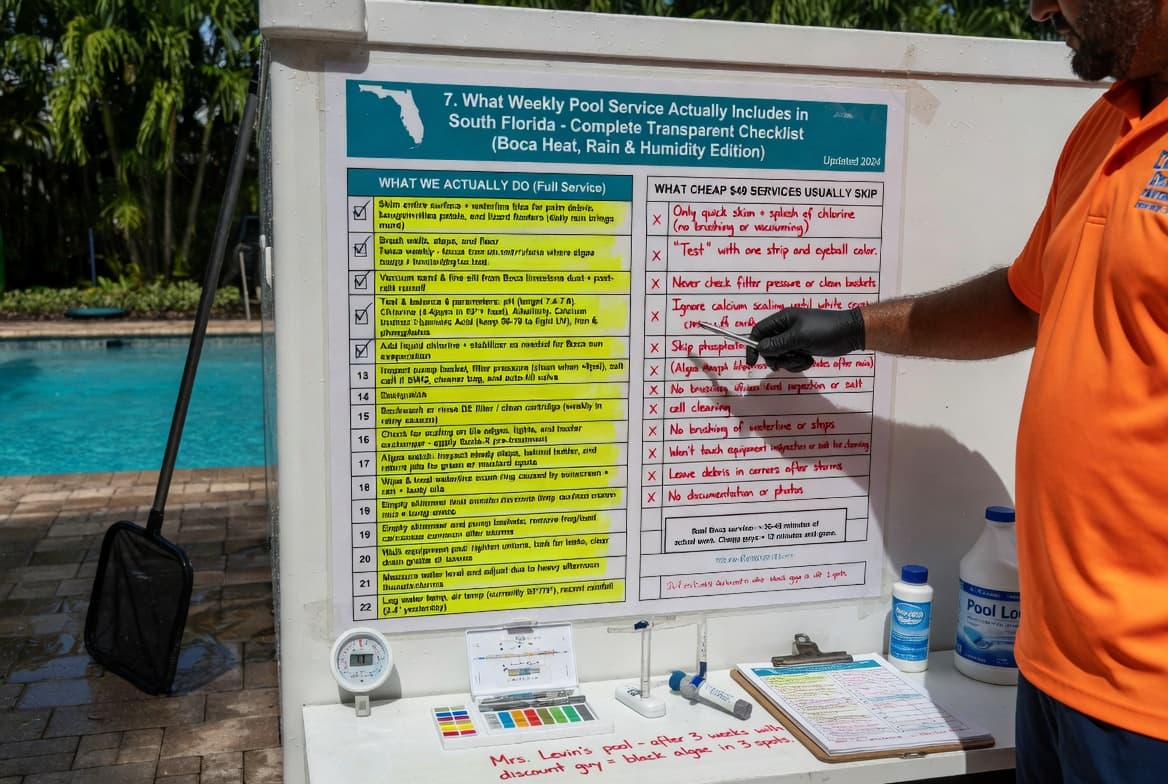
The complete 22-point weekly checklist
This is the protocol every tech on our route runs, in the same order, on every pool, every visit. The order matters — brushing before testing matters because suspended particulates change chemistry readings. Testing before dosing matters because dosing without testing is guessing. The whole point of a written checklist is that the order is not optional.
| # | Task | Why it matters | Time |
|---|---|---|---|
| 1 | Visual pool walk-around on arrival | Catches level drop, fresh debris load, surface film, color shift, equipment noise before any work starts | 1–2 min |
| 2 | Surface skim — leaf rake on the water, deck included | Removes pollen, palm seeds, oak tassels, lovebugs, bugs, and any oily film before they sink | 2–4 min |
| 3 | Empty pump basket | A clogged pump basket starves the pump, raises filter pressure, cuts circulation 20–40%, accelerates algae in dead zones | 1 min |
| 4 | Empty skimmer basket(s) | Same circulation logic; also catches the debris BEFORE it gets into the filter where it's harder to remove | 1 min |
| 5 | Brush walls, tile line, and steps | Algae sticks to walls 24–48 hr before it shows in water — brushing IS prevention, not cosmetic | 5–10 min |
| 6 | Brush sun shelf, swim-out, and corners | Dead-zone areas with low circulation grow algae first — they need targeted attention every week | 2–4 min |
| 7 | Brush behind ladders, around lights, behind return jets | Black algae and mustard algae start in shaded crevices — miss these and you set up the recovery call | 1–2 min |
| 8 | Vacuum or robot pass | Dedicated vacuum head + hose to waste OR robot — NOT “system vac” that pushes debris through your filter | 5–10 min as needed |
| 9 | 7-point calibrated chemistry test | Reagent test (Taylor K-2006 or LaMotte ColorQ), not strips. Strips are accurate to ±0.5 ppm — that's the difference between “balanced” and “going green” | 3–5 min |
| 10 | Free chlorine 3–5 ppm dose if low | Florida sun burns through unstabilized FC in 4–6 hours; the residual is what kills incoming algae spores | 1–2 min |
| 11 | pH 7.4–7.6 adjust with muriatic acid or soda ash | Salt cells push pH up; rain pushes pH up; low pH etches plaster; high pH precipitates calcium on tile | 1–2 min |
| 12 | Total alkalinity 80–120 ppm adjust if drift >15 ppm | Alkalinity is the pH buffer — out of band means pH won't hold between visits | 1–2 min |
| 13 | Calcium hardness check 200–400 ppm | Hard South Florida water (often 250–350 ppm baseline) scales tile, salt cells, heaters if drifting high | included in test |
| 14 | Cyanuric acid (stabilizer) check 30–50 ppm; flag if >80 ppm | Above 80 ppm chlorine is “locked” — pool can go green at 3 ppm FC. This is the #3 cause of summer blooms | included in test |
| 15 | Salt level check 3,000–3,500 ppm (salt pools) | Heavy rain dilutes; salt cell can't make chlorine if salt is below 2,800 ppm. Monthly minimum, weekly Jun–Sep | included in test |
| 16 | Weekly shock May–October to 10 ppm FC | Burns off combined chlorine (chloramines), organic load, and low-level algae before bloom | 2–3 min |
| 17 | Filter pressure reading + log vs. baseline | Clean at 8–10 psi over baseline. A filter run too long cuts flow and grows algae; one cleaned too often shortens cartridge life | 1 min |
| 18 | Return jets visual — direction and force | Weak return = clogged impeller, dirty filter, or air leak; mis-aimed return = dead zones grow algae | 1 min |
| 19 | Equipment-pad walk-around — pump, heater, automation, plumbing, salt cell | Catches early pump bearing noise, salt-air corrosion, fresh leaks, electrical pre-fail signs — saves $1,400–$2,400 surprise replacements | 3–5 min |
| 20 | Salt cell visual + scale check (quarterly disassembly & acid bath) | Cells lose 40–60% output in their last 6–12 months — early catch means proactive replacement, not green-pool emergency | 1–2 min weekly |
| 21 | Final visual sweep + close pump cover + return tools to truck | Last-look catches anything missed; documents the closeout condition | 1–2 min |
| 22 | Photo-documented service report with chemistry log + before/after | Photo report is the receipt. No report = no proof you got service. We deliver via email on request | 2–3 min |
| Total visit time | 20–40 minutes per pool, depending on size, complexity, and seasonal load | — | |
That checklist is the job. None of it is optional. None of it is “we'll skip it this week because the pool looks fine.” The whole reason a pool that looks fine in May goes green in July is that someone skipped four of those points across eight visits and the deficit compounded.
Worth noting: of the 22 points above, only 3–5 are realistically automatable with current robotic / IoT pool tech — brushing, vacuuming, and (partially) chemistry dosing. The other 17 still require a human on the deck with eyes on the equipment pad. We break down what robots actually replace vs. what they only augment in our 2026 AI & Robotics Pool Automation industry report.
Why a 20–40 minute visit, not a 5–10 minute visit
The cheap-service math: a tech running 22 pools a day on a 9-hour route has roughly 22 minutes of driveway-to-driveway time per stop. Subtract 4 minutes of drive time, 2 minutes of pulling tools off the truck and putting them back, 1 minute of gate access — you have 15 minutes on the deck. Now do the 22-point checklist above in 15 minutes. You can't. The tech will skip 8–14 points to make the math work. That's not a personal failing — it's the route economics that the company sold them on at $90/month. A fair-priced South Florida route runs 12–16 pools per day per tech (not 22), at 20–40 minutes per stop, and routes are built around the checklist — not the other way around.
What cheap services usually skip (in order of frequency)
I've onboarded hundreds of homeowners who switched to us after a year or two with a lowball service. The patterns are remarkably consistent. Here's what the cheap service was skipping, ranked by how often we find it:
| Skipped task | How we detect it on the first visit | What it costs the homeowner |
|---|---|---|
| Real chemistry test (strips instead of reagents, or no test) | CYA at 90–150 ppm, calcium drifted to 450+, phosphates 500+ ppb — none of which a strip catches | Eventually a green-pool recovery + drain & refill $1,500–$3,500 |
| Brushing (just netting and dose) | Algae film on shaded walls, behind ladder, in sun-shelf corners. Tile waterline has scumline | $350–$900 tile cleaning every 12–18 months |
| Filter cleaning on schedule | Filter pressure 10–15 psi over baseline, weak return jets, dead-zone algae growth | Cartridge replacement comes early ($50–$200 single), and pool runs algae-prone for months |
| Equipment-pad walk-around | Salt-air corrosion advanced, fresh oil under pump, pad-side electrical box rusted, leaks not flagged | $1,400–$3,200 surprise pump/heater repair caught months late |
| Salt cell maintenance (no acid bath, no inspection) | Cell covered in calcium scale, output reading 30–50% below rated | Cell replacement at 2.5–3 yrs coastal instead of 4–5; $800–$2,100 every cycle |
| Weekly shock May–October | Combined chlorine elevated, irritation in eyes after swim, chlorine “smell” | Bather discomfort + 50–70% bloom risk per summer |
| Stabilizer drift monitoring | CYA >100 ppm from years of tab chlorine without testing — pool tips green at “normal” FC | Forced drain & refill 25–50% to reset CYA; one summer of $400–$1,500 recoveries first |
| Photo documentation | No service log, no chemistry numbers, no record of what was actually done | No accountability — homeowner has zero leverage when something goes wrong |
| “System vac” instead of real vacuum | Debris pushed through filter into baskets; filter cleaned more often, runs hotter | Shortened filter life by 20–40%, recurring small fees |
| Spa/water feature service | Spa chemistry off-balance, jets not brushed, separate sanitizer not dosed | Spa-specific bloom, spa heater scale, separate $200–$600 corrective treatment |
The most expensive part of a $90/month pool service isn't the $35/month you save versus a $125 floor — it's the $1,400 to $7,500 in compounded repairs, recoveries, and re-balances that ride along in years 2 and 3.
The 7-point chemistry panel — what we actually test
“Chemistry testing” is one of those phrases every pool service uses. The honest version is whether the test is calibrated reagents or paper strips, and how many parameters get measured every single visit.
| Parameter | Target band | Why it matters in South Florida specifically |
|---|---|---|
| Free chlorine (FC) | 3–5 ppm | UV burns FC in 4–6 hours; below 1 ppm pool goes green in 24–72 hr |
| pH | 7.4–7.6 | Salt cells push pH up; daily rain shifts pH; low pH etches plaster; high precipitates calcium |
| Total alkalinity (TA) | 80–120 ppm | Buffer for pH; rain dilutes it; out-of-band means pH won't hold |
| Calcium hardness (CH) | 200–400 ppm | South Florida fill water is hard (250–350 ppm); drift up scales tile, cells, heaters |
| Cyanuric acid (CYA) | 30–50 ppm | Above 80 ppm chlorine is “locked” — drives 15% of all summer green pools. See our CYA reference |
| Salt (salt pools) | 3,000–3,500 ppm | Heavy rain dilutes; cell stops making chlorine below 2,800; monthly minimum, weekly Jun–Sep |
| Phosphates | <100 ppb (action at 500+) | Lawn runoff + palm seed decay drives phosphate high; food for algae year-round in Florida |
A “3-way test strip” service measures chlorine, pH, and alkalinity at strip-grade accuracy (±0.5 ppm). That's the difference between balanced and going green. It also doesn't catch CYA creep, calcium drift, salt dilution, or phosphate load — the four things most likely to cause an expensive failure six months from now.
The equipment-pad walk-around — the highest-ROI part of the visit
Of all 22 checklist items, the one that saves homeowners the most money over a 5-year window isn't the chemistry — it's the equipment-pad walk-around. Catching a salt-air-corroded electrical connection at week 4 instead of week 16 is the difference between a $40 fix and a $1,600 replacement. The pad-side protocol on every visit:
- Pump: bearing noise, vibration, fresh oil under, lid o-ring seal, basket condition, motor housing temperature
- Filter: pressure vs. logged baseline, gauge function, multi-port valve position, sand condition (sand filters) or cartridge pleat condition
- Heater: external corrosion, internal cabinet check (where safe), drip-leg moisture, vent screen clear, automation panel error codes
- Salt cell: visual scale check, terminal corrosion, output rating reasonable for current salt level, cell flow rate audible
- Automation: control panel responsive, schedule correct, valve actuators function, no fault codes
- Plumbing: visible fittings, unions, jandy valves — any drip, white efflorescence, or fresh moisture
- Electrical: conduit corrosion, GFCI test (quarterly), breaker temperature ambient
Three minutes of attention. Saves an average of $300–$900/year in catching things early. This is the part of weekly service most homeowners never see — and the part the cheap services skip first because no one is watching.
Seasonal additions — what changes May through October
A complete weekly checklist isn't static. Florida's climate runs on two seasons (algae season and equipment-corrosion season), and the protocol adds tasks accordingly.
| Season / event | Added to standard 22-point checklist |
|---|---|
| May–October (algae season) | Weekly shock to 10 ppm; phosphate test monthly; pump run-time bumped to 10–12 hr/day; extra brushing on shaded walls |
| Pre-storm (named storm forecast) | Shock to 10 ppm 24 hr before, lower water 6″, turn off breakers, secure deck items, photograph pre-storm condition |
| Post-storm (within 24 hr) | Skim heavy debris, brush all surfaces, shock, re-test full panel, restore breakers and confirm pump prime, photograph post-storm |
| Vacation hold (>7 days summer) | Pre-vacation shock + stabilize + extend run-time + mid-trip visit if >10 days |
| Snowbird hold (Nov–Apr northbound) | Winter visit cadence confirmed, lower run-time, sensor on equipment for owner peace of mind if requested |
| Quarterly | Salt cell disassembly + acid bath, CYA + CH independent test, filter teardown, equipment-pad photo set |
| Annual | Drain & refill 25–33% to reset baseline, deep tile clean if scumline forming, GFCI test on all pad circuits |
Photo documentation — what your service report should look like
A real service report is a written receipt for the work that happened on Tuesday at 10:14am. Ours includes: timestamp of arrival and departure, all seven chemistry numbers, doses added, filter pressure, salt level, equipment-pad note (clean/anomaly/action needed), and three photos minimum — surface, equipment pad, any specific anomaly. If something needed attention, the photo is the proof. If nothing did, the photo is the proof of that too. We deliver these on request via email or text, and store them so we can look back six months to diagnose drift. A company that won't put any of that in writing is selling you trust without accountability — that's not a service, that's a hope.
Red flags on a quote
- Price under $125/month for a standard residential pool — the chemistry alone runs $60–$90 wholesale; the route math forces 8–14 skipped checklist points
- “Chemistry surcharge” on the invoice — the advertised fee didn't actually include chemicals, which is bait-and-switch
- Filter cleaning billed separately — should be included on schedule
- No written list of what's included vs. extra — get the answer in writing before signing anything
- No photo or written service report on request — you have no proof of service or chemistry trend
- Visit times under 15 minutes — mathematically can't cover the 22 points, period
- Strip-based chemistry only — accurate to ±0.5 ppm, which is the “balanced vs going green” threshold
- No CPO license number on the contract — required for chemical handling in Florida; ours is C-105377
- No certificate of insurance (general liability + workers' comp) on request — exposes the homeowner to slip-and-fall liability for any uninsured worker injured on your property
Run your pool through the calculator first
Want a number for what fair weekly service should cost your specific pool — built around the protocol above, not a stripped-down version? Run yours through our pool service cost calculator. It asks about pool size, salt vs chlorine, spa, screen, and coastal proximity, then returns the band a fair 2026 quote should land in. For the full pricing breakdown by city and what drives quotes up or down, see our 2026 South Florida pricing reference.
The 30-second test for any service you're considering
- Ask: “Can you send me your weekly checklist in writing before I sign?” A real service company has one and shares it.
- Ask: “How long is each visit, and how many pools does each tech run per day?” Math has to work — 12–16 pools/day, 20–40 min each is fair; 22+ pools at 7–15 min is not.
- Ask: “Can I see a sample service report with chemistry log and photos?” If they can't produce one, you won't get one.
Those three questions, asked before signing, eliminate the bottom 80% of the South Florida service market in about three minutes.
The low-risk first step
Whether you're evaluating us or three other companies, the lowest-risk first step is a free on-site evaluation. We'll test your water on calibrated equipment, walk your equipment pad, run a copy of the 22-point checklist on your specific pool, and tell you honestly what your pool actually needs — whether you hire us or not. If a competitor is missing something on their protocol, you'll see it in our report side-by-side.
Florida's Best Pools is family-owned, CPO C-105377, fully insured, and runs weekly routes through Boca Raton, Delray Beach, Fort Lauderdale, Highland Beach, Boynton Beach, Pompano Beach, Coral Springs, Coconut Creek, Wellington, and the surrounding South Florida service corridor. Same tech every visit (once your route is established). Photo-documented service reports on request. Month-to-month — no long-term lock-in. Built around 40+ years of combined founder experience between Matt Balog, Joe Ford, Ronald Liddell, and Doug Santiago.
Request a free evaluation or call 954-347-1120. We'll send you the 22-point checklist as a one-pager so you can run it against any quote you're considering.
Watch: The order to brush a pool in
The order a pool gets brushed in: walls first, top to bottom, then everything pushed toward the main drain so the circulation already running carries it into the filter.
Frequently Asked Questions
A real visit runs 20–40 minutes per pool and covers 22 documented protocol points across five domains; Physical cleaning — surface skim, basket emptying, wall and tile brushing, vacuum or robot pass, sun-shelf brush; Chemistry — 7-point calibrated test (free chlorine, pH, total alkalinity, calcium hardness, cyanuric acid, salt, phosphates) with weekly shock May–October; Equipment — pump and skimmer basket check, filter pressure reading, return-jet inspection, equipment-pad walk-around, salt cell visual; Documentation — photo-documented service report with chemistry log every visit; Services under $125/month are mathematically forced to skip 8–14 of those 22 points to fit route economics.
A complete weekly service visit in 2026 South Florida runs 20–40 minutes and covers 22 documented protocol points across five domains: physical cleaning (surface skim, pump and skimmer baskets, brushing walls/tile/steps/sun shelf/corners, vacuum or robot pass), chemistry (calibrated 7-point reagent test — free chlorine, pH, total alkalinity, calcium hardness, cyanuric acid, salt, phosphates — plus dosing and a weekly shock May–October), equipment (filter pressure reading, return-jet check, salt cell visual, full equipment-pad walk-around), algae and scale watch (waterline tile, deep-end visual, dead zones), and documentation (photo service report with chemistry log every visit). Anything missing from that protocol leaves a known gap a Florida summer will eventually exploit.
20–40 minutes per pool for a standard residential South Florida pool, depending on size, salt vs chlorine, presence of an attached spa, and seasonal load. A visit under 15 minutes mathematically cannot cover the 22-point checklist — the route economics force the tech to skip 8–14 items. The check is simple: ask the company how long each visit takes and how many pools each tech runs per day. 12–16 pools per day at 20–40 minutes each is a fair operation; 22+ pools at 7–15 minutes each is not service, it's drive-by netting.
Across hundreds of homeowners we've onboarded after a lowball year, the consistent skip list ranked by frequency is: (1) real reagent chemistry (strips instead of test kits, missing CYA/calcium/phosphate), (2) brushing walls, tile, sun shelves, and dead zones, (3) filter cleaning on schedule, (4) the equipment-pad walk-around, (5) salt cell maintenance (no acid bath, no inspection), (6) weekly summer shock, (7) stabilizer drift monitoring, (8) photo or written service documentation, (9) real vacuuming (using 'system vac' that pushes debris through the filter instead), and (10) spa or water-feature dedicated service. Each skip eventually shows up as a $200–$3,500 corrective expense in years 2–3.
Math, not marketing. Properly dosed weekly chemistry alone runs $60–$90/month at wholesale — bottles, no labor. A pool service under $125/month after labor, fuel, insurance, taxes, equipment, and any margin has to come from somewhere, and that somewhere is the 22-point checklist. Lowball routes typically run 22–28 pools per tech per day at 7–15 minute stops; physical math forces 8–14 skipped protocol points per visit. The savings vanish in year 2 when a $400–$1,500 green-pool recovery, a $350–$900 tile cleaning, or a $1,400–$3,200 surprise pump or heater repair lands.
Seven parameters with calibrated reagents (not test strips): free chlorine target 3–5 ppm, pH 7.4–7.6, total alkalinity 80–120 ppm, calcium hardness 200–400 ppm, cyanuric acid (stabilizer) 30–50 ppm, salt 3,000–3,500 ppm for salt pools, and phosphates under 100 ppb (action threshold 500 ppb). Strips are accurate to roughly ±0.5 ppm — which is the entire span between 'balanced' and 'going green.' Strips also can't detect CYA creep, calcium drift, salt dilution, or phosphate load, and those four are the most common precursors to expensive failure six months out.
It's a 3-minute visual and audible inspection of the pump, filter, heater, salt cell, automation, plumbing, and electrical components on the equipment pad — performed every visit. The protocol catches pump bearing noise, salt-air corrosion on connections, fresh oil under the motor, drip-leg moisture on heaters, scale on salt cells, valve-actuator faults, automation error codes, and any visible drip, white efflorescence, or rust on conduits. Of all 22 checklist items, this one saves homeowners the most money over a 5-year window — averaging $300–$900/year in caught-early repairs versus catastrophic surprise replacements ($1,400–$3,200 for pumps, $800–$2,100 for salt cells, $1,400–$3,200 for heater core damage).
A real service report is a written receipt for what happened on the deck. It should include: timestamp of arrival and departure, all seven chemistry parameter readings, exactly what doses were added, filter pressure reading vs. baseline, salt level for salt pools, an equipment-pad note (clean / anomaly noted / action recommended), and a minimum of three photos — pool surface, equipment pad, and any specific anomaly flagged. Delivered via email or text on request and stored for back-look. A company that can't or won't produce a sample report before you sign is selling trust without accountability.
During hurricane season (June–November) the standard 22-point checklist adds named-storm protocols. Pre-storm (24 hr ahead): shock to 10 ppm free chlorine, lower water 6 inches below the skimmer to absorb rain, turn off equipment breakers, secure or stow deck items, photograph pre-storm condition. Post-storm (within 24 hours of all-clear): skim heavy debris, brush all surfaces, shock again, re-test the full 7-point panel, restore breakers and confirm pump prime, photograph post-storm condition. These should be included in flat-rate weekly service — not billed as a separate 'storm response fee.' If a company charges per-storm, you're a customer; if it's included, you're a client.
Three questions in three minutes eliminate 80% of the South Florida market: (1) 'Can you send me your weekly checklist in writing before I sign?' Real companies have one and share it. (2) 'How long is each visit and how many pools does each tech run per day?' 12–16 pools at 20–40 minutes is fair; 22+ at 7–15 is not. (3) 'Can I see a sample service report with chemistry log and photos?' If they can't produce a redacted example, you won't get one for your pool either. Also verify CPO license number on the contract (ours is C-105377) and request a current certificate of insurance ($1M+ general liability plus workers' compensation).
A real vacuum is a dedicated vacuum head and hose connected to either a hose-to-waste port (debris bypasses the filter, exits to the deck drain) or a dedicated vacuum line that runs debris through a separate trap. 'System vac' or 'in-line vac' connects the vacuum hose to the skimmer port and pushes all the debris through the pool's main filter — which clogs the filter faster, raises filter pressure, cuts circulation, and shortens cartridge or sand life by 20–40%. It saves the tech five minutes of setup but transfers cost to the homeowner through more frequent filter cleanings and earlier filter media replacement.
Need a pro to handle this?
Florida's Best Pools has serviced South Florida homes for 40+ years. CPO-licensed. Fully insured. 230+ five-star reviews.