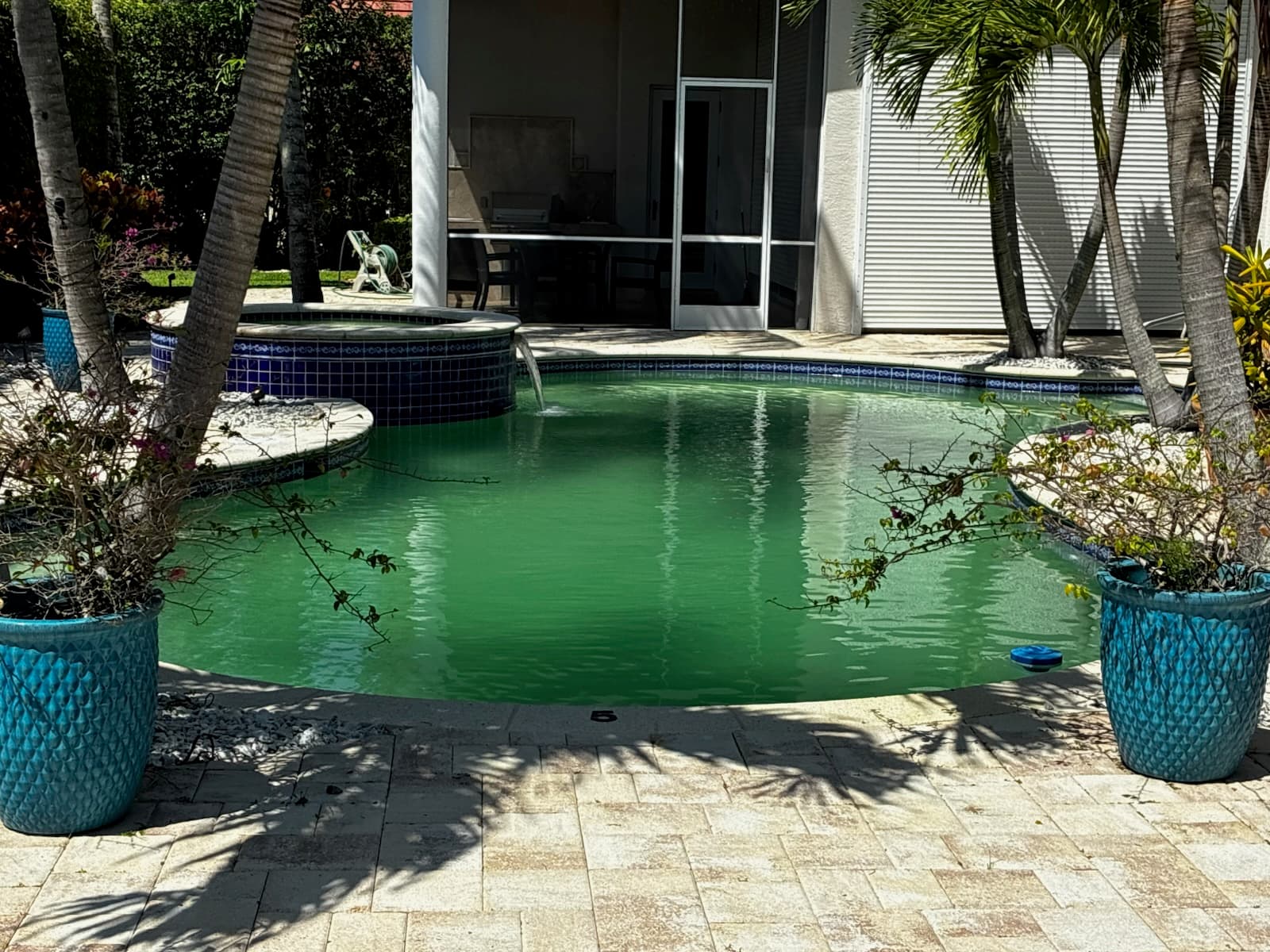
I've been on Florida pool routes since the late 1990s — my father has been a licensed Florida pool contractor since 1989, and he's the one who taught me — and after 25 years and somewhere north of 10,000 pools serviced from Pompano to Highland Beach, I can tell you that cloudy pool water is never random. Every cloudy pool has a signature: a specific cause, a specific tell, and a specific fix. The trick is knowing which of the seven causes you're looking at — because the fix for chemistry-cloudy is different from the fix for filter-cloudy, and the fix for “dead algae” cloudy is different from the fix for “pre-bloom” cloudy. Get the diagnosis wrong and you can spend $300 in chemicals making it worse.
The 7-cause diagnostic table
Here's the field-grade diagnostic I run on every cloudy-pool call. The order matters — you start at the top because it's the most common and the cheapest to fix, then move down. About 90% of cloudy pools resolve at cause 1, 2, or 4.
| # | Cause | Field signature (the tell) | Cost to fix |
|---|---|---|---|
| 1 | Chemistry out of balance — high pH, low alkalinity, or high calcium | Whitish/milky cloud, no green tint. Often after heavy rain or fresh fill. Calcium scale starting to form on tile. | $30–$100 in chemicals + 24 hr run |
| 2 | Low free chlorine — pre-bloom haze | Slight dull cloud, “lost sparkle.” FC reads under 1 ppm. 24–48 hr away from visible green. | $10–$40 in shock + 12–24 hr run |
| 3 | High cyanuric acid (CYA >80 ppm) | Cloudy despite chlorine showing “normal” on test (3–5 ppm). Usually 18–36 months of tab use. | $80–$200 — partial drain & refill 25–50% to dilute |
| 4 | Filter problem — dirty cartridge, bad sand, clogged DE, broken laterals | Filter pressure 8–15 psi above logged baseline. Weak return jets. Cloud worse near returns than skimmers. | $0–$450 — clean (free) to media replacement ($120–$450) |
| 5 | Poor circulation — pump undersized, run-time too short, dead zones | Cloudy in corners and on sun shelf, clearer near returns. Pump run-time under 6 hr/day. Filter looks fine. | $0–$30/mo more electric — bump pump to 8–12 hr/day summer |
| 6 | Fine particulates — pollen, sunscreen, post-rain runoff, dust | Cloud appears within 24 hr of a specific event (heavy pollen day, pool party, dust storm, 3″ rain). Filter pressure normal. | $15–$60 in clarifier or floc + filter clean |
| 7 | Dead algae after shock | Cloud appeared AFTER you shocked a green pool — successful kill, but particles too fine for the filter | $15–$50 clarifier or floc + extended filter run 48–72 hr |
Cloudy is the early-warning stage. In Florida summer, cloudy water at 8am Tuesday can be visibly green by Thursday afternoon if you ignore it — same dynamic I wrote up in our 24–72 hour green-pool timeline. Address it on day one and it's a $30 fix; address it on day five and it's a $400–$1,500 recovery. The downstream economics — what one missed cloudy-to-green escalation actually costs across a residential portfolio — sit in our 2026 Green Pool & Automation Tech industry report.
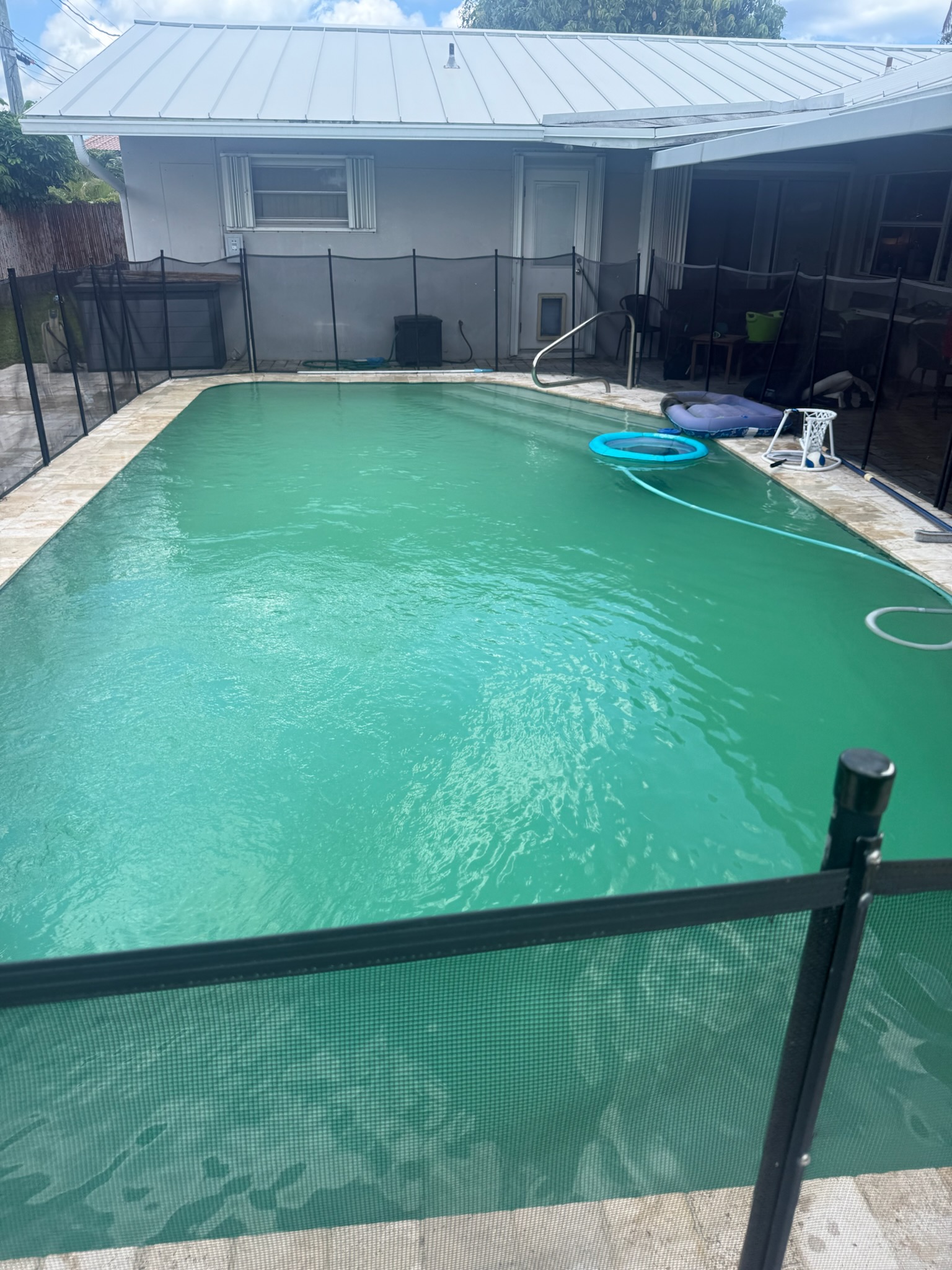
Cause #1 — chemistry out of balance (40% of cloudy pools)
The most common cause by a wide margin. South Florida fill water comes in with calcium hardness already at 250–350 ppm, and our daily 3pm thunderstorms keep adjusting pH and alkalinity up and down. When pH drifts above 7.8 with high calcium, calcium carbonate begins to precipitate out of solution — and it doesn't precipitate as visible scale right away; it precipitates as a milky cloud first. Same with low alkalinity: the pH bounces, calcium becomes unstable, and the water clouds.
The field tell: whitish/milky cloud, no green tint. Often appears within 24–72 hours of a heavy rain or right after a fresh top-up. Tile may have a fresh chalky film when you run a finger along it.
The fix:test the full chemistry panel — pH, total alkalinity, calcium hardness. Lower pH to 7.4–7.6 with muriatic acid first. Adjust total alkalinity to 80–120 ppm. If calcium is over 400 ppm, you need a partial drain and refill — chemicals won't help. After rebalance, run the filter overnight. Pool typically clears in 12–24 hours.
Cause #2 — low free chlorine (the pre-bloom haze)
This is the early stage of the 24–72 hour green-pool timeline. Free chlorine drops below ~1 ppm, algae cell division has started, and the water loses its “sparkle” before it shows visible green. Most homeowners don't notice until day 2 or 3 — by which point chlorine is at zero and the algae population has multiplied 4–8x.
The field tell:water looks slightly dull at deeper points, FC reads under 1 ppm on a calibrated test (strips will say “0” or “low”). No visible green yet. Often follows a hot weekend, a vacation, or a heavy bather load.
The fix:shock to 10 ppm FC with calcium hypochlorite or liquid chlorine. Brush walls, steps, and dead zones. Run the pump 24 hours. If you catch it here, you've prevented a $400–$1,500 green-pool recovery for the price of $10–$40 in shock.
Cause #3 — high cyanuric acid “locks” the chlorine
The under-diagnosed cloudy cause. CYA (cyanuric acid / stabilizer) protects chlorine from UV — which Florida sun requires — but every tab dissolves and leaves more CYA behind. After 18–36 months of tab use, CYA drifts from 30 ppm to 80, 100, even 150 ppm. Above 80 ppm, chlorine is chemically “locked” — present on the test, but not active. The pool runs perpetually on the edge of bacterial cloudiness.
The field tell:cloudy water despite a chlorine reading of 3–5 ppm. Owner says “I keep adding chlorine and nothing changes.” CYA test (NOT included on a strip — must be a reagent kit) reads over 80 ppm.
The fix: partial drain & refill 25–50% to dilute CYA back into the 30–50 ppm range. Switch to liquid chlorine or a salt system to stop adding CYA. Full detail in our library article on cyanuric acid, the pool stabilizer that breaks pools quietly.
Cause #4 — filter problem (25% of cloudy pools)
The filter is doing 95% of the visible work in a healthy pool. When it stops working — even a little — the water shows it within hours. Three common Florida failure modes: dirty cartridge past replace-point, sand filter with channeling or old media, or DE filter with broken laterals leaking DE back into the pool.
The field tell:filter pressure 8–15 psi above the logged baseline. Return jets feel weak. Water clearer near skimmers (where water is leaving the pool) than near returns (where it's coming back in dirty).
The fix:
- Cartridge filter: remove, hose off thoroughly (radial pleats need attention), or replace if pleats are torn or compressed. Cartridges last 2–4 years in South Florida. $50–$200 single.
- Sand filter: backwash. If clouding persists, the sand is channeling — replace it ($250–$450, every 5–7 years).
- DE filter: backwash, recharge with fresh DE. If DE keeps coming back through the returns, the laterals are broken ($300–$500 repair).
Cause #5 — poor circulation (the “invisible” cloudy)
Florida pools need 8–12 hours/day of pump run-time during summer, period. Anything less and the water in the dead zones — corners, sun shelves, behind ladders, swim-outs — stagnates faster than chlorine can reach it. The pool can look fine in the middle and cloudy in the corners.
The field tell: cloud is uneven — clearer near returns, hazier in corners and on the sun shelf. Pump runs 4–6 hours. Filter pressure normal. Chemistry tests fine on a sample taken near the return jet.
The fix: bump pump run-time to 8–12 hours/day during summer (6–8 winter). Aim return jets to create circular flow. Brush dead zones every visit. Cost: $0–$30/month more in electric, which beats any chemical fix you could throw at the symptom.
Cause #6 — fine particulates (the “event” cloudy)
South Florida is loaded with fine particulate inputs that overload filters: spring oak pollen, palm seed fines, lovebug season, mid-summer dust storms (Saharan dust pulses are real and we test for them), and post-rain runoff that washes lawn fertilizer and mulch into the pool. After a pool party with heavy bather load — sunscreen, body oils — fine cloud also appears.
The field tell: cloud appears within 24 hours of a specific event. Filter pressure is normal. Chemistry is normal. Cause is mechanical — too-fine particles for the filter to catch on a single pass.
The fix: add a clarifier ($15–$30) — clarifier coagulates fine particles into larger clumps the filter can catch. Run the filter 24–48 hours. For very heavy load (post-storm), use a flocculant ($30–$60) which drops everything to the floor, then vacuum-to-waste. Clean filter after.
Cause #7 — dead algae after shock
The cause every homeowner blames on the pool service and we have to explain isn't actually a problem. You shocked a green pool, the shock worked, the algae died — and now you have a pool full of dead microscopic algae cells too fine for the filter to grab on a single pass. The water turns from green to gray to milky white before clearing. It looks worse before it gets better.
The field tell: cloud appeared AFTER a shock treatment on a previously-green pool. FC is high (still 5–10 ppm). Chemistry is fine. Filter is clean. Pool is on the way back, not on the way down.
The fix:patience plus clarifier or floc plus extended filter run. Don't add more shock — you'll waste chemicals. Run pump 48–72 hours. Clean filter twice during that window. Clarity returns in 2–4 days.
The 30-second cloudy-pool diagnostic
When I get called out to a cloudy pool, the first 30 seconds determine the next 4 hours of work. Here's the field decision tree:
- Visible green tint or slight dullness? If yes → cause 2 (low FC) or 3 (CYA locked). Test FC first; if FC is fine, test CYA.
- Cloud after recent shock of a green pool? If yes → cause 7 (dead algae). Wait, run filter, clarifier.
- Cloud after a specific event (storm, party, dust)? If yes → cause 6 (fine particulates). Clarifier or floc.
- Filter pressure 8+ psi above baseline? If yes → cause 4 (filter). Clean or replace media.
- Pump runs less than 8 hr/day in summer? If yes → cause 5 (circulation). Bump run-time.
- None of the above + pH or calcium drifted? If yes → cause 1 (chemistry). Rebalance in order: alkalinity → pH → calcium.
- Still cloudy after the above? Call a pro for a calibrated 7-point test + equipment-pad walk-around. There's something a homeowner test can't see.
What NOT to do when your pool is cloudy
- Don't dump more chlorine in “to be safe.” Over-chlorination doesn't fix cloud and bleaches plaster.
- Don't add a clarifier on top of an unbalanced chemistry. Clarifier is a mechanical aid for filter, not a chemistry fix — fix the chemistry first.
- Don't backwash a sand filter just “in case.” Sand filters work BETTER slightly dirty. Backwash only when pressure is 8–10 psi above baseline.
- Don't use floc with a cartridge filter. Floc requires vacuum-to-waste; cartridges don't backwash. Use clarifier instead.
- Don't swim until water is clear. Cloudy water is a drowning hazard — the bottom is not visible. Even a strong adult swimmer can lose orientation.
- Don't ignore it past 48 hours in summer. Cloudy → pre-bloom → green is a 72-hour pipeline in Boca July heat. Address day one.
When cloudy water is a bigger problem than it looks
In Florida summer, cloudy water is almost never “just” cloudy. It's the first visible sign of a chemistry or equipment failure that's been brewing for days. Three escalation paths to watch:
| Starts as | Becomes (24–72 hr) | Recovery cost |
|---|---|---|
| Dull / lost-sparkle haze | Pale green tint → clearly green → swamp green | $0 if caught at haze; $300–$1,500 if caught at swamp |
| Whitish cloud (chemistry) | Calcium scale on tile, salt cell, heater — permanent until acid-washed | $30 chemistry fix vs. $350–$900 tile clean + cell life shortened |
| Cloud near returns (filter) | Filter at end-of-life, weak circulation, algae in dead zones | $50–$200 cartridge replace vs. $400–$1,500 algae recovery + filter |
Real cost to fix a cloudy pool in 2026 South Florida
| Cause | DIY cost | Pro visit cost (one-time, non-client) |
|---|---|---|
| Chemistry rebalance | $30–$100 in chemicals | $125–$200 service call (included for clients) |
| Shock low FC | $10–$40 | $100–$175 (included) |
| CYA drain & refill 25% | $80–$200 (water + chems) | $200–$400 (included for clients) |
| Filter clean | $0 (or $50–$200 cartridge replace) | $80–$150 cartridge clean / $250–$450 sand replace |
| Pump run-time fix | $0 (just adjust timer) | $0–$80 timer service |
| Clarifier / floc + filter run | $15–$60 | $100–$200 (included) |
| Dead-algae cleanup post-shock | $15–$50 + 48–72 hr filter run | $125–$240 follow-up (included) |
| Full diagnostic + reset | $60–$250 typical span | $200–$500 one-time / FREE for weekly clients |
If you're already on a weekly route with a real service company, cloudy water should never cost extra — it's part of the protocol. Our weekly clients get same-day or next-day response on any visible water-quality issue, included in the flat monthly rate. For the full pricing reference, see our 2026 South Florida pricing reference.
Run your pool through the calculator
Want a number for what fair weekly service should cost the pool that's currently giving you trouble? Run yours through our pool service cost calculator— it asks size, salt vs chlorine, spa, screen, and coastal proximity, and returns the band a fair 2026 quote should land in. If you're paying the high end and still getting cloudy water, that's diagnostic.
The low-risk first step
Whether your pool is dull, hazy, milky, or already heading toward green, the lowest-risk first step is a free on-site water test. We'll run a calibrated 7-point chemistry panel, check filter pressure against expected baseline, walk your equipment pad, and tell you exactly which of the 7 causes you're dealing with — and what it'll cost to fix. Whether you hire us or not.
Florida's Best Pools is family-owned, CPO C-105377, fully insured, and runs weekly routes through Boca Raton, Delray Beach, Fort Lauderdale, Highland Beach, Boynton Beach, Pompano Beach, Coral Springs, Coconut Creek, Wellington, and the surrounding South Florida service corridor. Same tech every visit (once your route is established). Photo-documented service reports on request. Month-to-month — no long-term lock-in. Built around 40+ years of combined founder experience between Matt Balog, Joe Ford, Ronald Liddell, and Doug Santiago.
Request a free water test or call 954-347-1120. If your pool is cloudy right now, we can usually get a tech out same-day or next-day before it tips green.
Frequently Asked Questions
Cloudy water is almost always one of 7 causes: chemistry imbalance, low free chlorine, high CYA above 80 ppm, filter problem, poor circulation, fine particulates, or dead algae after shock; 30-second triage: test the water, check filter pressure, look at pump run-time, and visually inspect the bottom; Fix cost runs from $0 (run the filter overnight) to $400–$900 for a full chemistry reset and filter clean; Get the diagnosis wrong and you can spend $300 in chemicals making it worse; Below 24 hours cloudy is annoying; above 72 hours in Florida summer, cloudy becomes green.
Almost every cloudy pool we diagnose is one of seven causes, in order of frequency: (1) chemistry imbalance — high pH, low alkalinity, or high calcium triggering a milky scale-cloud (about 40% of calls); (2) low free chlorine producing pre-bloom haze 24–48 hours before visible green; (3) high cyanuric acid above 80 ppm 'locking' the chlorine so the pool stays cloudy despite normal FC readings; (4) a filter problem — dirty cartridge, channeling sand, broken DE laterals (about 25% of calls); (5) poor circulation with the pump running under 8 hr/day in summer; (6) fine particulates from oak pollen, palm seeds, post-rain runoff, or pool-party sunscreen; (7) dead algae after a successful shock treatment, which clouds the water before it clears. Diagnose before dosing — wrong fix wastes $30–$300 in chemicals and makes the cloud worse.
In Boca Raton summer heat (May–October), a cloudy pool can tip visibly green in 24–72 hours if the cause is low free chlorine. The 'dull, lost-sparkle' stage means FC has already dropped below 1 ppm and algae cell division has started — the water turns hazy at hour 18–30, pale green at hour 30–48, clearly green at hour 48–72, and swamp green past hour 72. Catch it at the cloudy/dull stage and the fix is $10–$40 in shock. Wait until day 5 and you're looking at a $400–$1,500 green-pool recovery. Address cloudy water within 24 hours during summer, period.
Three field tells separate them quickly. Chemistry-cloudy is whitish/milky throughout the pool, often appears 24–72 hours after heavy rain or a fresh top-up, and tile starts showing a chalky calcium film. Filter-cloudy is uneven — water is clearer near skimmers (where it's leaving) than near returns (where it's coming back in dirty), filter pressure reads 8–15 psi above your logged baseline, and return jets feel weak. The 30-second triage: check filter pressure first (free), then test pH, total alkalinity, and calcium hardness with a calibrated reagent kit. Whichever is out of band is your starting point.
That's actually the shock working, not a problem. When chlorine kills a population of algae, the dead algae cells stay suspended in the water — too fine for the filter to grab on a single pass. The pool goes from green to gray to milky white before clearing, which often looks worse than the original problem. The fix is patience plus a clarifier ($15–$30) or flocculant ($30–$60) to coagulate the fines into clumps the filter can catch. Run the pump 48–72 hours and clean the filter twice during that window. Don't add more shock — you'll waste chemicals and bleach the plaster.
Yes, indirectly — and it's one of the most under-diagnosed cloudy-pool causes in South Florida. CYA (stabilizer) acts as a UV sunscreen for chlorine, which is essential in Florida sun. But every chlorine tab dissolves and leaves more CYA behind. After 18–36 months of tab use, CYA can drift from 30 ppm to 80, 100, even 150 ppm. Above 80 ppm, chlorine is chemically 'locked' — present on the test as 3–5 ppm but no longer active enough to keep bacteria and fine algae populations in check. The pool runs on the edge of bacterial cloudiness. Fix: partial drain and refill 25–50% to dilute, then switch to liquid chlorine or a salt system to stop adding CYA.
No — clarifier is a mechanical aid, not a chemistry or filter fix. It coagulates fine particles into larger clumps that the filter can catch, so it works on causes 6 (fine particulates from pollen, dust, sunscreen) and 7 (dead algae after shock). It will not fix causes 1 (chemistry imbalance), 2 (low free chlorine), 3 (high CYA), 4 (broken filter), or 5 (poor circulation). Adding clarifier on top of unbalanced chemistry or a failing filter wastes the product and prolongs the cloudy state. Always diagnose the cause first, then decide if clarifier helps.
No — for two reasons. First, cloudy water is a documented drowning hazard. Florida and CDC guidelines recommend you can see the main drain clearly before allowing swimmers in; if you can't see the bottom of the deep end, a swimmer in distress is not visible to anyone watching from the deck. Second, depending on the cause, cloudy water may indicate a sanitizer failure (low free chlorine or CYA-locked chlorine) that allows bacterial or algal growth to outpace disinfection. Wait until the water is clear and chemistry is balanced (FC 3–5 ppm, pH 7.4–7.6, combined chlorine under 0.5 ppm) before swimming.
Depends on the cause. A chemistry rebalance clears most pools in 12–24 hours with the filter running. A shock for low FC clears in 12–24 hours plus filter time. Fine particulates (event-driven cloud) clear in 24–48 hours with clarifier and a clean filter. Dead algae after shock takes the longest — 48 to 96 hours of extended filter run with one or two filter cleans in between. A high-CYA cloudy condition won't fully clear until you've done a partial drain and refill to dilute CYA, which is a 1–2 day operation including refill stabilization. Filter-driven cloud clears as fast as you fix the filter — sometimes hours.
Costs range widely based on which of the seven causes is responsible. DIY: chemistry rebalance $30–$100 in chemicals; shock for low FC $10–$40; CYA drain and refill 25% $80–$200 in water and chems; filter cleaning $0 (cartridge hose-off) up to $250–$450 (sand replacement); clarifier or floc $15–$60. Pro one-time service call: $200–$500 for full diagnostic and reset (depending on cause and chemistry complexity). For weekly-route clients, cloudy-water response is included in the flat monthly rate — same-day or next-day response, no surcharge.
Call immediately if: (1) the pool is cloudy AND visibly green or tinted green — that's already past the cloudy stage, you're in active algae bloom; (2) you've rebalanced chemistry and run the filter for 48 hours and it's still cloudy — there's something a homeowner test isn't seeing; (3) filter pressure is 15+ psi above baseline, which suggests media failure rather than just dirt; (4) you have a salt pool and the cell display reads 'normal' but the pool can't hold chlorine — the cell is likely in its end-of-life decay; (5) any cloudy condition that lasts more than 72 hours in summer; (6) you're new to the pool and don't yet have a calibrated baseline to test against. Our free on-site water test will identify which of the seven causes is at work — whether you hire us or not.
Need a pro to handle this?
Florida's Best Pools has serviced South Florida homes for 40+ years. CPO-licensed. Fully insured. 230+ five-star reviews.